




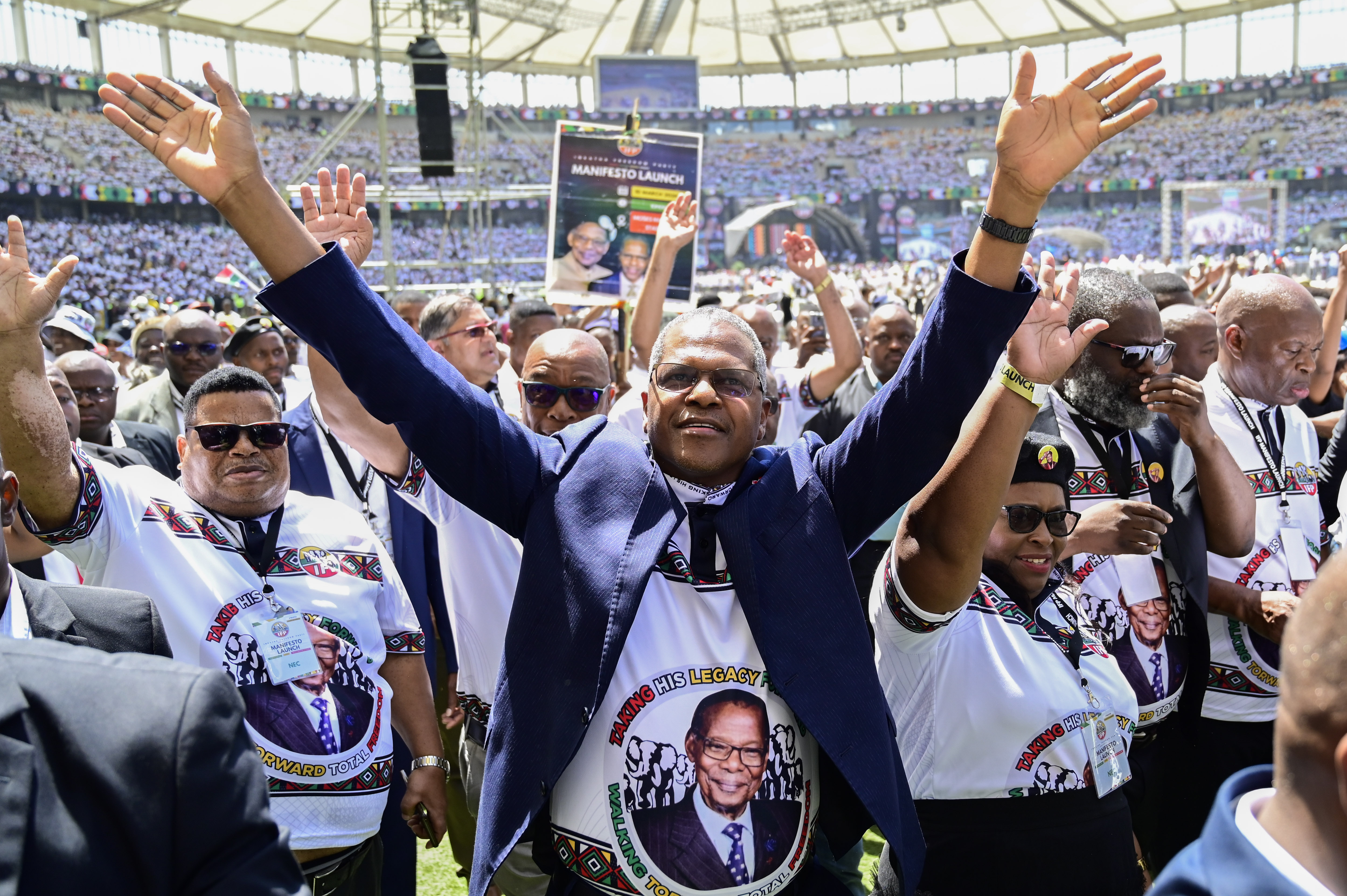
 IFP leader Velenkosini Hlabisa at the party's manifesto launch at Moses Mabhida Stadium in Durban on 10 March 2024. (Photo: Gallo Images / Darren Stewart)
All about…
The IFP manifesto is well crafted for its target support base. It is the most rural-focused of the manifestos we have seen so far; the party would give more power to traditional leaders if it were to come to power. It uses the late leader Mangosuthu Buthelezi’s popularity as its leitmotif, with the hashtag #DoItForShenge.
Basic income, grants and social policy
- An unemployed graduate grant of R3,000;
- Review grants and increase if necessary – link all grants to opportunities and training;
- One community, one social worker;
- Legalise baby savers (baby boxes at NGOs for abandoned babies).
Crime and corruption
- More powers to traditional courts;
- Open a national debate on reinstating the death penalty;
- Prompt dismissal and prosecution of corrupt officials, irrespective of rank or political affiliation;
- Use the force of the South African National Defence Force in areas where gangsterism is rife;
- Support and implement the principles of restorative justice.
Economy
- Curb data costs by 50% through state intervention;
- Grow the cannabis and hemp sectors;
- Revitalise Ithala Bank (Perennially corrupt – Editor).
Education
- Raise the pass mark to 50%;
- Redirect Seta billions to give internships to unemployed graduates in municipal, provincial and national government departments;
- Free primary education and a focus on fixing NSFAS, the financial aid scheme for disadvantaged students;
- Focus on early childhood education as a priority;
- Teacher accommodation for rural-based teachers.
Food
- A South African Social Security Agency food relief voucher system.
Global policy
- It’s a nationally focused manifesto.
Governance
- Elevate the role of traditional leaders in governance.
Health
- Devolve autonomy from national to provincial and local levels;
- One regional hospital in each of 52 health districts; expand clinic network;
- Reduce the high cost of medicine.
Jobs
- A strict 80:20 South Africans to foreigners rule across all businesses;
- Job reservation for entry-level and low-skill sectors.
Land and housing
- Increase the qualifying income for fully subsidised housing from R3,500 to R5,500 monthly;
- Introduce a housing benefit scheme for those who earn above the subsidy threshold;
- Subsidise first-time homeowners;
- Integrate hostels into communities;
- A full-scale land audit (This has been done many times – Editor);
- State support for new farmers and viable cooperatives;
- Make sure communal land stays in the hands of traditional leaders;
- Provincial governments must support this land to the standard of commercial farms;
- Supports land expropriation with reasonable compensation;
- Reactivate local agricultural support centres – promote public-private partnerships in agricultural development.
Migration
- Deploy the SANDF to ports of entry and borders to fortify them;
- Invest in a National Immigration Inspectorate;
- An all-of-government plan to deport illegal migrants;
- A six-month permit review process for all foreigners;
- Ensure critical skills visas are issued in four weeks;
- Invoice countries whose citizens are in South Africa illegally and who use healthcare services.
National Health Insurance (NHI)
- Supports universal health coverage;
- Redress the funding model of the NHI Bill, while defining the roles of public and private healthcare services more clearly.
Power cuts
- Manage Eskom as a public-private partnership.;
- Cut unnecessary fuel levies;
- Maintain coal as a primary energy source while promoting renewables;
- Support the green hydrogen economy.
Traditional leaders
- Protect and sustain traditional leadership through respect, compensation and capacitation;
- Amend chapters 7 and 12 of the Constitution to improve traditional leaders’ roles, powers and functions;
- Extend the Ingonyama Trust land model to other provinces. Before 1994, the apartheid government transferred traditional leadership land in KwaZulu-Natal to the Ingonyama Trust. (It’s not the most democratic system, is open to abuse and places women landholders at a disadvantage – Editor).
Reality check
- It’s an expensive manifesto that would substantially increase the social wage, with hikes in grants and housing subsidies, yet it doesn’t grapple with the necessary trade-offs;
- The powers it envisages investing in traditional leaders raise questions of how much South Africa can afford to spend here;
- The migration policy is Trumpian;
- In Johannesburg, a portfolio run by the IFP in an administration where it was part of a governing coalition was notoriously corrupt.
What’s good
The IFP manifesto is well written and based on the principle of trust. For example, each section starts with a line like “Trust us to get you working” or “Trust us for safe and dignified homes”. DM
Read more in Daily Maverick: 2024 elections
This story first appeared in our weekly Daily Maverick 168 newspaper, which is available countrywide for R29.

Comments
Scroll down to load comments...