



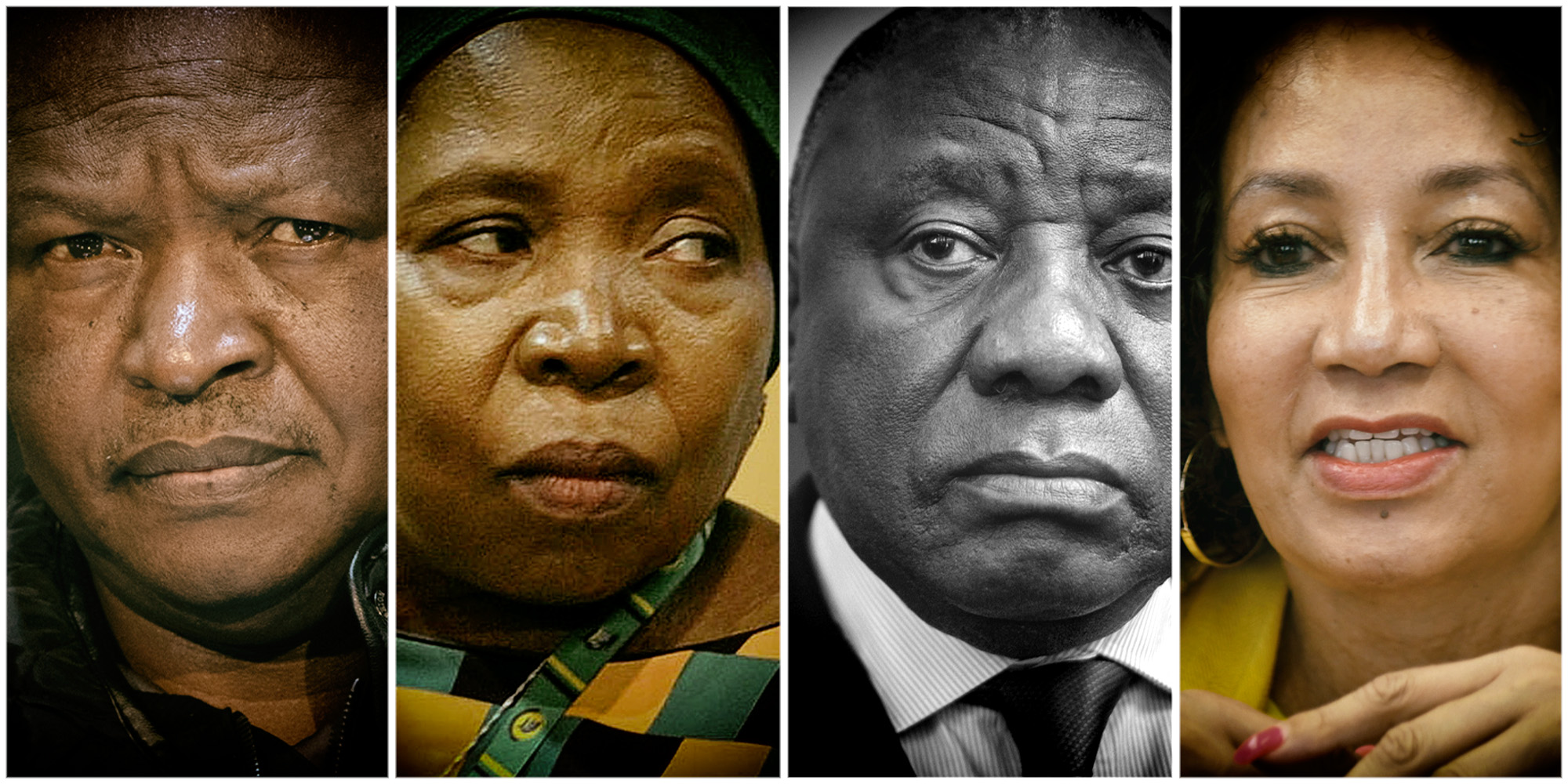
 From left: Deputy president David Mabuza. (Photo: Leila Dougan) | Nkosazana Dlamini-Zuma. (Photo: Gallo Images / Sowetan / Veli Nhlapo) | President Cyril Ramaphosa. (Photo: Gallo Images / Alet Pretorius) | Minister Lindiwe Sisulu. (Photo: Gallo Images / Netwerk24 / Edrea du Toit)
President Cyril Ramaphosa on Sunday promised that the renewal of the ANC was now “irreversible and irrevocable”. There may be no better way for him to put his money where his mouth is than by conducting a major Cabinet reshuffle and removing those with big question marks against them.
But there are limits to how far he can go. Some of the questions a reshuffle poses are actually vexed political decisions that can have major repercussions. Within all of this, at least one person who is in Cabinet now, Mineral Resources and Energy Minister Gwede Mantashe, is likely to significantly enhance his political power and negative influence on South Africa’s energy policy.
Normally, it is difficult to predict if, or when, a president will reshuffle their Cabinet. Changing a Cabinet is entirely within a president’s power. They do not have to consult anyone, and those who are removed have no legal recourse — they can only ask how high they need to jump. There is no legal duty on a president to explain their decisions in a reshuffle.
In the real world, a reshuffle is all about politics. It was generally understood in the past that an ANC president would not reshuffle a Cabinet without consulting at least the top six national officials. When Jacob Zuma failed to do this, in December 2015 and March 2017, it was clear that he was acting of his own accord.
Still, this is one of those rare occasions when a reshuffle can be said to be imminent, mainly because the ANC’s constitution states that the position of secretary-general is full-time, which means Fikile Mbalula can no longer be transport minister.
But it is also because the results of the ANC’s conference have changed the political equations that some kind of action must be taken.
For example, it appears that Paul Mashatile is keen to replace David Mabuza as Deputy President, after his election as deputy leader of the ANC.
Also, certain people who are in Cabinet have lost significant power.
Mabuza is one example, while ministers Lindiwe Sisulu, Pravin Gordhan and Naledi Pandor are no longer in the National Executive Committee.
The question then is: How far will Ramaphosa go? And, perhaps: How far does he want to go?
Easy questions and difficult ones
Some questions are relatively easy to answer.
Mbalula will be replaced. Mabuza has been shown to have a very limited constituency, which means removing him may cost Ramaphosa virtually nothing. Replacing him with Mashatile will be a net gain.
But some questions are more difficult.
Take Tourism Minister Lindiwe Sisulu.
She has claimed that Ramaphosa lied about the outcome of a meeting with her and has attacked his political positions. Despite that, Ramaphosa did not act against her in 2022. That was a clear sign of her near non-existent constituency within the ruling party.
If Ramaphosa is not prepared to act against someone who attacked him publicly, accused him of lying, and has now been shown to have no one to protect her within the party, then when will he act?
The Sisulu question may actually be a question of his own political strength and self-confidence. If he does not act against someone so weak, that in turn could lead to more people in Cabinet feeling they can also publicly criticise him and get away with it. So, to refuse to act against Sisulu would be a clear sign of weakness.
But some of Ramaphosa’s presumed allies, such as Gordhan and Pandor could, arguably, be in a similar position.
They also do not appear to have strong personal constituencies. It could be suggested, fairly or unfairly, that Gordhan has mismanaged rolling blackouts and should be removed.
Some in the ANC could claim that Pandor is responsible for giving slightly mixed messages on Russia’s invasion of Ukraine, and is out of step with the party’s true and undying support for Russia.
If Ramaphosa were to move against Sisulu, he could be accused of protecting his allies.
The question of Nkosazana Dlamini Zuma
Then there is Cogta Minister Dr Nkosazana Dlamini Zuma.
When Ramaphosa defeated her at the 2017 Nasrec conference he was quick to embrace her and include her in his Cabinet.
Since then she has publicly criticised him, saying he should resign over the Phala Phala scandal.
But this may require a decision from the ANC’s new NEC. This is because Dlamini Zuma defied ANC instructions when she voted to continue with Parliament’s process investigating Phala Phala.
Visit Daily Maverick's home page for more news, analysis and investigations
Here, the issue is whether the ANC itself can tolerate a Cabinet minister who defied its instructions, rather than whether Ramaphosa can tolerate such a person.
That said, if both the NEC and Ramaphosa allow her to remain in Cabinet, it could give a permission slip to other ministers to defy party instructions in future, with serious consequences for the ANC’s coherence as a political party.
At the same time, removing Dlamini Zuma might well be seen as an attack on a particular faction of the ANC. This makes the problem more complicated.
Of course, as at least one political analyst has already suggested, it is possible that Dlamini Zuma could resign from her position, to make a political point.
If she did this, she may be the first person to resign from Cabinet on a point of principle since we became a democracy nearly 30 years ago — a telling revelation.
But this may not be even the most difficult question for Ramaphosa.
If he conducts a wide-ranging reshuffle, how would he manage Deputy State Security Minister Zizi Kodwa?
Kodwa has been a strong ally of Ramaphosa, and the political power of that ministry is well-known. And yet he faces a finding from the Zondo Commission that he should not have received payments from the IT company EOH.
Others, such as David Mahlobo, appear to have moved from supporting Zuma during the State Capture era to supporting Ramaphosa. If Mahlobo were to be removed from his position as deputy minister of water affairs and sanitation, could it look like he has received no political reward for his switch of “heart”?
A further, crucial limitation
While all of this may pose vexing questions for Ramaphosa, there is a further, crucial limitation on his possible actions.
Any person who is removed will have to be replaced by a member of Parliament.
And the current group of MPs representing the ANC were selected through a list process over which former ANC secretary-general Ace Magashule had a strong influence.
This means that there may be very few people for Ramaphosa to appoint to replace those whom he removes.
To put it another way, if he did remove Dlamini Zuma, who could replace her and also be able to turn around local government?
Then there is at least one person who is probably untouchable and in a position to demand increased responsibility, which in political terms, means increased power.
Gwede Mantashe was re-elected as chair of the ANC (albeit by a very slim margin). The same conference which re-elected him also decided that Eskom should be moved from the Public Enterprises Ministry to the Energy Ministry.
This means that Mantashe would now have political authority over Eskom. With that could come control over the future direction of the state-owned enterprise.
Several analysts have made the point that one of André de Ruyter’s major achievements as CEO was to point Eskom in the direction of the green transition, to move its future away from coal towards renewables.
But Mantashe will now have carte blanche to influence that direction. This could realise the worst fears of those who support the move towards renewables and those who, foolishly, were hoping to live without Nigerian-style rolling blackouts.
Mantashe’s apparent increase of — what was already considerable — power is truly bad news for South Africa,
All of these elements show there are real limits to what Ramaphosa’s actions are within the realm of reason. He can’t just act against those who oppose him, and he cannot just replace them with allies.
Ramaphosa has, however, set a high bar for himself. His reshuffle is likely to be the first significant political act of his second, and final, term as ANC leader. He has said publicly that the renewal of the ANC cannot be stopped and it is the party’s most important priority.
If he fails to make major changes now, if he fails to remove those who have publicly opposed this agenda, it could suggest, within the first two months of his new term, that this promise is empty and hollow and he would instead become South Africa’s earliest lame duck President ever. DM