



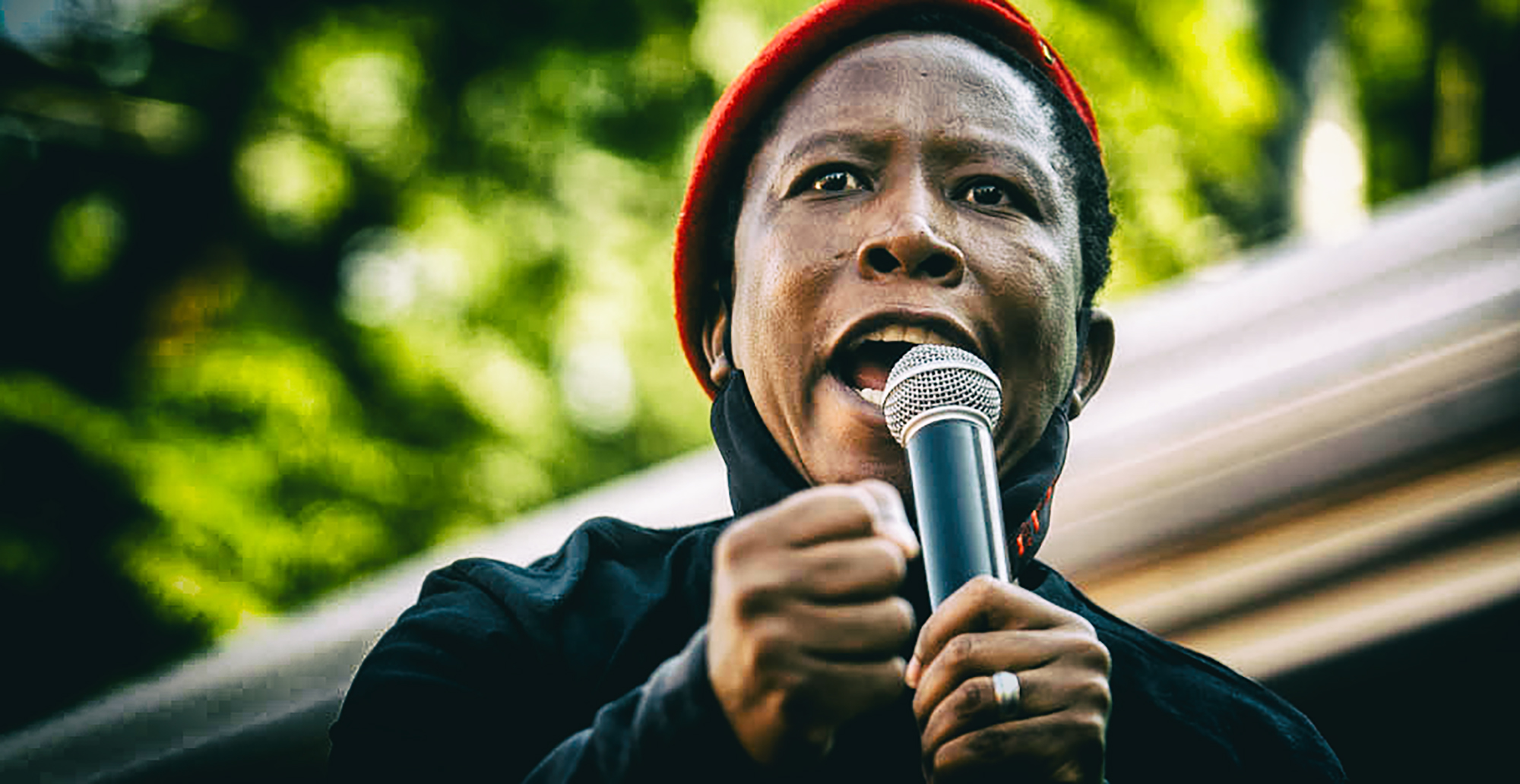
 Leader of the EFF, Julius Malema. (Photo by Gallo Images / Alet Pretorius)
One of Julius Malema’s favourite sayings in the latter part of his ANC Youth League presidency was that “nature abhors a vacuum”. Another was how the people from Alexandra would move through Sandton en route to the Union Buildings and “just open the fridge and get the cheese”. In the same speech, delivered exactly a decade ago during the youth league’s last proper conference in June 2011, he warned that this would be part of a “leaderless revolution” that would unseat “white monopoly capital”.
Fast forward to Monday, the third day of out-of-control looting in KwaZulu-Natal and Gauteng after the imprisonment of former president Jacob Zuma, and Malema was on Twitter with some Leadership 101 lessons for his former ANC elders. He tweeted that it was wrong to “start with” the police and the South African National Defence Force as the first port of call for calming the rioters.
“The question should be: Where are the leaders to speak to their people? Are they scared of their people? And if the answer is yes, the next question should be: why are the[y] leaders in the first place?”
Seeing that Zuma is in jail and Twitterless, this is most likely directed at President Cyril Ramaphosa. Earlier in the day, Malema tweeted with fury after it emerged that the army would be deployed after all.
“No soldiers on our streets! Otherwise, we are joining. All fighters must be ready ... they won’t kill us all. We need a political solution to a political problem, not soldiers. #NoToSoldiers”.
It’s not clear why Malema didn’t step in to offer his leadership to tell the looters to stop. Possibly he could score more points by tweeting — and there is also the risk of the looters not listening to him should he address them directly.
At a press conference on Monday, ANC Deputy Secretary-General Jessie Duarte half acknowledged that ANC faction fighting sparked the riots, but also admitted that this was overlaid by tribal undertones and criminal elements, and increasingly out of the party’s control.
Duarte herself didn’t want to comment too much about the possibility of Malema getting involved in directing the looters too, other than saying these acts should be reported to the police. Possibly this was the leaderless revolution Malema had prophesied years before.
/file/dailymaverick/wp-content/uploads/2021/07/Carien-MalemaSANDF1.jpg "EFF leader Julius Malema tweeted that it was wrong to ‘start with’ the police and the South African National Defence Force as the first port of call for calming the rioters. (Photo: Felix Dlangamandla)")
What was clear on Monday night after Ramaphosa’s sombre-faced televised address to the nation, however, was that, if anyone can coax the marauding mobs to leave the malls and go back to their lives as mostly obedient, law-abiding citizens, it won’t be the president. Even as he spoke, groups of people were finding new places to loot.
Ramaphosa also announced he would be meeting opposition parties to try to rope them in to find ways to quell the violence.
Covid-19 lockdown regulations haven’t presented Malema with too many opportunities to campaign with the crowded rallies he loves to do, so there's his opportunity to appearing to be on the side of 'the people'.
“It in part arises out of a leadership vacuum,” says political commentator and broadcaster Lukhona Mnguni. “Remember how he intervened in Marikana when not a single leader could go to Marikana?”
Ramaphosa has not set foot in the troubled North West mining town and even Zuma avoided it for a while after police shot and killed more than 30 protesting miners there in 2012. It was the worst government-sponsored atrocity in democratic South Africa.
“That was a fermentation of that space as a no-go zone for those not seen as being on the side of the people,” Mnguni said. Marikana was also where Malema officially launched the EFF formally as a political party in October 2013.
Populist leaders could have their place in a situation South Africa finds itself in. “You do need popular and populist leaders to help you absorb the irrational and seemingly outrageous emotions and tempers and agitations of people,” Mnguni said. “They tend to listen more to those they feel they can identify with, those they feel they can defer to, because they understand their struggle and they have been champions of their struggle.”
He said part of what fuelled the protests was a feeling of alienation from the state, and anti-establishment sentiments. When triggered, these could quickly turn against establishments that didn’t supply jobs or pay wages, so that the poor cannot afford to buy the goods that they are selling or manufacturing.
Mnguni said the only pushback Malema might encounter from his supporters would be if the army and police began to use force.
“People are ambivalent with the army on the ground, and they are scared to be caught in the crossfire,” he said.
While Malema stands ready to find new relevance, it remains to be seen if his supporters will have the courage to follow. DM