




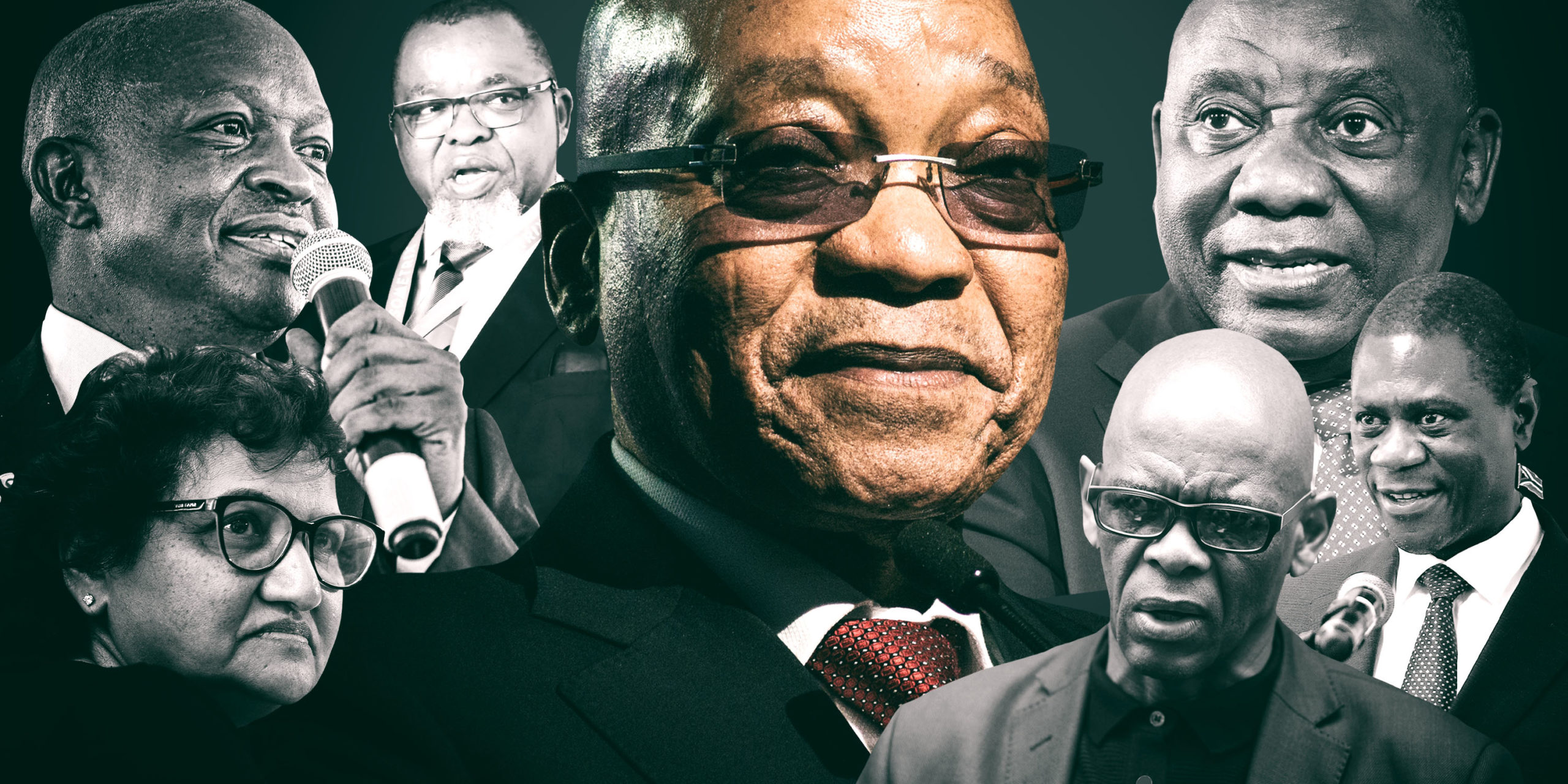
 Deputy Secretary-General Jessie Duarte. (Photo: Gallo Images / Netwerk24 / Lulama Zenzile) | Deputy President David Mabuza. (Photo: Gallo Images / Sharon Seretlo) | ANC National Chairperson Gwede Mantashe. (Photo: Gallo Images / Business Day / Freddy Mavunda) | Former president Jacob Zuma. (Photo: Getty Images / Bloomberg / Waldo Swiegers) | President Cyril Ramaphosa. | Treasurer-General Paul Mashatile. (Photo: Gallo Images / Fani Mahuntsi) | ANC Secretary-General Ace Magashule.
 As the legal wrangling over whether or not former president Jacob Zuma will be arrested and how that will happen continued deep into the night on Wednesday, and even as he was on his way to jail, over the longer term it may be the underpinning political events that prove to be much more important. The ANC’s attitude to this situation, and its strong backing of the judiciary, the Constitution and constitutionalism in general, may turn out to be more significant in the years to come than Zuma’s sentence of imprisonment.
The ANC’s recent National Executive Committee (NEC) meeting and its emphatic decisions also show just how significantly the power in the party has changed, to a point where it is now prepared to support the jailing of the man who dominated it so emphatically for so long. All of this is, of course, a boost for President Cyril Ramaphosa, and could further help the removal of those who have opposed him, personally, and his agenda.
The statement of the ANC published on Tuesday in response to the public show of support for Zuma on Sunday at Nkandla is a demonstration of how, step by infinitesimal step, the balance of power in the party has changed fundamentally over the last three years.
The NEC said that it noted, “Our unequivocal commitment to and defence of the Constitution, in particular the supremacy of the Constitution, the rule of law and the independence of the Judiciary, amongst the founding principles and values of the Republic.”
It went on to say that the NEC “reaffirmed our understanding that we consciously chose a democratic system and constitutional dispensation. It was not an accident, concession or a compromise, but rather an expression of our fundamental values and beliefs as espoused by the African Claims, the Freedom Charter, the Harare Declaration and the Constitutional Principles. The meeting stressed that it must always be clear that the interests of an individual cannot take precedence over or jeopardise the interests of our democracy or of the nation.”
While the statement did not mention Zuma by name, it was obvious who was being referred to.
In the press conference that followed the publication of the statement, ANC Deputy Secretary-General Jessie Duarte said she still hoped that the Constitutional Court would not order Zuma to go to jail.
Some have seen this as a contradiction of the main thrust of the statement, but that may not necessarily be the case. It is clear that the party believes, firmly, that the rule of law must be followed. But there is nothing wrong with also hoping, as a human being, that someone you worked with for many years does not have to spend time behind bars. That would allow someone to both show sympathy and to uphold the rule of law.
The more important issue is how things have changed.
In December 2017, just 3½ years ago, Zuma’s preferred candidate for the presidency of the ANC, Dr Nkosazana Dlamini Zuma, lost by just 179 votes to Ramaphosa. Very few people then would have believed that just 3½ years later the ANC NEC would stand behind the Constitution and against Zuma. Or that an ANC-appointed police minister, himself from KZN, would say in public the SAPS were prepared to arrest Zuma to comply with the law.
This again underscores the unique nature of this situation. It is not just that a former president is being arrested, it is that that person’s political party is still in power, which makes this so rare.
At the same time, while Zuma and his supporters have issued direct public challenges to the rule of law and the authority of the Constitutional Court, this NEC statement is vital for many other reasons.
There have been some suggestions that Ramaphosa should speak up for the rule of law. But the message of support for the judiciary is now that much stronger, coming from the NEC. While Ramaphosa could have spoken up, any comments by him could have been used against him, and he could have been accused of using the law to deal with personal opponents.
Now it is the might of the ANC NEC that has made this statement. And any comment by Ramaphosa will simply be a reiteration of the substance. He can preface answers to questions with, “Well, as the NEC of the governing party has said…”.
While Zuma still does have some support, the vast majority of South Africans are appalled by the corruption and incompetence that crippled the country while he was president. Zuma is the symbol of everything that was wrong, and the testimony of multiple witnesses at the Zondo Commission has revealed the role that he played.
It would now appear virtually impossible for the ANC, and the NEC, to walk their strong statement back. They have said, publicly, after a full meeting, that they back the judiciary, that the “interests of an individual cannot take precedence… over the interests of our democracy”.
While Zuma still does have some support, the vast majority of South Africans are appalled by the corruption and incompetence that crippled the country while he was president. Zuma is the symbol of everything that was wrong, and the testimony of multiple witnesses at the Zondo Commission has revealed the role that he played.
For the party to shield him from jail could well cost them many votes in the coming elections.
This could even be a useful moment for the party. Zuma could be turned into the symbol of corruption and on the campaign trail the ANC leaders could claim that they are prepared to take action against corruption by their own, as evidenced by Zuma’s incarceration. This could be useful with some voters.
Of course, there have been important steps along the way to this moment.
The first was the NEC (the same group of people which make up the NEC now) who voted overwhelmingly that Zuma should vacate his position as president of South Africa in 2018.
Then there were the difficult moments when it appeared Zuma might refuse to leave, his actual resignation, the ongoing testimony at the Zondo Commission, Zuma’s failure to stop the election of a joint ANC leadership in KwaZulu-Natal, the NEC’s “step-aside resolution”, and the decision that Ace Magashule should be suspended as secretary-general.
All of these, and others, have been crucial moments in this process, but that process is not necessarily complete.
While it is still likely that this will end with Zuma going to prison, there are others who are now going to find themselves in a difficult political position.
The NEC has resolved that there will be investigations into those who were at Nkandla and who spoke in favour of Zuma.
These would appear to include Tony Yengeni, Magashule and perhaps even the Human Settlements Minister, Lindiwe Sisulu, along with several others. Even a man as insignificant as Carl Niehaus is not being spared.
By going to Nkandla and displaying their support for Zuma, it is possible that they will be accused of also displaying their rejection of Ramaphosa and of the NEC’s statement. As a result, there could be disciplinary processes against them. And thus Ramaphosa may now be able to oversee their removal.
This could spell the end of major resistance to Ramaphosa within the ANC. And, perhaps as important, it could be the end of public resistance from ANC figures towards Ramaphosa.
This does not mean there will be no opposition, or that he will be able to do what he wants in the ANC. There are simply too many constituencies within the party for that to happen. But it could be the end of this phase of our politics.
All of this, should it play out in this way, could be a vindication of Ramaphosa’s “long game” approach. It would suggest that he was right to take the longer, more difficult route of using legal processes, both in South Africa and in the ANC, rather than the quicker, more direct methods of majoritarian politics.
As Professor Anthony Butler once noted, it shows how Ramaphosa first used the power of ANC process against Magashule, and thus ensured that no one in the party could retain their position after being criminally charged. It also suggests, as Jonny Steinberg has pointed out, that Ramaphosa has been right to prioritise the rule of law in all ways, rather than to abuse his position as president to achieve his aims.
Of course, the focus over the short term is on Zuma and his possible or probable arrest. While that is important, it may symbolise something much more significant for our future: that the politics of the ANC has changed dramatically. At least for now. DM