



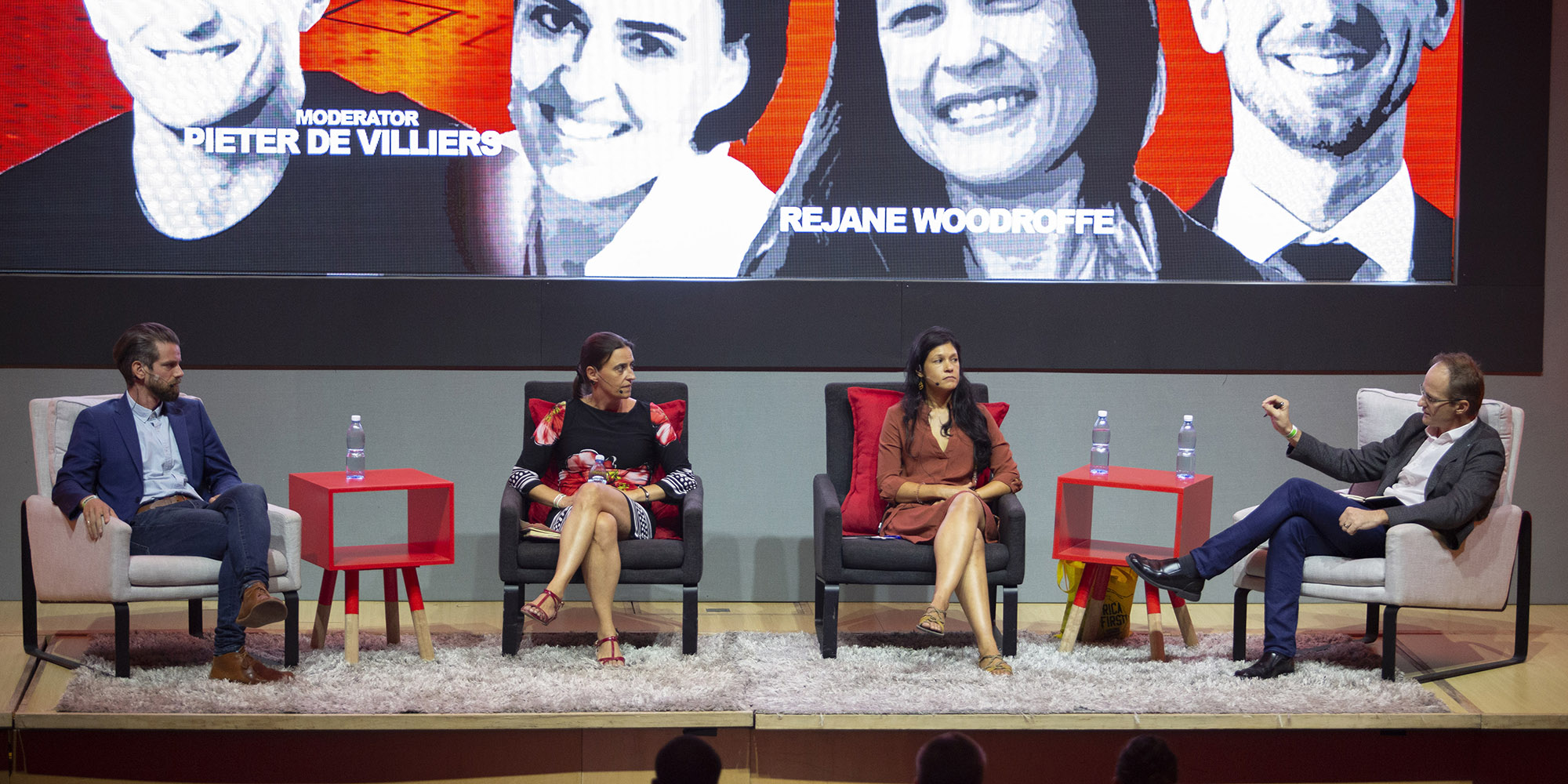
 Pieter de Villiers moderates the panel Human Capital & Innovation-Save South Africa’s Education, with speakers Sonja Giese, Rejane Woodroffe and Robert Paddock at Daily Maverick’s The Gathering on Friday, 6 March 2020. (Photo: Leila Dougan)
“If you can get me in the room with the Western Cape MEC for Education I will talk about the rollout of digital education. To cope with the influx of people into the Western Cape we are going to have to build 22 schools a year in the province. We have budget for four and we realistically build three. We need to roll out digital education,” Robert Paddock, the co-founder of Get Smarter, said.
Paddock and panellists Rejane Woodroffe, economist and founding member of the Bulungula Incubator, based along the Eastern Cape's Wild Coast and education expert Sonia Giese agreed.
“I am speaking from a perspective of rural learners in one of the remotest parts of the country,” Woodroffe said.
/file/dailymaverick/wp-content/uploads/Ellis-innovate-gather016.jpg "Sonja Giese at Daily Maverick’s The Gathering on Friday, 6 March 2020. (Photo: Leila Dougan)")
Giese is the founding director of Innovation Edge.
Woodroffe said they have already seen huge strides made in e-learning over the past decade. “We give children tablets from Grade 1. Learners have huge gaps in their foundational learning and e-learning allows us to do differentiated learning. It is crucial to building confidence.
“Our numbers show that we are making good progress in early childhood learning and we are still evaluating how effective this is at the higher grades,” she said.
Giese, however, added that simply providing children with tablets was not a solution to the problems in the education sector. “Tablets can be great but it is not a solution to everything. It is about finding ways to engage children where they find themselves but it can also be a band-aid that makes no difference whatsoever. We need to think about the quality of interaction between children and teachers and also think about what happens even before children are starting school.
/file/dailymaverick/wp-content/uploads/Ellis-innovate-gather004.jpg "Rejane Woodroffe at Daily Maverick’s The Gathering on Friday, 6 March 2020. (Photo: Leila Dougan)")
She said they found that 48% of children are already behind when they start school in South Africa. “We have to recognise that children up to the age of three are cared for at home. We must think of parents but also we must think of nutrition, stunting and malnutrition, which is entirely preventable. We also know if children had two years of high quality early learning programs they are more likely to start school on track.
“Just introducing an extra year of Grade R won't solve it. We must look at these three things,” Giese said.
Paddock said that technology can have a profound amplification where there is a supportive ecosystem but merely dishing out tablets will just be an “unsophisticated signalling to society.
“I think the provision of tablets is the wrong place to be providing emphasis right now. The vast majority of our attention must go to early childhood technology,” he said.
Giese said if she had control of the majority share of the education budget she would spend much more of it on teacher mentoring. “We know the quality of teachers makes a fundamental impact,” she said. “It is not sufficient to just address infrastructure. The same is true of early childhood education.
Paddock said he wanted to propose an entirely new model. “We have an unreasonable expectation of our teachers. They have an unreasonable job description. What other jobs do you know where you have to do 10 to 12 jobs really well, and be paid poorly and go and live in a poor area? We must get out of this paradigm to expect this from one teacher. It is time to rethink teaching,” he said.
/file/dailymaverick/wp-content/uploads/Ellis-innovate-gather020.jpg "Robert Paddock at Daily Maverick’s The Gathering on Friday, 6 March 2020. (Photo: Leila Dougan)")
Woodroffe said she agreed that there is no silver bullet that will solve all the problems in education adding that solutions must be tailored to suit the problems experienced in townships and in deep rural areas. “In rural areas, the quality of teaching is some of the worst in the country.”
Paddock said through his newly founded Valenture Institute they have converted an unused classroom and turned it into a digital laboratory. “We have employed some of the best teachers in the world to design and develop the curriculum. Learners are getting the material online but also live sessions for five hours a day in small classrooms with between 15-20 students. But you can't just have a digital provision for teenagers. Learning is not just about cognitive gain. We overestimate the degree to which education is a cognitive process and underestimate the emotional process. We found that the best mechanism is for a support person from the area to be present in the classroom with the learners,” he said.
He said the best teachers will not go work in the poorest areas. “Through this programme, they can facilitate learning with these learners from anywhere. But a person in the classroom with them to look after their emotional well-being is absolutely essential,” he said.
Giese said that she also sees this model working. “The combination of having someone in the classroom who has a relationship with the child and a teacher and realising that they do not have to be the same person can bring about huge change,” she said. She said implementing this model will likely encounter resistance from unions.
“Unions will be a challenge as well as high levels of crime. Technology comes with solar panels, digital equipment and screens. This wouldn't work in areas where there are high levels of crime,” Giese said.
/file/dailymaverick/wp-content/uploads/Ellis-innovate-gather025.jpg "Pieter de Villiers moderates the panel Human Capital & Innovation-Save South Africa’s Education, with speakers Sonja Giese, Rejane Woodroffe and Robert Paddock at Daily Maverick’s The Gathering on Friday, 6 March 2020. (Photo: Leila Dougan)")
“The desire for change is low. We have to start thinking differently. We must start coordinating the efforts of everyone doing this work in the country. Collective intelligence will improve overall efficacy,” Paddock added.
Giese said that if all programs looking for new solutions can agree to a core set of values it will present a powerful argument to government. DM