



 A sign sits on the exterior of a Bank of Ireland Group Plc bank branch in Dublin, Ireland, on Wednesday, June 6, 2018. Companies are expanding in Dublin rather than the U.K. in a "silent Brexit," according to Hibernia REIT Plc boss Kevin Nowlan. Photographer: Jason Alden/Bloomberg
“The rhetoric around Brexit has ramped up since Boris Johnson took over, and the mood music around the impact on Ireland has changed as well,” Eamonn Hughes, an analyst at Goodbody Stockbrokers in Dublin, said. “A few months ago there was commentary that Ireland could see some benefits from Brexit, now it’s uniformly seen as very damaging.”
Against the background of rising turmoil around Brexit, Irish Finance Minister Paschal Donohoe will travel to London next week to meet investors in the nation’s debt and banks -- the state still controls a large chunk of the financial system after the 2008 financial crisis. As proxies for the economy, banks are especially exposed to the fall out from the U.K. crashing out of the European Union. Donohoe has said 80,000 Irish jobs might be at risk in a hard Brexit.
“It’s been a perfect storm for the banks,” Owen Callan, an analyst at Investec Plc in Dublin, said.
Donohoe will meet investors on Sept. 9. While they’ll likely lay out their concerns about the banks, ranging from the ECB’s “lower for longer” interest rate policy to a mortgage overcharging scandal, Brexit overlays everything.
The tough outlook was reflected in first-half earnings. AIB’s pretax profit dropped 43% year-on-year amid narrowing margins and higher costs. Chief Executive Officer Colin Hunt warned the geopolitical environment is “getting increasingly difficult.”
Bank of Ireland meanwhile told investors its net interest margin will move lower in 2020 and 2021. Lower interest rates and Brexit uncertainty meant income and lending targets set out a year ago will be harder to hit, Chief Executive Officer Francesca McDonagh said.
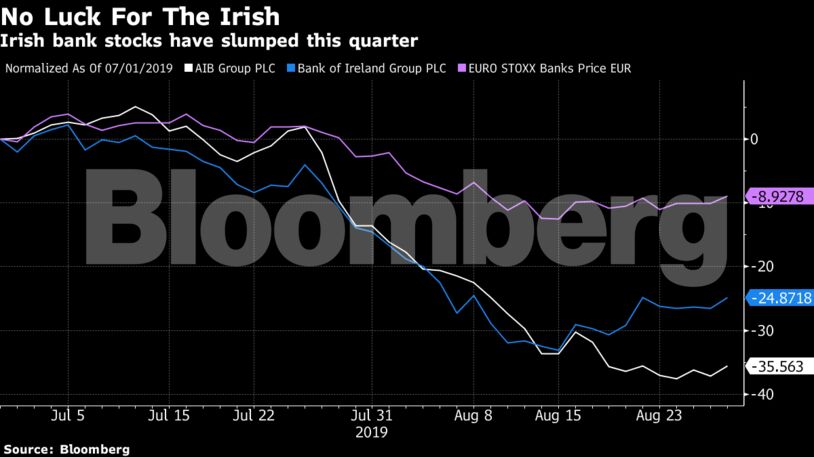
For Donohoe, the drop in the share prices poses an additional problem. Ireland controls about 71% of AIB and 14% of Bank of Ireland, after state bailouts.
AIB has fallen 60% from its high of 5.80 euros ($6.34) in January 2018. The stock now trades at little more than half the 4.40 euros a share price when the government sold a stake in 2017.
The drop threatens the government’s vow to recover about 30 billion euros of aid given to the banks during the financial crisis, in part through selling its shares in the lenders.
AIB is “trading well below book value anyway but the government shouldn’t be beholden to the IPO price,” said Callan. “The world has changed since then.”