



 A watchman stands guard next to a decommissioned gold mine headgear near Johannesburg, South Africa, 26 February 2009. Gold Fields, South Africa's second-biggest gold producer, could cut up to 6,900 jobs, or 13 per cent of its 53,000 workforce, and possibly defer a R5,4 billion (Û470 million) project in order to meet a 10 per cent cut in power use imposed by the country's power utility Eskom, the company announced 25 February. South Africa is experiencing a crippling energy crisis due to its inability to supply enough electricity to satisfy its daily domestic and commercial requirements. EPA/JON HRUSA
Gold open interest, a tally of outstanding futures contracts, surged the most since mid-2016 on Monday to the highest in more than seven weeks. Prices of the metal have advanced amid escalating tensions in the Middle East and between the U.S. and China. The rebound comes after bullion slid in the past three months, partly under pressure from gains in the dollar and equities.
“There’s been a change in attitude: there’s safe-harbor buying” in gold, said Peter Thomas, a senior vice president at Chicago-based broker Zaner Group. After the recent price retreat, “we saw a lot of people buying gold again.”
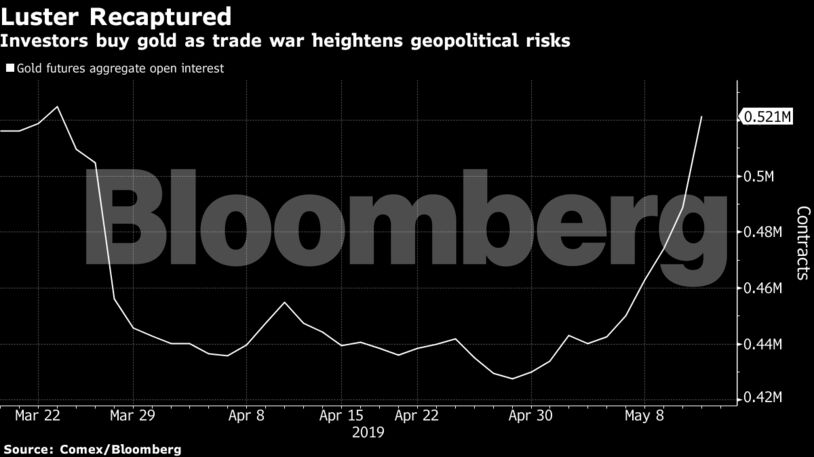
On Tuesday, markets steadied as investors assessed the U.S.-China trade war, with the world’s biggest economies planning more tit-for-tat tariffs. Gold futures for June delivery slipped 0.4% to settle at $1,296.30 an ounce on the Comex in New York, after reaching $1,304.20, the highest since April 11. The spot price slipped 0.2% on Tuesday.
“The dollar is back in green and this has pushed the gold price lower, but I think this is only temporary because investors are largely concerned about the trade-war issue,” Naeem Aslam, chief market analyst at ThinkMarkets, said in an email. “Any pull back could be an opportunity to buy.”
Comments
Scroll down to load comments...