



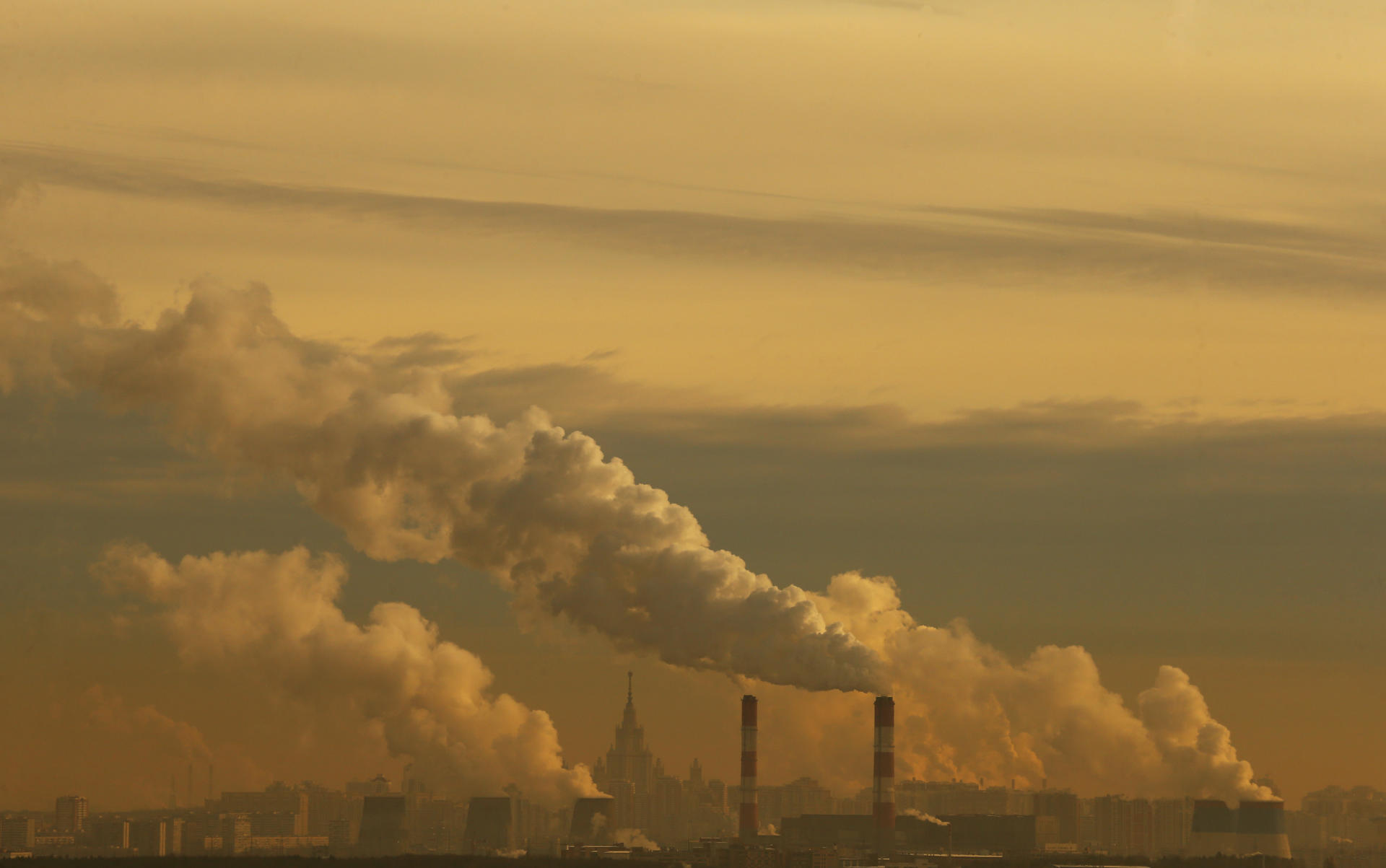
 (FILE) - A thermoelectric power station emits smoke in front of the main building of Moscow State University, as the air temperature in the Russian capital fell to minus 13 degrees Celsius in Moscow, Russia, 03 February 2017. Media reports on 30 October 2017 state the greenhouse gas bulletin by World Meteorological Organization (WMO) says the CO2 concentration in the atmosphere of the earth has considerably increased in 2016, with last year's increase being 50 per cent higher than the average of last 10 years. Concentrations of carbon dioxide in the earth atmosphere surged at a record-breaking speed in 2016 to the highest level in 800 000 years WMO said. EPA-EFE/SERGEI ILNITSKY
"Without rapid cuts in CO2 and other greenhouse gases, climate change will have increasingly destructive and irreversible impacts on life on Earth," the head of the World Meteorological Organization Petteri Taalas said in a statement.
"The window of opportunity for action is almost closed."
The Greenhouse Gas Bulletin, the UN weather agency's annual flagship report, tracks the content of dangerous gases in the atmosphere in the post-industrial era (since 1750).
This year's report, which covers data for 2017, puts the concentration of CO2 in the atmosphere at 405.5 parts per million (ppm).
That is up from 403.3 ppm in 2016 and 400.1 ppm in 2015.
"The last time the Earth experienced a comparable concentration of CO2 was 3-5 million years ago, when the temperature was 2-3°C warmer," Taalas said.
Researchers have reliable estimates of C02 concentrations rates going back 800,000 years using air bubbles preserved in ice in places like Greenland and Antarctica.
But by studying fossilised material the WMO also has rough CO2 estimates going back up to three to five million years.
In addition to CO2, the UN agency also highlighted rising levels of methane, nitrous oxide and another powerful ozone depleting gas known as CFC-11. DM