



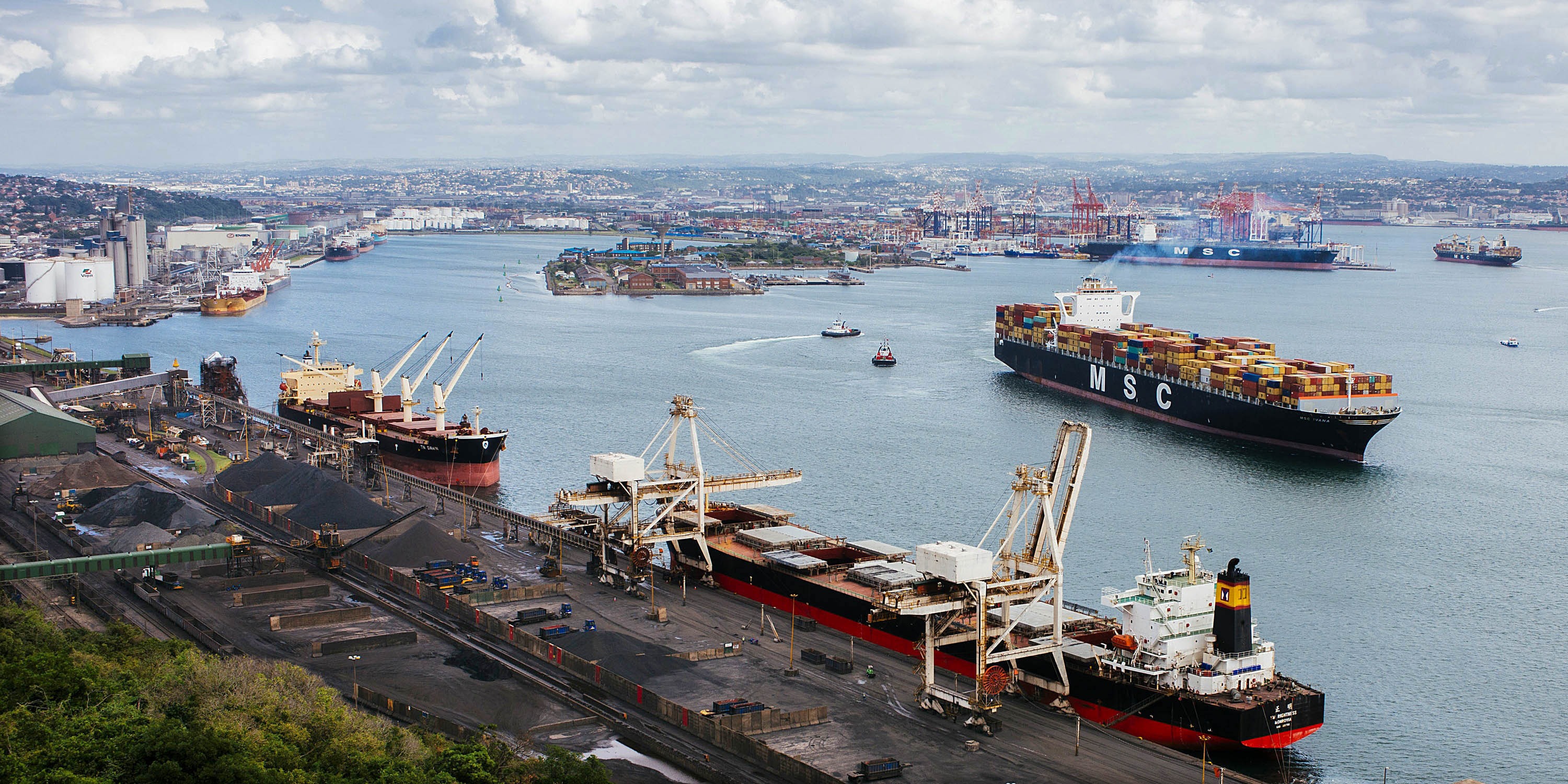
 Shipping containers onboard a cargo ship as it departs from the Port of Durban, operated by Transnet. (Photo: Waldo Swiegers / Bloomberg via Getty Images)
Sometimes the things that should be simplest are the most complicated. Moving goods from A to B is a great example, as the saga of Durban Gateway Terminal (DGT) reminds us.
International Container Terminal Services Inc (Ictsi), the Philippines-based company that acquired a 49% stake in DGT from Transnet, has been operating the terminal since the beginning of this year, and is in the spotlight due to a recent slowdown in cargo flows.
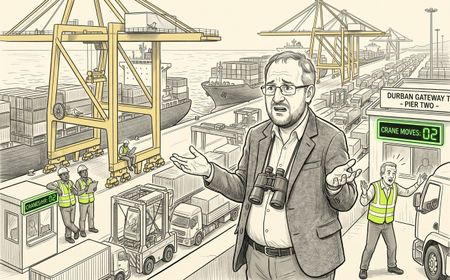
An IT system update in August led to a backlog and eventual crisis serious enough to show up in earnings reports and Department of Health warnings.
“At the heart of the matter has been the poor and unsafe condition of equipment at the facility, owing to years of underinvestment and inadequate maintenance,” DGT wrote in a statement last week.
Transnet begs to differ.
In a Saturday statement, the state logistics arm highlighted improvements in ship turnaround time in 2025:
“Ictsi also assumed management of Pier 2 after a significant Transnet-funded equipment-renewal programme… The broader equipment investment at Pier 2 over the preceding 18 months amounted to approximately R1.5-billion. Transnet therefore welcomes the continued investment, technology and international operating expertise being introduced by Ictsi. However, that contribution must be recognised as building on the operational recovery, equipment investment and workforce capability established before the transition, rather than starting from a position of complete operational failure.”
The Southern African Association of Freight Forwarders pointed out that, from 9 to 15 November, DGT’s waterside performance was at its strongest in four months, but a recovery is not necessarily enough to handle the backlog.
At DGT, the average anchorage time was nine days, compared to zero in Cape Town and one in Ngqura and Gqeberha, over the same period. At Durban Multipurpose Terminal, not managed by Ictsi, it was 11.
The average time at berth was four days at DGT and three days at Durban’s Pier 1, but only one to two days in the Eastern and Western Cape.
Break glass in case of emergency
Transnet Freight Rail (TFR) is making trains available “to enable evacuation of import containers destined for Gauteng” while Transnet National Ports Authority (TNPA) has offered additional berthing capacity. Durban-bound containers are being diverted to Ngqura Container Terminal, where they “can be discharged and subsequently transferred by smaller geared vessels” to Durban.

Capacity at Durban’s Pier 1 is expected to improve with the return of ship-to-shore cranes. Transnet Port Terminals is also scouting other ports that can lend equipment, but at the moment, only Cape Town has similar equipment, and it cannot afford to give any away.
On Friday, Transnet acknowledged a list from the Department of Health of “pharmaceutical products that were on 16 vessels in and approaching the South African port system, which required urgent evacuation”.
Six ships have been unloaded, and the containers have left the port. Three will be berthed over the next few days (two at DGT), and seven are still approaching the port system.
“A proposal to berth and discharge urgently needed containers at other terminals is being considered, to prevent queuing in Durban. This will be finalised before the vessels arrive,” said Transnet.
On the side, TNPA has opened up the possibility of private access to Durban’s Island View precinct, a section of the harbour which handles about 74% of South Africa’s liquid bulk imports. TNPA said:
“The current [expression of interest] relates exclusively to participation in existing terminal capacity and should not be construed as an invitation for the development of new petroleum storage infrastructure.”
At DGT, the operators say the new software is “running smoothly”, and they are refurbishing old equipment while awaiting replacements.
By the end of the month, new empty container handlers should arrive; by the end of the first quarter of next year, second-hand straddle carriers will arrive, and by the end of Q3, shiny new straddle carriers are due. Rubber-tyred gantry cranes will arrive next December and in March 2028.
So, a bit of a wait.
DGT is also working on “a new truck appointment system”, which is where things get interesting, as we ask: what happens once the cargo actually arrives on land?
Waiting on a freight train
Trade and Industrial Policy Strategies reported early this year that the proportion of SA’s total freight that moves by rail had slipped to less than 15% in 2025 from 22% in the mid-2010s.
This “contradicts the long-standing national policy goal of shifting from road to rail” – a move that would cut emissions and logistics costs, which currently represent 11.2% of gross domestic product versus 8.6% in the US.
There are many benefits to moving more cargo by rail, starting with the fact that it would make our roads much more pleasant to travel.
Moshe Motlohi, CEO of Transnet Rail Infrastructure Manager (Trim), told Daily Maverick that rail reform is not “anti-truck”, but designed to support a truck-to-train interface – letting trucks cover shorter distances and reducing driver fatigue.

“We need each other,” he said. “The railway needs trucks because we cannot get door-to-door, but the trucks need us to carry more cargo, and that is going to lower the cost of doing business.”
Motlohi did not specify the proportion of SA’s total cargo that Trim aims to get onto rail in 2027. He did say his team is working towards the government’s pledge of moving 250 million tonnes by rail, from 168 million at the last financial year-end.
According to Stats SA, from June to August, rail carried 43.2 million tonnes and road carried 242.8 million tonnes, meaning that for every tonne moved by rail, more than five tonnes were moved by road.
SA’s railway woes are a long story. Like many former colonies, we have faced the challenge of retrofitting infrastructure designed mainly to carry natural resources off into the sunset for the benefit of others.
The looting of Transnet in the State Capture era was like a sledgehammer to the knees of a struggling marathoner. One estimate puts Transnet’s State Capture debt at R60-billion. That’s billion with a “b”.
Several African nations have chosen rail privatisation. Motlohi stressed that what Transnet is doing is different: it is asking companies to “co-invest”.
Those who doubt the model can look to South Africa’s ports, he added. We would say, “Maybe not right now”, given the DGT debacle.
Transnet’s extended cinematic universe
Transnet set up Trim as a separate operating division in 2024. Trim is in charge of the actual infrastructure, allowing train operating companies (TOCs) to use the rail.
One of those TOCs is the old state entity, TFR; 11 others have secured concessions to operate on the network.
If you are confused about Transnet’s role in this, you are not alone.
A special task force was established to oversee a more definitive split of Trim from Transnet – even though Trim’s “operational and financial separation” from TFR supposedly came into effect in April last year.
The next step, according to Motlohi, is for Trim to “be corporatised out of Transnet”, but financial issues have delayed this.
Alistair Christison, an independent freight consultant, said the part of Transnet that is now Trim includes assets that were part of the collateral for loans previously made to Transnet.
Motlohi confirmed that “if one entity moves, it has to carry some responsibility or take an allocation of that debt.”
Basically, when you try to pry Trim from Transnet, it gets messy.
“Right now, Trim is not in that state of being corporatised because the financial viability is not there,” said Motlohi.
Establishing Trim has brought private-sector goodwill, but Trim remains “part of Transnet… We are not privatising the ownership of the rail infrastructure,” he emphasised.
Routes and regulations
The government has flagged delays in corporatising Trim and establishing a transport economic regulator (TER), which it aims to have “fully operational by March 2027”. Parliament has completed the shortlist for a transport economic council, which will be part of the TER.
A genuinely independent economic regulator is key to the whole system of open-access rail, Christison explained, because the regulator decides how much TOCs need to pay to use different routes.
Motlohi said Trim is not “reserving” routes for anyone (like TFR), even though some freight corridors are more profitable than others. He said the less profitable routes are still “essential” to the national economy, and Trim has requested more state funding to back them.
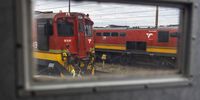
Meanwhile, Trim has had to draft four iterations of a network statement for private partners, due to their “bankability” concerns.
Motlohi maintains that “impartiality” was built into Trim’s proposals, saying: “We don’t want anyone to feel unwelcome or that [there are] favours being done.”
Ultimately, whether a private TOC invests in SA’s rail network comes down to one thing: how much money it can make.
According to Christison, lack of progress is “causing most potential train operators to steer clear”.
Trim does not expect private TOCs to bear the full cost burden, hence the appeals to government.
What would really help is if someone – anyone – could do something about the route between Durban and Johannesburg, to relieve the pressure on the roads.
“We are considering this corridor,” said Motlohi. It is a matter of determining how much is “fair” for the private sector to contribute.

One company that has not steered clear is Grindrod, which ran the first test train along the North-East Corridor earlier this month. Another two TOCs are expected to conduct test runs before the end of the year, and more next year.
“We understand that the strength of this intervention will depend on how the weakest part performs. As things stand right now, the weakest part has been either where sidings have been neglected, [or] where there’s no proper port and rail interface,” said Motlohi.
If we want to move goods around the country more easily, we all need to be on the same page and to know who is in charge – even if the structures of power involve more offshoots than a superhero franchise. DM
Comments
Scroll down to load comments...