




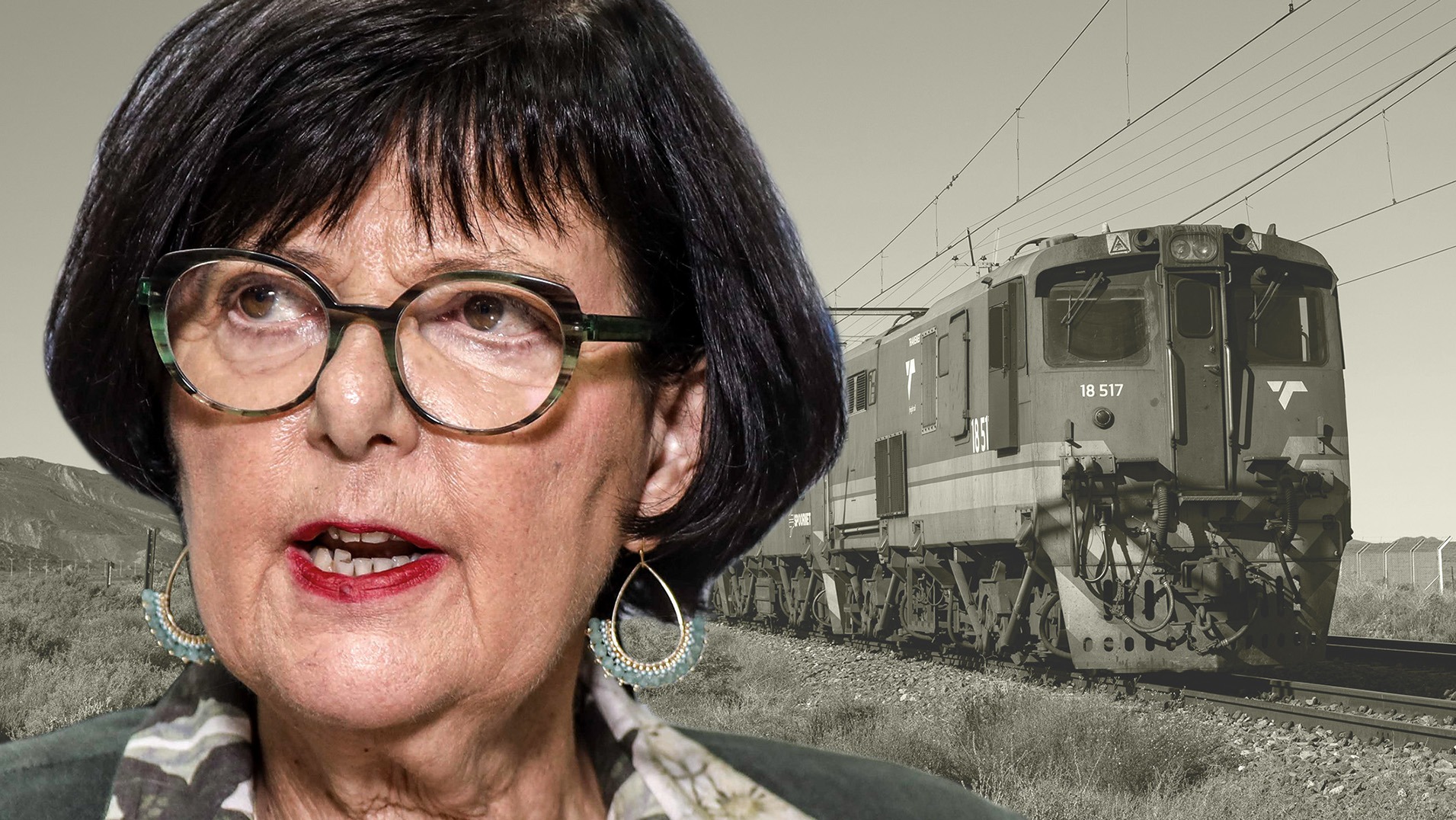
 Illustrative image: Minister Barbara Creecy. (Photo: OJ Koloti / Gallo Images) | A Transnet freight train. (Photo: Per-Anders Pettersson / Getty Images)
In rugby terms, the transport portfolio, responsible for getting South Africa’s domestic products to the ports and customers in the global economy, would be our primary ball carrier, tasked with getting us on the front foot. Goal number one in clearing the freight rail backlog was offloading some of the burden to private industry — which the government achieved just a few months ago.
“I am pleased to share a significant milestone in South Africa’s freight rail history — the approval of the first 11 private train operating companies to access the national freight rail network on 13 March 2026,” said Transport Minister Barbara Creecy during her keynote address at the 2026 Africa Rail Conference on Tuesday, 7 July.
“This marks the beginning of the era of open access, with operations expected to commence on 1 April 2027. Collectively, these operators plan to move up to 24 million tonnes of freight per annum.”
The licensed private train operating companies are ARC South Africa, The Railway Corporation, TLD Marine, Menar Ports & Rail, Sharp Logistics, Barberry, Grindrod, Minrail, IRACEMA, Motheo Logistics and Interlinks. This reform increases the active operators on the national network from one to 12 across five strategic corridors.
While the minister targeted a uniform start date of 1 April 2027, reading the documents reveals a more staggered trajectory: some operators are targeting commencement before the end of 2026, whereas others will onboard progressively during 2027.

Free kick, early engagement
“Our sector-specific target is to move 250 million tonnes [Mt] of freight on South Africa’s rail network annually by 2030,” Creecy continued.
“The National Rail Master Plan [NRMP] seeks to address the critical gap between the 165 million tonnes of freight currently moved by rail and the 280 million tonnage market demand...”
The minister’s baseline estimate of 165Mt is highly optimistic, compared to actual Transnet performance. Audited results show Transnet Freight Rail (TFR) moved 160.1Mt of cargo in the financial year ending 31 March 2025. While this was a 5.5% improvement on the previous year’s 151.7Mt, it missed the state’s own shareholder’s compact target of 170Mt by 5.8%.
To reach the 250Mt target by 2030, freight volumes must expand by 56% in under five years. However, the NRMP reveals that South Africa’s declared network capacity for FY25/26 is legally and operationally restricted to just 209Mt due to systemic network instability caused by theft, vandalism, and deferred maintenance.
Restoring the network to meet the 250Mt strategic benchmark is highly capital-constrained. The NRMP estimates that returning the infrastructure to its basic pre-COVID design capacity requires an immediate investment of over R60-billion by 2030.
“On Thursday last week, Trim [Transnet Rail Infrastructure Manager] published the second network statement that is now open for public comment,” said Creecy.
This is a big deal because the private companies Daily Maverick has spoken to have been calling for an updated network statement to address glaring issues in the reform plan.
Player not held
“South Africa’s formal depositing of the Luxembourg Rail Protocol for ratification... Work is under way to domesticate the protocol through the Mobile Equipment Act of 2007, ensuring its full implementation within South Africa’s legal framework. This would certainly provide a boost to train operating companies that seek to compete in our rail network corridors,” said Creecy
This is a crucial step to reform. The NRMP formally recommends evaluating and adopting the Luxembourg Rail Protocol to enable rolling stock leasing companies and private train operating companies (TOCs) to access affordable international asset financing.
Access to rolling stock is a primary constraint, with unmet demand estimated at 6,605 wagons and 121 locomotives. The state’s recovery schedule originally mandated the establishment of a rolling stock leasing company (LeaseCo) by 31 March 2025, a deadline that Transnet missed.
/file/dailymaverick/wp-content/uploads/2023/04/GettyImages-477815377.jpg "Access to rolling stock is a primary constraint for Transnet. (Photo: Dean Hutton / Bloomberg via Getty Images)")
However, the trajectory has stabilised. In June 2026, Transnet issued a formal request for proposals to two shortlisted bidders to establish a LeaseCo joint venture, allowing private TOCs to lease high-value assets and mitigate the chronic rolling stock deficit.
Wait, what about passenger rail?
Creecy is under pressure to get freight into a good space after years of neglect and plundering, but she did have a message for commuters:
“By the end of March 2026, annual passenger journeys on our commuter rail network surpassed 100 million… The objective remains clear, to achieve pre-pandemic levels of 600 million passengers per annum on our commuter network by 2030.”
There is a significant gap between the minister’s 2030 target (600 million journeys) and the master plan’s engineering models. The NRMP explicitly states: “Full recovery of services and achieving previous passenger trip highs is only likely in 2032”.
The passenger rail network, however, continues to run on an unsustainable financial model. Passenger fare revenue is insufficient to cover base salaries, forcing a reliance on massive operational subsidies that increased to R2.1-billion by FY23/24.
On the positive side, Prasa recovered from a pandemic low of 10 million journeys (2021) to 39 million in 2024. Annualised journeys crossing the 100 million mark by March 2026 represents a sharp recovery (+156% over 2024).
Front-foot ball
“Economic modelling commissioned for the National Rail Master Plan indicates that every one million [rands] invested could generate approximately 4.3 million [rands] in GDP growth...” said the minister of the economic side of the policy.
“The Private Sector Participation [PSP] framework has generated a strong pipeline of investment-ready projects through the PSP Unit ... in public investment is already in execution, with a further R23.6-billion in development.”
There is a sobering reality on the other side of the infrastructure investment coin to which Creecy is referring: the R276-billion (3.6% of GDP) lost annually due to rail and port bottlenecks.

But because Transnet is highly leveraged — with total debt increasing to R144.8-billion by March 2025 and a tight cash interest cover of 1.8:1 — public capital cannot fund the required upgrades. S&P’s CreditWatch on Transnet further demonstrates that private capital mobilisation is the only viable pathway.
Which is why, in keeping with the minister’s speech, high-volume export corridors are currently in the market, with requests for proposals (RFPs) released to secure private investment and concessions for the Richards Bay Dry Bulk Terminal and the Ngqura Manganese Export Corridor.
In rugby terms, Transnet is not the Springboks of the current day. Issues like the maintenance backlog of more than R100-billion and persistent security/vandalism hotspots (such as the loss of 700km of cable in FY25) are reminiscent of the Bok team that lost to Italy before Italy was good.
But there is a solid plan, and the National Treasury is backing the rail reform play. The rise to the top will be hard. DM
Comments
Scroll down to load comments...