




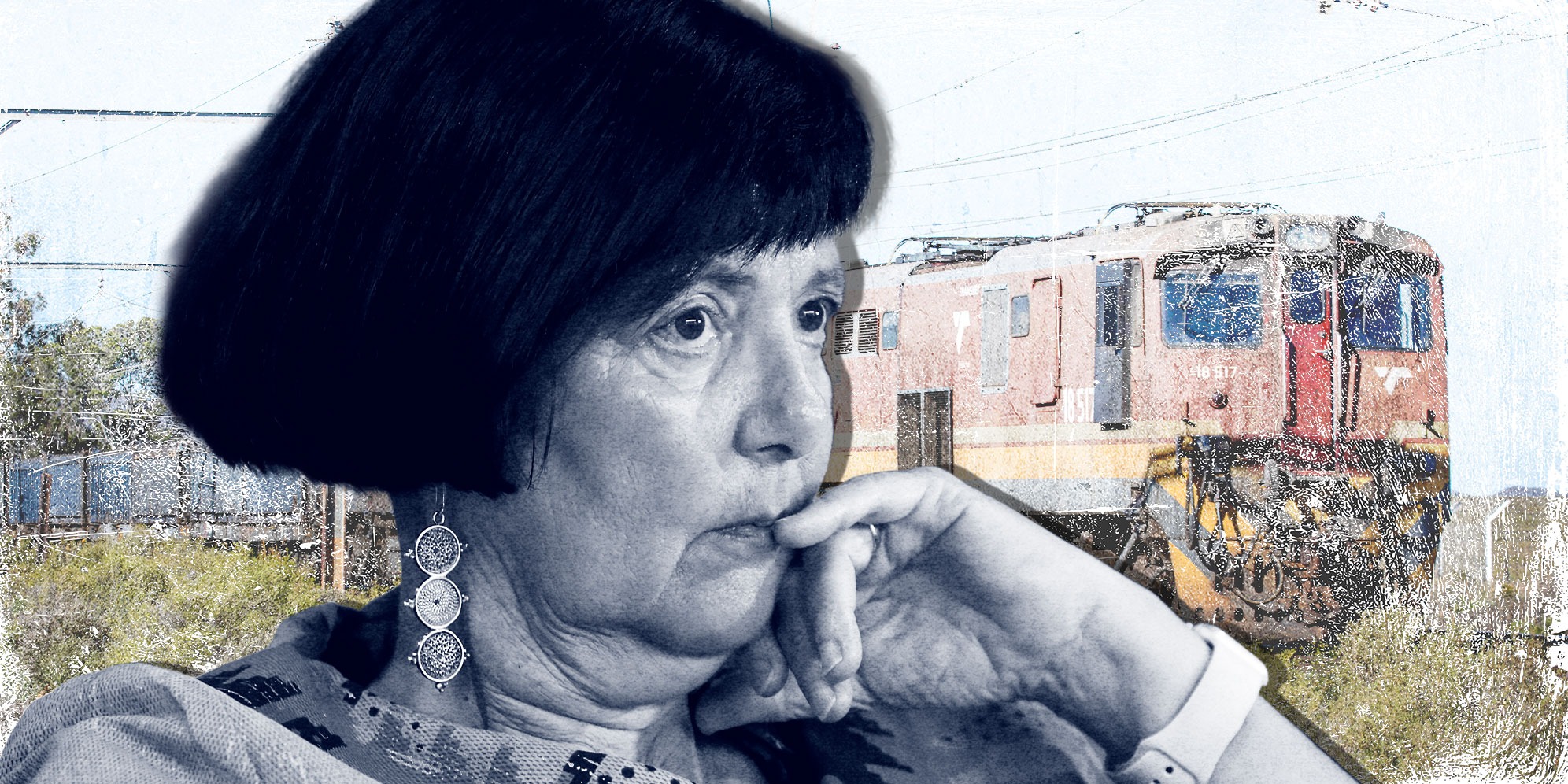
 Illustrative image: Minister of Transport Barbara Creecy. (Photo: Gallo Images / Sharon Seretlo) | A Transnet freight train. (Photo: Per-Anders Pettersson / Getty Images) | (By Daniella Lee Ming Yesca)
The last time there was a bright idea to reform South African rail, the AFRO4000 locomotives were too tall (the rail nerds call it “out of loading gauge”) and the “engineer” behind the long-distance passenger rail revival didn’t even have a degree.
And while everyone laughed at the Passenger Rail Agency of South Africa (Prasa) side of the equation, Transnet quietly laid the foundation for a scandalous order of 232 MTU Series 4000 engines from Rolls-Royce Power Systems for its fleet of new locomotives (this part is important later).
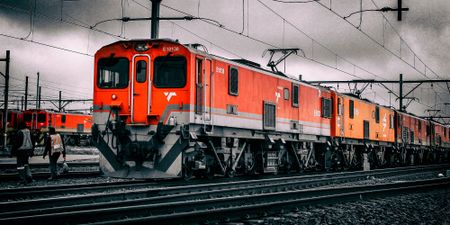
But today, when Transport Minister Barbara Creecy stepped up to the podium she was more than qualified to speak the love language of the local industrialist: “This plan aims to position rail as the backbone of South Africa’s logistics and transport ecosystem”.
“It is not about re-inventing the past; it is about building a resilient, adaptable, dynamically scalable rail system that serves the nation’s broader economic and social goals.”
Mixed track signals
Unfortunately, the gross opportunism of State Captures past still weighs heavy on the freight carrier’s neck.
Transnet group CEO Michelle Phillips – also back in the big smoke after an appearance before the Standing Committee on Public Accounts (Scopa), where she had to explain that there are no Ferraris at Durban Port – told Songezo Zibi:
“What we’ve seen in Transnet is a convergence of a number of these factors that have impacted not only on the [financial sustainability] of the organisation, but has impacted also on its performance... We’ve seen a convergence of infrastructure deterioration. We’ve seen equipment shortages. We’ve seen some governance failures, financial constraints...”
For context: Scopa summoned Transnet to explain its financial strategies and significant problems associated with its audit results, emphasising the importance of transparency and accountability.
The committee expressed deep concerns regarding Prasa’s financial performance, specifically highlighting the contract given to Swifambo for the provision of 88 locomotives, valued at R3.5 billion … which was viewed as a significant irregularity.
And it is into this malaise that the National Rail Master Plan (NRMP) must come to restore sense and order.
Wait, what’s a National Rail Master Plan?
Let’s catch up… The Department of Transport Strategic Plan sets an ambitious target of increasing annual freight volumes on the Transnet rail network to 250 million tonnes (Mt) by 2030.
The NRMP explicitly adopts this exact target, but does say that while only about 160-167Mt is currently being moved, the master plan’s interventions are designed to reach the 250Mt goal by 2029/2030 by unlocking a viable market of 262Mt.
Here’s how the two documents fit together… Both frameworks demand the vertical separation of rail infrastructure from operations. The department’s Strategic Plan mandates the establishment of the Rail Infrastructure Manager (Trim) as a subsidiary of Transnet.
The NRMP operationalises this by formalising Trim’s role in granting open, non-discriminatory network access to private sector participation and third-party train operating companies. Both documents also highlight the passage of the National Rail Bill and the establishment of the Transport Economic Regulator as critical enablers.
The devil in the Transnet balance sheet
Remember those Transnet locomotives? Those were ordered from CNR (China North Rail, now CRRC SA-Rolling Stock) and form a major part of the 1,064 locomotive supply agreements – a recurring main character in the nightmare that was Transnet at the end of the past decade.
In March 2021, Transnet and the Special Investigating Unit launched a high court application to review and set aside the locomotive supply agreements with four original equipment manufacturers (OEMs), specifically targeting China South Rail (now CRRC E-Loco) and CNR. The agreements with both CRRC entities are currently suspended pending the outcome of this court application.
Transnet’s capital work-in-progress reflects R4.2-billion in advance payments made for the acquisition of 95 electric locomotives from CRRC E-loco and 210 diesel locomotives from CRRC SA, all of which remain outstanding.
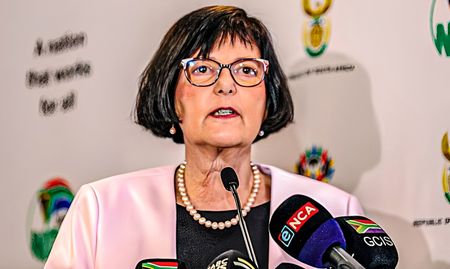
The suspension of these contracts and the subsequent unavailability of the locomotives have placed severe pressure on Transnet Freight Rail and have been a handbrake on its capacity to move planned volumes.
Phillips described to Scopa that the dispute left Transnet unable to source parts to fix its current fleet. However, the logistics arm of the state recently became aware that CRRC had brought spare parts into South Africa and kept them in various warehouses without handing them over.
To overcome the ongoing equipment shortages caused by the CRRC impasse, Transnet’s strategic response includes awarding contracts to alternative OEMs to re-engineer the existing CRRC locomotives so they can be returned to active service.
Keeping the deal on the rails
Creecy’s plan proposes a differentiated funding model. Freight rail is mandated to operate primarily on a commercial, user-pays basis with targeted private sector investment. By contrast, passenger rail requires direct operational subsidies from the government to fulfil its socioeconomic mandate of affordable mobility.
Why the difference? Because there is a concerning anomaly in Transnet capital allocation. Analysis shows that more than 75% of Transnet Freight Rail’s recent capital spend was actually used for basic operational asset maintenance rather than genuine network improvement or expansion.
This reliance on debt to fund routine maintenance creates a vicious cycle of negative equity that directly threatens the infrastructure upgrades promised in the NRMP.
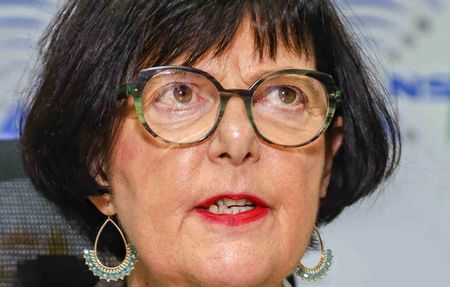
Despite these challenges, the Minister says that “a major shift in the NRMP is the commitment to inclusive, consultative planning; broadening beyond rail’s traditional commercial and SOE considerations to incorporate diverse stakeholder perspectives from the outset”.
There is still a way to go to get SA’s rail back on track, and all stakeholders admit that. But getting this far is a massive achievement. The NRMP is open for public comment right now in a genuinely impressive web portal, which Creecy says must become a living document and not some “dusty folder in the bottom of a drawer in Pretoria”. DM
Comments
Scroll down to load comments...