



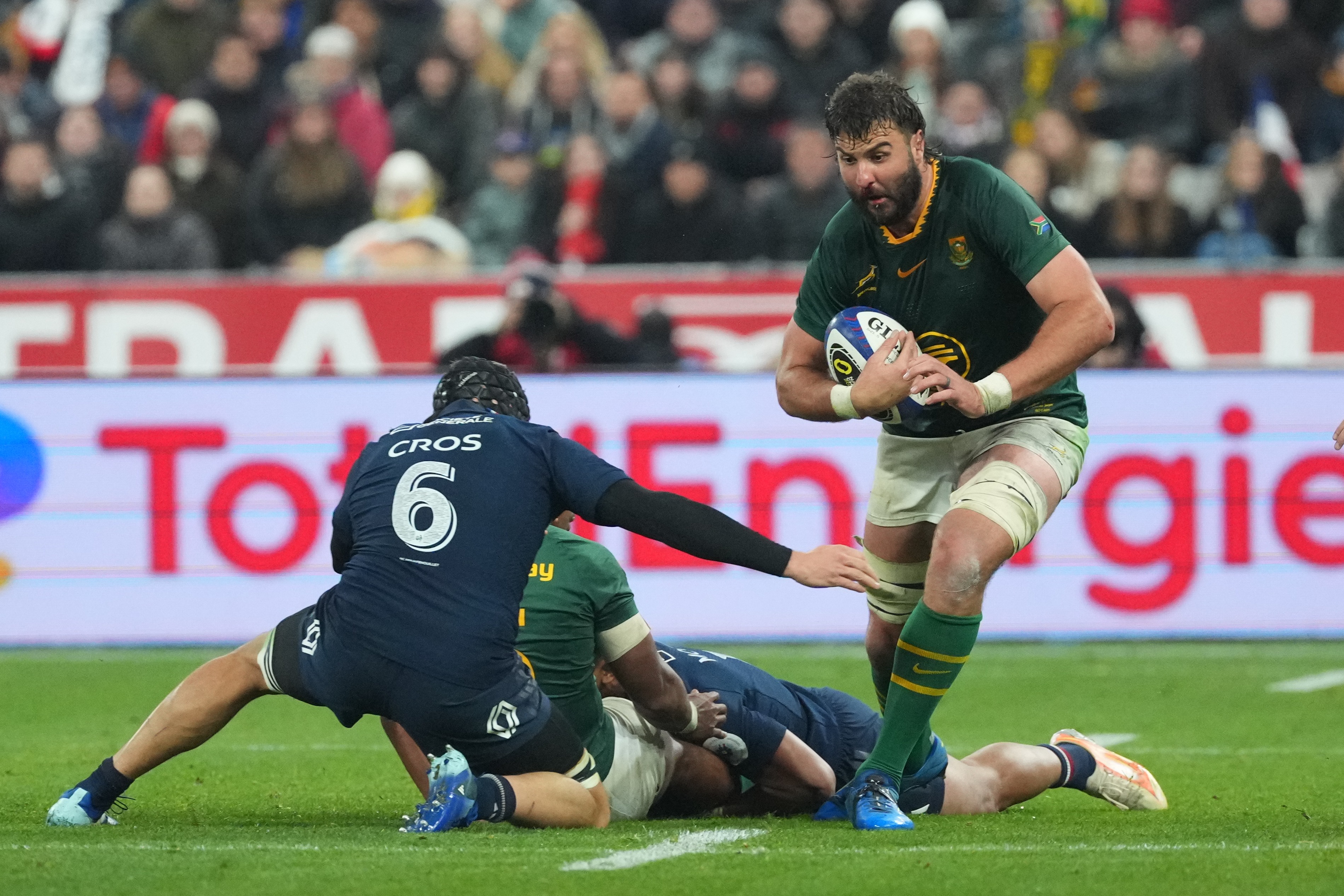
 France flank Francois Cros is clearly on his knee before tackling Bok lock Lood de Jager during the Nations Championship match at Stade de France in Paris on 13 November 2026. (Photo: David Winter/Gallo Images)
Few aspects of last week’s Test between the Springboks and France have caused more argument than the “knee-drop” tackle.
In the grainy screenshot below, Springbok centre Damian de Allende is lowering himself to tackle a French ball carrier. His knee is slightly off the ground in the final split second before contact. Remember, this is a freeze-frame of something happening at high speed in a dynamic sport.
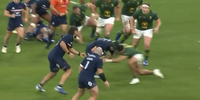
Referee Andrea Piardi is just in frame and appears to be looking at the play. De Allende has got it right – just. A split second later, his knee touches the ground, but by then he has made the tackle. By the letter of the law, it’s legal.
Bok coach Rassie Erasmus counted 17 incidents in which, in his assessment, French tacklers’ knees hit the ground moments before contact. The Boks lost 21-19.
Some of the clips doing the rounds show clear examples. Many are marginal.
Think for a moment about what the sport is asking of its officials.
At high speed, through a mass of moving bodies, at ground level and from one angle, a referee must judge whether De Allende’s tackle was legal or not. That’s before considering that, despite his low body height, it came close to head-on-head contact, which is another offence.
Scroll through the fans’ comments under those clips, and even they are arguing with each other, with the benefit of a replay. Yet they demand perfection from officials in real time.
Erasmus’ unhappiness stemmed from the fact that the television match official (TMO) did not step in and adjudicate on the knee-drop tackles he saw.
He wasn’t really pointing a finger at Piardi, beyond suggesting the referee brushed off captain Siya Kolisi’s queries. Most of his wrath was aimed at the TMO Matteo Liperini.

Painted into a corner
It was those comments about the TMO, not the knee-drop tackles themselves, that earned Erasmus a six-match ban this week.
An independent panel found his remarks suggested the officials had acted with bias or deliberately influenced the result, calling them an “unacceptable attack on the credibility and competence of the match officials”.
Whatever you make of how he said it, the underlying question is fair. If a tackle is illegal, who is supposed to catch it?
This is where World Rugby has painted itself into a corner. It has spent the past two years trying to cut stoppages and keep the ball in play, and its TMO protocol now limits interventions to the “clear and obvious”.
Yet the knee-drop happens in a split second that the naked eye, at full speed, can barely pick up. Players are being asked to lower tackle height, but not so low that their knee touches the ground. But if it does touch the ground, it must be after, or simultaneously with the tackle, to be legal. It’s impossible.

World Rugby’s own guidance says the TMO should get involved only if the outcome is dangerous, such as a player landing on his head.
So, the one official with the tools to judge a knee-drop properly – the TMO – has essentially been told to stay out of it.
Policing the law effectively would need more TMO intervention, not less. That is the very thing the game’s lawmakers have been trying to reduce.
The stat that World Rugby is championing is “ball in play time”. The yardstick appears to be that the higher the number of minutes a ball is in play, the better the game, or “product”, will be, as the suits like to say.
Yet, they’ve introduced a new law, which by its very nature demands more third-party scrutiny via the TMO than just about any other law.

Law jungle
Rugby’s lawbook is immense.
There are 21 laws in rugby, made up of 372 numbered clauses, and beneath those are roughly 320 more lettered sub-clauses.
If you strip out the laws dealing with the pitch, the ball, the team sheet, kit, time and the officials themselves, there are still 271 clauses that govern what happens once the ball is in play.
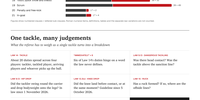
Law 14, the tackle law, places about 20 separate obligations on four different players: the tackler, the tackled player, player/s arriving at the tackle and whoever picks up the ball.
The tackler must release their opponent immediately. The tackled player must make the ball available immediately. Arriving players must stay on their feet and come through the “gate”.
The word “immediately” appears six times in Law 14. The law never defines it.
Now, layer on what has been added around the tackle in recent seasons.
Was there head contact? Was the tackle above the sanction line? Did the tackler swing round and drop his bodyweight on to the ball carrier’s legs (the hip-drop), which became an offence on 1 November?
And now the knee-drop. Did the tackler’s knee hit the ground before contact, or at the same moment? A knee on the turf a fraction too early turns a legal tackle into an illegal one.
Several of those questions also sit in Law 9, the foul play law, where the word “intentionally” appears 10 times. The referee must judge not only what a player did, but what he meant to do.
And the tackle is only the start. A split second later, the referee must decide whether a ruck has formed, and if so, where the offside lines are, and whether to play advantage or blow up.
All of that happens in the time it takes for a tackle to become a breakdown, often in a pile of six or eight bodies, from one angle, at ground level.
Judgement calls
Referees have always made judgement calls, and nobody can reasonably expect perfection. The knee-drop guidance is also a message to coaches to stamp the technique out in training.
There’s a welfare case, too. A tackler on his knees puts his head at the height of the ball carrier’s driving knees, and World Rugby research found that tacklers suffer most head injuries in the tackle.
Seventeen knee drops without an injury in last week’s Test doesn’t make the technique safe.
But if World Rugby has chosen to let some knee drops go in exchange for flow, it should say so.
Instead, its guideline claims the technique has “led to an increase in injuries to both participants”, without publishing a single number to back it up.
What it can’t have is all three at once: fewer stoppages, less TMO intervention and a new offence that can only be reliably judged on slow-motion replay by a TMO.
Something has to give.
Go back to De Allende’s tackle, or several others from the same game. Even freeze-framed, their legality has been debated for days. Piardi had a fraction of a second and one angle with each call.
Obviously, the higher the level of rugby, the more scrutiny, the greater the consequences of losing and the higher the pressure on coaches and officials.
Perhaps though, the question isn’t only whether officials got it right, but whether anyone could, under the laws? DM
Comments
Scroll down to load comments...