



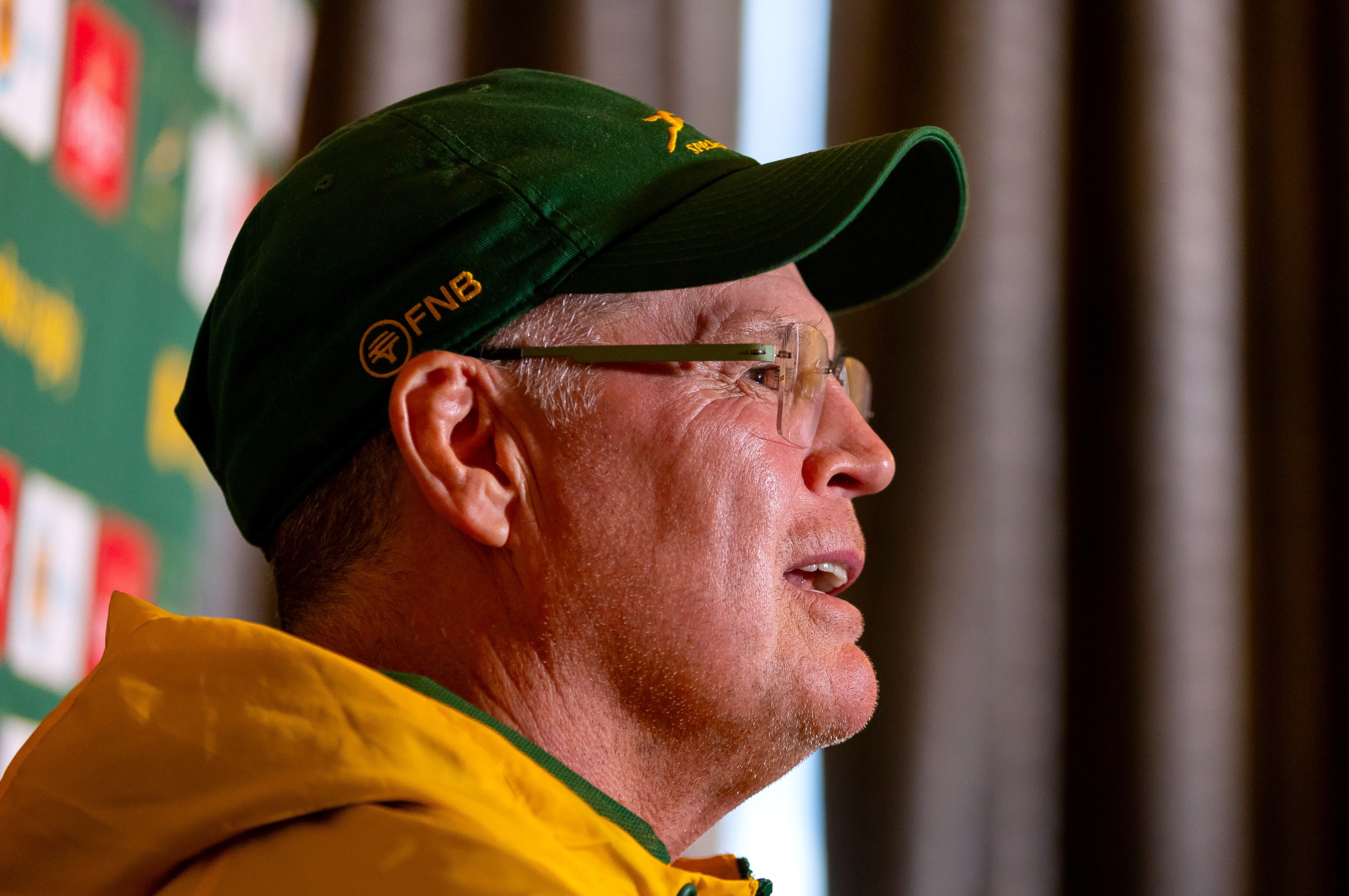
 Rassie Erasmus during his now infamous media conference at St Helens Hotel on 16 November 2026 in Dublin, Ireland. (Photo: Tom O’Hanlon / Gallo Images)
Aside from diehard fans, no one likes a serial winner, especially in professional sports.
The Springboks, who are serial winners, are finding that out, although what rival fans think has never really bothered them. They exist in their own bubble, created by coach Rassie Erasmus, where it’s them against the world.
Erasmus, though, has left his squad in a precarious position and has succeeded in turning the Boks into the most loathed team in the world. This is different because Erasmus has called the integrity of officials into question. It’s an attack on a relatively small, tight group of influential people in rugby.
Spend a few hours going through global stories, videos and their accompanying comments and it’s clear that Boks are losing the PR war. No, they have lost it.
Erasmus’ comments at a press conference in Dublin on Monday, where he asked a rhetorical question about whether match-fixing was involved in the Boks’ 21-19 loss to France, ended in the only way it could – with a lengthy six match ban.
Many South Africans have sprung to Erasmus’ defence. They argue that his observation that 17 knee-drop tackles by France occurred. Erasmus suggested that at least three were yellow card offences and 11 in total should have been penalties. They all went unpunished.
Assuming for a moment he was correct about all the calls, which is in dispute, does that give him the right to stray into the world of innuendo and character assassination about a match official?
Erasmus has a point, and discourse around the knee-drop tackle law and the role of the television match official (TMO) in this area of the game needs to be had.
Factually, what Erasmus was saying had merit. But when he threw out the phases “match-fixing” and “game manipulation”, all credibility died.
If you’re even suggesting match-fixing took place, you’d better have hard evidence to back it up, and not just video clips of a game. You’d need proof that an official agreed to manipulate the outcome of a game for some sort of personal gain.
It was a wild, and frankly irresponsible statement.
Erasmus, of course, was speaking in his second language, so there is a possibility he mangled his words. He has requested a hearing to make a case for himself, but it will be extremely difficult to extricate himself from this mess unless he produces a smoking gun to back-up his “match-fixing” comment.
Imagine if every weekend, an array of coaches came into a media conference and outright claimed the match officials were cheating without evidence. Where would that get the sport? It would become impossible to manage and to attract officials.
Impossible expectations
By its nature, rugby is a complex game to referee – Erasmus has admitted this numerous times.
In 2022 in a column in the Daily Mail, Erasmus wrote: “It’s impossible to expect a referee to make between 800 and 850 decisions in one match. The game isn’t allowed to flow any more and you’re always going to end up with one team that is pissed off.”
At RWC 2023, Erasmus went further and extended an olive branch to officials, having endured two suspensions in 2021 and 2022 for criticism of match officials.
“Last year I had a phone call with [former referee] Nigel Owens and I said ‘we really want to get this right, we don’t want people not to like us’.
“That is not the reason for us, maybe sometimes having differences and doing things in a way just to get a response,” Erasmus said in Paris in 2023.
“We wanted to know how things worked. I must say what we learned from those conversations is that no matter if we are right, the respect you show to the referee you will get back from that referee, even if he makes mistakes or you make mistakes.”
Well, that seems to have fallen by the wayside.
As it stands, Erasmus must leave the Bok camp, he won’t have any input from here on in for the remainder of this tour.
Preparing the team in these final days before the clash against Ireland at the Aviva Stadium will probably fall to Mzwandile Stick and Felix Jones.
The players will obviously be emotional and will play for their coach as the Boks will almost certainly use this outcome as motivation.

Charm offensive
Erasmus is a brilliant coach and innovator and a person who does not accept the status quo. He challenges policy and laws, he tries to find loopholes and spends just about every waking hour looking for ways to gain an edge.
It’s that obsessiveness and attention to detail that has made him the most successful South African coach in history. They’re also the traits that led him into trouble.
Maybe people’s opinion of the Boks doesn’t matter to Erasmus, although his quote above from 2023 would indicate otherwise.
But the perception of the Boks certainly matters to the upper echelon of the South African Rugby Union (Saru). Soon after winning Rugby World Cup 2023, they suggested the Boks embark on a charm offensive.
People at Saru were savvy enough to understand that in a sport where the laws are often open to interpretation and where the writings and musings of journalists and rugby personalities matter, the Boks needed to start winning off the field.
Officials are human – if they read and see enough negativity about the Boks, it has the ability to seep into their thinking.
Battles in professional sport are waged physically and psychologically.
And whether we like it or not, the rugby media and influencers in the northern hemisphere have the most clout and therefore potential influence.
It’s almost impossible for a member of the South African media (outside of host broadcaster SuperSport) to get a one-on-one interview with Erasmus or key players. An annual drink and chat in a group environment is about as close as it gets these days.
One-on-ones
But for the media in the United Kingdom, Erasmus has done one-on-ones. In 2024 the British press pack was invited to join the Boks for three days on the island of Jersey as they prepared for their November UK tour that year.
This is not a “woe is the poor South African media contingent” observation.
It’s just an illustration of the unseen battles that take place off the field. The Boks are also in a struggle to win hearts and minds that are not already primed to give them their unconditional love and support.
Experience tells us that winning a RWC comes down to tiny margins. The outside perception of the team might be down on the list of priorities, but it’s still on the list. It could be the difference between one penalty or not over a 50/50 call with a World Cup knockout game on the line.
Now, all that lies in tatters. DM
Comments
Scroll down to load comments...