



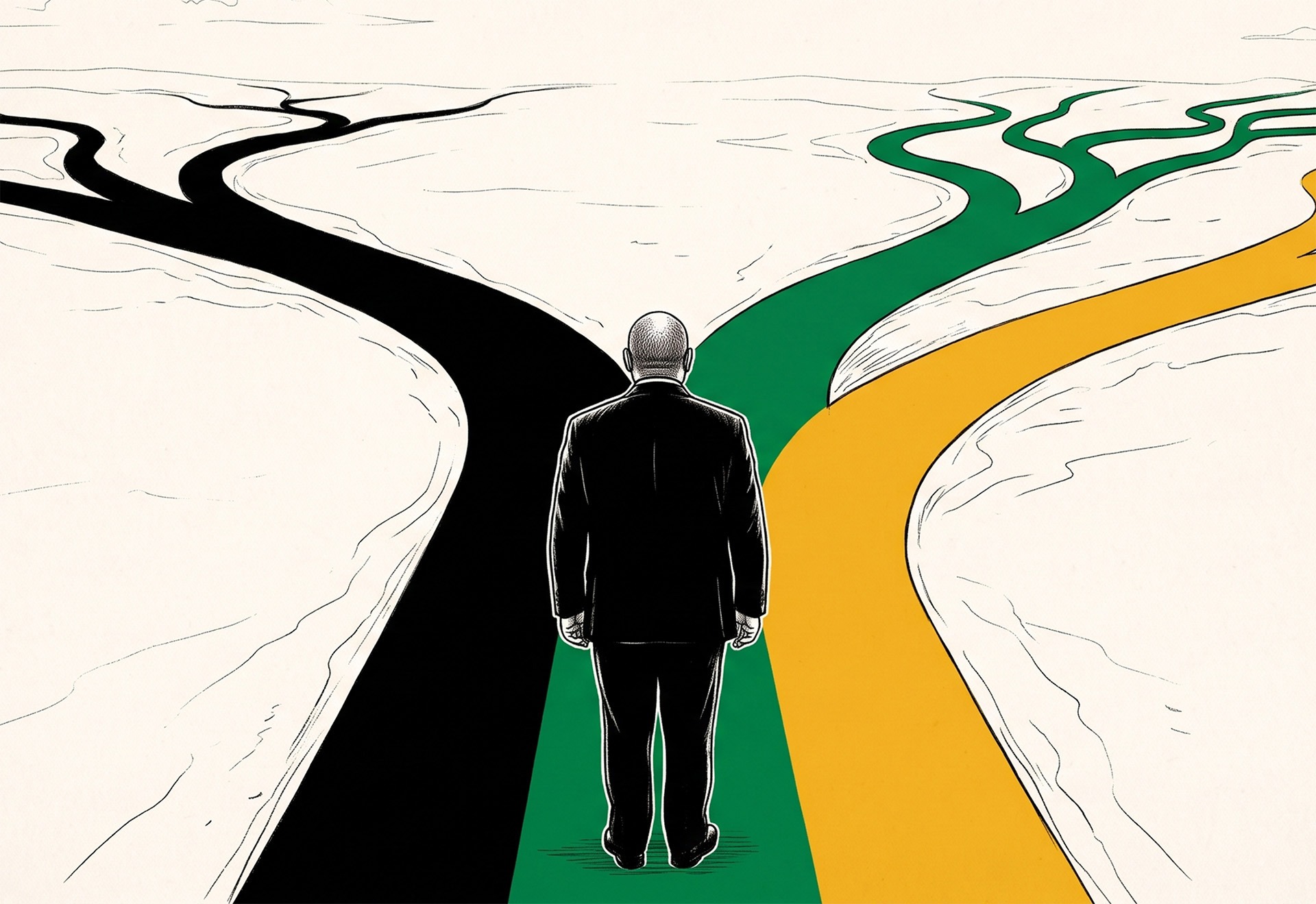
 Illustrative image: Generated with Google Gemini Flash Image 2.5
With results trickling, flowing and sometimes flooding through the Electoral Commission’s systems the real political debates are about to begin. The ANC may be about to enter a season of incredible division since decisions made in the next three weeks could tear it apart.
Never in the history of the post-1994 election has the ANC had to make so many political decisions with so many consequences for so many of its members in so many places.
But in the next three weeks it will have to decide which parties it will work with in six or seven metros and scores of councils around the country. It will be deciding which members will get jobs and positions and which will not.
All of that will send important signals about the future direction of the party in the 2029 national and provincial elections.
Who will decide?
It appears the first important decision of the post-election period has already been made by the ANC. The party has already indicated that coalition decisions will be taken by its national leadership, rather than by regions on a case-by-case basis.
While this will inevitably be frustrating for the regions and branches, it is probably the only possible decision. Otherwise different parts of the ANC will be going in different directions. The party could even give the impression of being a set of very different political factions with different interests and agendas.
This also raises the possibility that the ANC’s national leadership might be considering a set of principles to guide their negotiations.

For the moment, the party has not publicly expressed its negotiating strategy or even hinted if one exists.
However, the party could decide, for example, that it will always be prepared to work with the biggest party in any council. That would give it the strongest chance of being in government in the highest number of places.
But it would also mean it would probably be working with the DA in three Gauteng metros and the MK party in eThekwini.
Another approach, to look at each and every case on its own, could have other consequences.
It would give the impression of a party that has no serious agenda or direction. It would just be governing for the sake of governing, with the patronage that would bring.
While this might be in the interests of the regional leaders in the party, it might damage the ANC with votes in three years from now. Certainly, it would contribute to the process of fracturing that is already underway in the party.
All of this means that power is about to be concentrated in the ANC in a very important way. And, as in the aftermath of the 2024 national elections, a very small number of national officials will have the final say.
While the national executive committee would surely expect to be consulted, a meeting about the question of whether to work with, for example, the EFF, MK or the DA, is a meeting without end.
Even then, is it possible that those national officials could take a decision against the will of the party’s leader, President Cyril Ramaphosa? What happens if he and Deputy President Paul Mashatile disagree?
In 2024, it appears the top officials were able to make a decision fairly quickly. But that was a national election and there was really only one decision that had to be made – who to work with in the national government.

No matter how the final decisions are made, it is very likely that there will be difficult contestation, and perhaps even confrontation, with the ANC’s regions.
The national officials might want the Joburg ANC to work with the DA to retain what power they can in that metro. But the Joburg region may prefer to work with people they feel they know better, in the EFF and MK.
As a result the region could simply refuse to follow instructions from Luthuli House.
This happened in 2024 when it was clear that the national ANC wanted the party in Gauteng to work with the DA. But the premier, Panyaza Lesufi, refused to follow that decision and was able to form a government with other parties.
To make things worse...
This situation could be further inflamed by other strategic considerations.
For example, the national leadership could decide to work with the DA in the three Gauteng metros. But, as part of the deal, the ANC would support Helen Zille in Joburg, with the DA supporting Nkosindiphile Xhakaza as mayor in Ekurhuleni.
You could imagine how Dada Morero or Loyiso Masuku might feel in that situation.
The real problems might be cases where a former ANC mayor has to work under a mayor from another party.
Since the start of the national coalition, just two deputy ministers have publicly disagreed with ministers in their department. In both cases (Mondli Gungubele at Communications and Sihle Zikalala at Public Works and Infrastructure), it was an ANC deputy minister who had previously been minister in that department.
This might suggest it would be inherently risky to create such a situation in local government.
But it might be impossible to avoid.
A question of mayors
While the ANC’s national leadership has all of this on its plate, it also has to resolve who the ANC mayors in the metros it can govern will be.
The incredible contestation over these positions is obvious. And was completely revealed when the ANC called the media to an announcement at which it promised mayoral candidates would be revealed, only for the party to be forced into the embarrassment of admitting it hadn’t been able to finalise the process.
That might well be one of the reasons for the party’s strangely muted election campaign. It just hasn’t been able to mount a proper message in some metros, perhaps because none of the leaders involved could be sure they would benefit from it.
All of that tension has been bottled up. Now, it will be uncorked at a moment when that anger will be intensified if the ANC loses significant support in these elections.
In normal times, these elections would be the most significant political development of the year.
In fact, what they uncork in the ANC might become even more important. DM
Comments
Scroll down to load comments...