



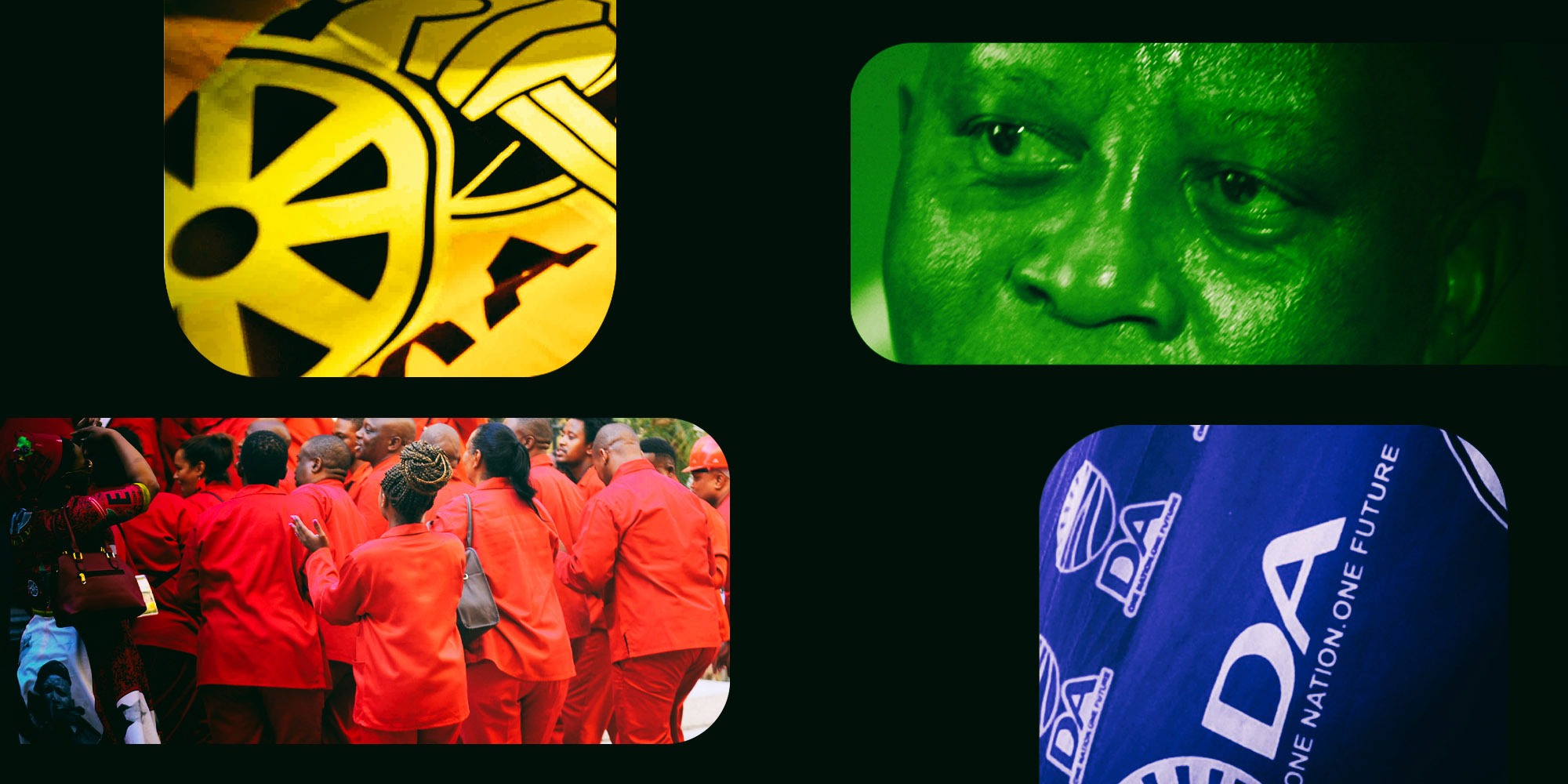
 Illustrative image: ANC flag. (Photo: Thulani Mbele / Gallo Images / Sowetan) | Herman Mashaba. (Photo: Sharon Seretlo / Gallo Images) | DA flag. (Photo: Laird Forbes / Gallo Images) | EFF members. (Photo: Brenton Geach / Gallo Images)
Johannesburg votes on Wednesday. Its second election – the high-stakes battle for a governing coalition – begins on Thursday.
Not a single major published poll gives any party an outright majority in Johannesburg. The DA is widely expected to finish first, but nobody looks likely to secure 136 of the 270 council seats alone. The 4 November election will determine how many councillors each party gets. The negotiations that follow will determine who governs.
That makes ActionSA leader Herman Mashaba the man to watch. But the ANC could ultimately decide who becomes mayor.
The timetable is tight. The first council meeting must be called within 14 days after the council is declared elected. The parties have little time to turn a fragmented vote into an administration for South Africa’s economic heartland.
In 2021, Johannesburg’s inaugural council sitting was postponed for almost a week because of a planned Rand Water shutdown. Even choosing a new government had to accommodate the city’s infrastructure problems.
Mashaba’s terms
Mashaba’s condition for working with the DA is blunt: “If DA wants to really work with ActionSA, they must remove Helen Zille.”
It is personal. Mashaba announced his resignation as mayor in October 2019 after Zille returned as chair of the DA’s federal council. The wound has not healed.

But it is also a strategy. Depending on the result, ActionSA could be the hinge between rival administrations. A DA-ActionSA pact may still need smaller parties to reach a majority. An ANC-MK-EFF-ActionSA combination offers another route.
Mashaba has form. In 2024, ActionSA helped remove the DA’s Cilliers Brink in Tshwane, then secured the mayoralty with ANC support. His willingness to work with former opponents makes it tempting to read the Zille demand as an opening bid.
That may be too easy.
Politicians routinely abandon positions they once presented as principles. But Mashaba is not a typical politician, and his arithmetic is often his own. The prospect of office will not necessarily soften his opposition to Zille.

The question is whether he wants power, power at any cost, or power only on his own terms. Flexibility over partners does not necessarily extend to who dictates the arrangement. He could accept concessions that give ActionSA influence, or decide that accepting Zille would cost him more than remaining outside government.
His veto is both a bargaining weapon and a potential trap. Its strength depends on the other parties needing him more than they need one another.
The numbers behind the demand
The polls describe substantially different bargaining positions.
The July Common Sense/Social Research Foundation survey put the DA on 42% and ActionSA on 10%. Together, they would cross the majority line. The eNCA/MarkData survey put them on 35% and 10.3%, leaving a considerable gap.
In one scenario, Mashaba can help deliver a majority through a single agreement. In the other, even reconciliation with Zille leaves more negotiating to do.
Poll percentages do not translate perfectly into council seats. But the distinction matters: ActionSA’s leverage comes from the seats it contributes and the alternatives available to everyone else.
A strong showing could make Mashaba indispensable to a DA-led administration. A weaker result could turn his demand into an obstacle the larger parties find a way around.
Smaller parties could complete an agreement, but each brings demands, rivalries and another potential point of failure. Getting Zille elected would be one negotiation. Keeping an administration together would be another.
The ANC holds the lock
The DA, which has ruled out agreements with the EFF and MK, has no easy options. Dropping its advertised mayoral candidate to satisfy a smaller partner would be an extraordinary concession. What was the point of building the campaign around her?
If Mashaba holds his line, the ANC could become the DA’s most practical coalition partner: the very party it has spent the campaign blaming for Johannesburg’s collapse.
The national Government of National Unity (GNU) provides a precedent, but no ready-made municipal agreement. An ANC–DA majority would offer a stronger numerical foundation than dependence on several small parties. It would not settle appointments, spending priorities or accountability.
For the ANC, the choice is uncomfortable. It could accept a junior role under a DA mayor and retain influence over the administration. Or it could assemble a government that keeps Zille out and gives it a better chance of retaining the mayoralty.
Regional leaders, provincial figures and Luthuli House will weigh those options differently. National leaders may favour reinforcing cooperation with the DA. Local and provincial figures may see enough potential partners to avoid serving under it.
A stronger ANC result would widen its options, especially if it brought an alternative coalition within reach without ActionSA.
That is the limit of Mashaba’s veto. If the DA and ANC reach an agreement, they could remove him from the equation. He would have held his line but lost the power to shape the outcome.
The Mashaba way, pursued at all costs, could leave Mashaba powerless.
Anyone but Zille
An ANC-led arrangement involving MK and the EFF is more than a remote possibility.
In the eNCA/MarkData poll, those parties together account for 46.2% – short of a majority, but close enough for smaller parties to matter. A stronger ANC performance could bring them closer. ActionSA could make the arrangement easier to assemble.
Mashaba’s rejection of Zille may therefore point towards a different government, rather than merely a bargaining tactic.
Tshwane shows ActionSA’s willingness to construct an alternative to DA rule. Johannesburg shows that parties can agree on whom to exclude before agreeing on how to govern.
In 2023, Al Jama-ah’s Kabelo Gwamanda became mayor despite his party’s tiny electoral footprint. Larger parties supplied the votes. Even the smallest parties matter when their candidate offers a compromise the bigger players can accept.

An arrangement to keep Zille out would still have to reconcile demands for positions, manage mistrust and make decisions affecting residents. It would also strain the GNU’s political argument, although it would not automatically end the national partnership.
What to watch
The Speaker election will provide the first serious indication of the numbers, although support for a Speaker does not guarantee support for a mayor or a lasting coalition.
Watch ActionSA’s language. A softer position on Zille suggests room for a DA-led agreement. Continued insistence on her removal makes the ANC route more significant.
Watch the ANC’s mandate, including whether it bargains across several municipalities. Johannesburg’s government may be shaped by what the parties want elsewhere.
And watch the smaller parties. The price of their seats may reveal more about the next administration than its launch statement.
Above all, distinguish the agreement that elects the mayor from the agreement that governs the city.
Mashaba may hold the key. The ANC could open the door to either side.
The danger is that they spend the fortnight deciding who gets Johannesburg, rather than how to govern it. DM
Sam Mkokeli is lead partner at Mkokeli Advisory, a public affairs firm.
Comments
Scroll down to load comments...