



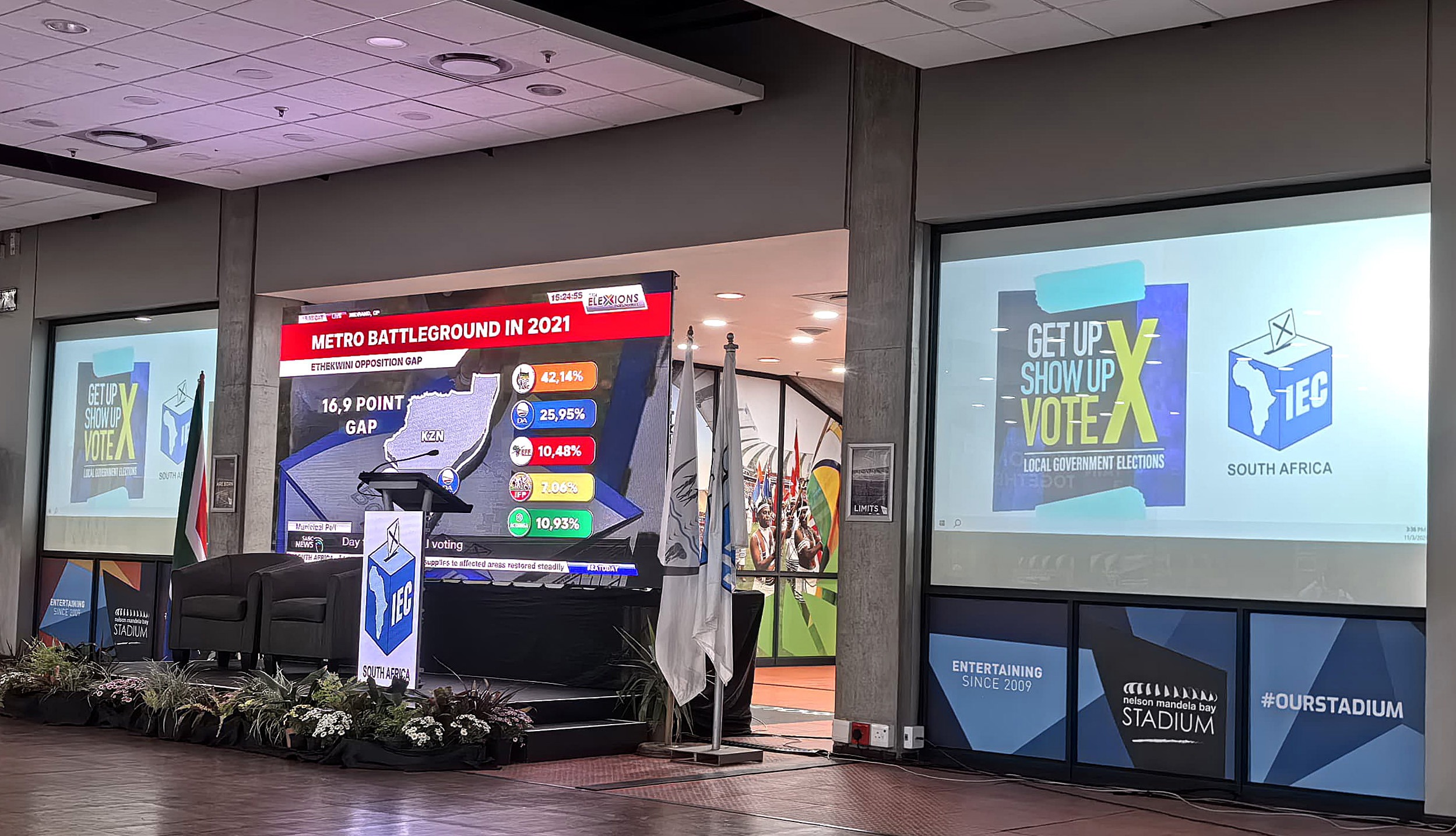
 The Independent Electoral Commission’s Local Government Election results centre for Nelson Mandela Bay metro is at the Nelson Mandela Bay Stadium. (Photo: Mthubanzi Mniki)
The race to govern Nelson Mandela Bay is unlikely to end with one party taking an outright majority, setting the stage for coalition negotiations in which even the smallest parties could wield considerable influence.
This is the view of political commentator Dr Ntsikelelo Breakfast, who was analysing the metro’s political landscape on the eve of Wednesday’s local government elections.
While the ANC and DA were the only parties to win ward seats in the 2021 elections, the new kids on the block and other smaller parties have been mobilising support in communities across Nelson Mandela Bay.
A total of 636,660 registered voters in Nelson Mandela Bay are expected to make their mark to elect ward councillors for the metro’s 60 wards and determine proportional representation seats for the 38 contesting political parties.
The ballot also features a mix of new, smaller and less familiar political parties including the Mayibuye Civic Movement, People’s Power, Democratic Movement, Organic Humanity Movement, Eighteen Twelve Movement and Service Delivery Party.
Breakfast said he had seen some curious polling conducted by organisations in Nelson Mandela Bay, with the findings indicating that the DA could receive the largest share of the vote.
“There have been some scientific findings that have been conveyed, that predict an interesting line-up [in] that the DA will receive the most votes followed by the ANC and the EFF.”

‘No outright winner’
While this could be the case, Breakfast believes that none of the three parties will secure an outright majority — more than 50% of the votes – “which means they will be forced to negotiate a power-sharing arrangement.”
Asked what the possible coalition formations could look like, Breakfast said it was difficult to predict formations because the arrangements depended on how the parties reached out to one another and the kind of agreements they struck.
“You must remember that the Constitution makes a provision of 14 days to constitute a government after the election results have been officially declared, which is a very short period. Anyone between the ANC and the DA could lead the coalition talks. It doesn’t mean that if the DA has the upper hand by having the most votes as per the predictions – it will be the party that leads the power-sharing discussions.”
Breakfast said a similar scenario had been seen in KwaZulu-Natal in 2024, where the uMkhonto Wesizwe party received about 45% of the votes, but remained in the opposition benches.
With several smaller parties expected to get council seats, Breakfast said the coalition talks would be like musical chairs.
“The participation of several smaller parties will definitely play a huge role in the coalition negotiations; they have the potential to be kingmakers.”
He said the coalition talks would be based on what benefits each of the involved parties wanted, “because they care for what’s in it for them. They will demand seats in the mayoral committee so they can lead certain portfolios. So it depends on how they outmanoeuvre each other.”
Special votes
The first day of special votes in the Bay ran smoothly. The Electoral Commission of South Africa’s (IEC’s) preliminary draft report for Nelson Mandela Bay indicates that a total of 32,955 special vote visits were recorded on Monday, 2 November 2026.
Nelson Mandela Bay Metro Electoral Officer Dumisani Mbebe said the priority was to ensure that every eligible voter was allowed to exercise their democratic right in a free, fair, transparent and peaceful environment.
“The smooth administration of the first day is an important step towards achieving this objective. We encourage all registered voters who have been approved for special votes to visit their designated voting stations and make use of this opportunity. Your vote matters, and every eligible voter should take responsibility for participating in our democracy,” said Mbebe.
Do’s, don’ts and must-haves
As the electorate heads to the city’s voting stations, here are some do’s and don’ts:
As tempting as it may be, photographing your marked ballot or taking a selfie inside the voting booth is prohibited. Police in Limpopo have already arrested a 32-year-old man for photographing his ballot.
If you’re voting in a metro such as Nelson Mandela Bay, you will receive two ballot papers: one to elect your ward councillor and another to choose the political party you want represented in the metro council. Unlike voters in local municipalities, you won’t receive a third district council ballot.
Bring your green barcoded ID book, smart ID card or valid Temporary Identity Certificate (TIC). You will need it to vote.
You must vote at the station where you are registered. Check your designated voting station before leaving home.
There is no need to rush. Read your ballot carefully and make one clear mark next to your preferred choice.
Everyone has the right to vote freely and privately. For some, this may be their first opportunity to vote, so be considerate and respectful. Avoid intimidation, political arguments or trying to influence someone else’s choice.
A queue at your voting station is possible, so allow yourself enough time. Follow the instructions of IEC officials and wait your turn. If you’re in the queue when voting closes, you must still be allowed to vote.
Political analyst Dr Ongama Mtimka said the incoming leadership of Nelson Mandela Bay would inherit a municipality whose administration was in tatters.
He said the municipality’s challenges extended beyond its financial difficulties, with low revenue collection reflecting both the municipality’s internal capacity constraints and the difficulties facing the local economy.

Voters withdraw support
Beyond the administrative challenges, Mtimka said South Africa’s broader political landscape was characterised by a failure among political parties to offer voters compelling alternatives.
He said the growing number of voters staying away from the polls should not necessarily be interpreted as indecision, but rather as a withdrawal of support from established political parties.
“The voters are decided. They decide to withdraw support from the major party, which has been the ANC for a long time, but are not finding compelling alternatives and therefore are not voting,” he said.
According to Mtimka, the failure to attract voters who had withdrawn their support from established political parties had contributed to an environment in which coalition governments had become an increasingly prominent feature of South African politics.
He said residents in the metro had shown a willingness to support localised political formations including independent candidates, civic movements and smaller parties.
Political parties needed to draw lessons from the country’s coalition experiences, particularly since coalition politics expanded after the 2016 local government elections.
Mtimka’s counsel
Mtimka said parties entering coalition agreements needed to set out clear terms for their partnerships, including the circumstances under which a party could withdraw.
He also called for coalition arrangements to be guided by longer-term principles, rather than agreements driven solely by immediate political interests.
These considerations were essential to improving how parties negotiated and managed coalition governments, Mtimka said. DM
Comments
Scroll down to load comments...