



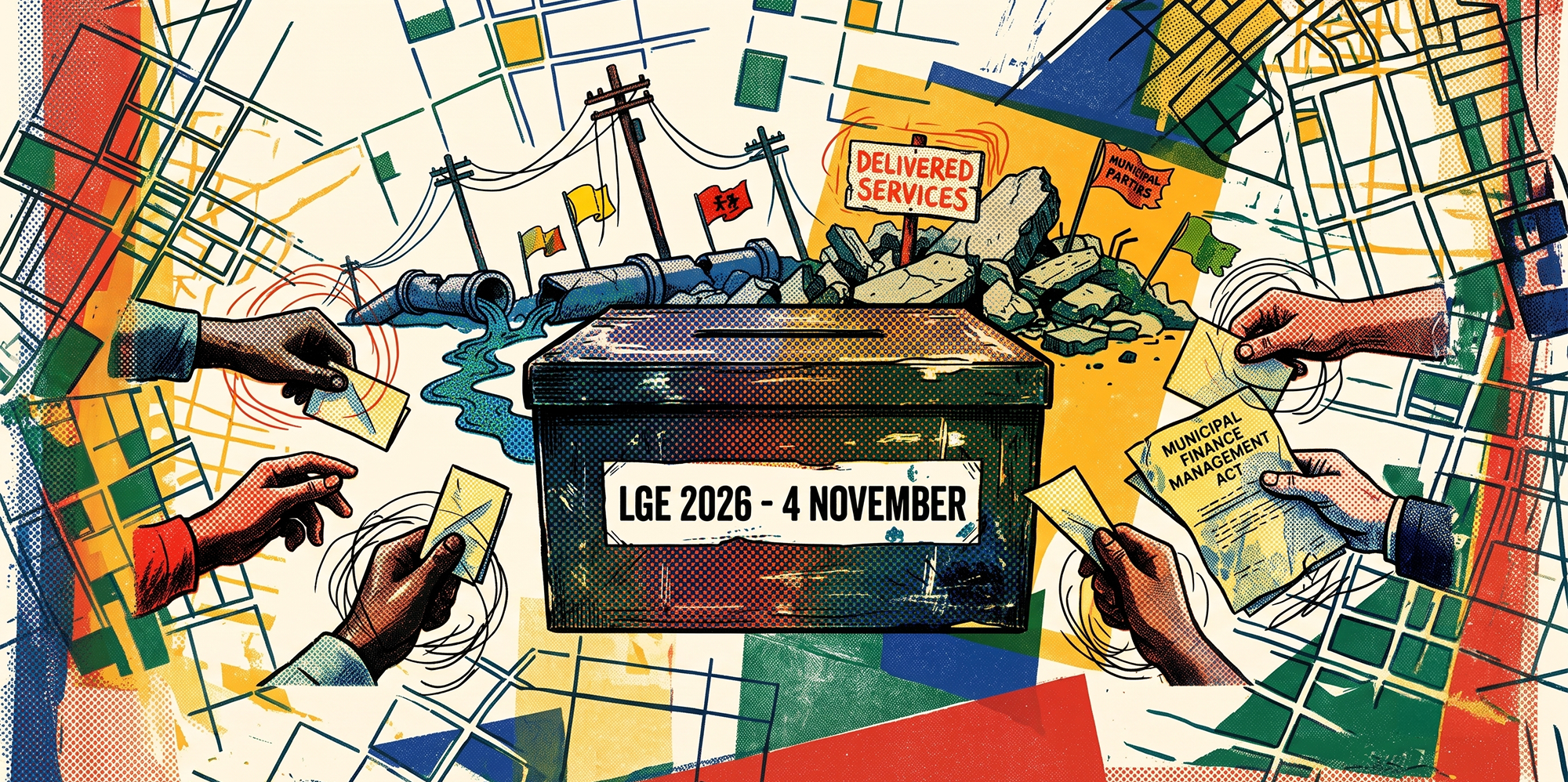
 The November 2026 elections leave accountability entirely up to the voter. (Graphic: Kevin Momberg)
Everything you need to know before you vote: what to bring, how to find your ward and voting station, what to do with your two or three ballot papers and how your votes translate into council seats. Want to know who’s running to lead each metro? You’ll find that here too.
Watch the video below for a step-by-step walk-through, or read on.
When is the 2026 local government election day?
South Africans will go to the polls in the local government elections on Wednesday, 4 November 2026. It is declared a public holiday, and voting stations will open from 7am to 9pm. If you are in the queue by 9pm, you will still be allowed to vote. If you have to work on election day, your employer should make arrangements for you to vote.
What are we voting for?
South Africa has three spheres of government.
National government makes laws and sets policy for the whole country.
Provinces run services such as schools, hospitals and clinics.
Local government runs your municipality and delivers local services, which can include water and sanitation, electricity, local roads and waste collection. Who provides what depends on where you live: some households buy electricity directly from Eskom, and outside the metros water is often run by the district municipality.
In the local government elections, you’re choosing who will run your municipality for the next five years.
Where can I vote?
You need to vote at the voting station serving the voting district in which you are registered to vote. You can find your voting station here. You can check your voter registration status here. You can also SMS your ID number to 32810. All SMSes are charged at R1. Contact the call centre at 0800 11 8000.
What do I need to bring?
You need one of the following: a green barcoded ID book, a smart ID card or a valid temporary identity certificate. A driver’s licence, passport or photo of your ID on your phone will not be accepted.
If you are not registered, you cannot vote in this election. The voters’ roll closed on 7 August 2026.
Can I vote if I’m in another town or province on election day?
You can only vote in person at the voting station where you are registered. Unlike national elections, municipal elections require physical residency within a local ward.
Who qualifies for a special vote?
According to the Electoral Commission of SA’s (IEC’s) criteria, people who are infirm, disabled or pregnant can request a home visit. Those who simply cannot make it to their voting station on election day vote at their station on the special voting days.
Special voting took place on Monday, 2 November and Tuesday, 3 November 2026. Applications closed on 12 October.
How does the ballot system work?
If you live in a metro, you will get two ballots. One for a ward councillor to represent your area and one for a party, which fills the rest of the council’s seats. If you live outside a metro, you may also get a third ballot for your district council.
Once the new council is elected, councillors vote for a mayor and a speaker. If no party has a majority, parties must form a coalition to elect them.
Ward councillor: You vote for a person to represent your ward on local issues. Candidates can belong to a party or stand as independents.
PR (proportional representation) councillor: You vote for a party, not a person. PR councillors don’t represent a specific area. Parties fill these seats from their lists, and seats are shared out so that each party’s total number of councillors roughly reflects its share of the vote.
District council (outside metros only): A second party ballot, this time for your district municipality, which runs some services across several local municipalities.
Most votes win the ward. A ward candidate doesn’t need more than 50% of the vote. They need more votes than anyone else. This is called first past the post.
You can split your vote. You can vote for one party’s ward candidate and a different party on your PR ballot, or the same party on both.
Ward and PR councillors are equal once elected. They’re chosen differently, but their votes on council decisions count the same.
District councils outside the metros. your district ballot decides a portion of the district council’s seats. The rest are filled by councillors sent from the local councils in that district. District municipalities can be responsible for things such as regional roads, bulk water, waste disposal and firefighting, depending on how responsibilities are divided.
Why is the Freedom Front Plus first? The IEC holds a random draw before each election to decide which party appears first on the ballot. This time it was the Freedom Front Plus, listed by its Afrikaans name, Vryheidsfront Plus, wherever it is contesting. The order then runs alphabetically from V and wraps around to A. Where many parties are contesting, ballots run to two columns. Cape Town has 55 parties on its PR ballot.
How do votes become council seats?
Roughly half the seats on a municipal council go to ward councillors and half to PR councillors from party lists. The PR seats are used to make the overall council roughly reflect each party’s share of the vote.
To work out each party’s share, the IEC adds together the votes for the party on the PR ballot and the votes for its ward candidates. This means your ward vote also counts towards a party’s overall share of the council.
Take a simplified council with 10 seats: five ward seats and five PR seats. If Party A gets 60% of the combined vote, it is entitled to six seats. If it has already won four wards, it gets two PR seats to make up its six, not another six on top of the wards.
The real formula is more complicated, with quotas, remainders and provisions for independent ward councillors, but this is the basic principle.
How to find your ward number
To find your ward, check where you are registered to vote on the IEC website using your ID number. This will show your ward and voting station for election day.
You can also use the IEC’s Voting Station Finder. Type in your address and your voting station details will pop up along with your ward number.
If the ward shown for your address is different from the one where you are registered, you must vote at your registered voting station. The voters’ roll closed on 7 August 2026.
Who is my ward councillor?
To find your current ward councillor, use the IEC’s Who Is My Ward Councillor tool here. Enter your ID number and it will show your councillor and their contact details. SMS your ID number to 32245. Each SMS costs R1.
The councillor you find now was elected in 2021 and serves until the new council is sworn in after the November elections.
You can also use this ward councillor tool here. Enter your ward number to find your current councillor and their contact details.
What to look for in a ward councillor
A ward councillor serves as a vital bridge in service delivery between the municipal council and the local community.
According to Professor Jaap de Visser, South African Research Chair in Multilevel Government, Law and Development at the Dullah Omar Institute at the University of the Western Cape, voters should look beyond political ideologies and assess whether individual councillors delivered on their promises, met service delivery demands and didn’t steal from the public purse.
De Visser made the comments in a 2021 Daily Maverick interview, when he was director of the institute.
Rules in the voting station
Make one clear cross on each ballot paper. If your mark could be read as a vote for more than one party or candidate, your vote will be discarded.
If you make a mistake, ask the presiding officer for a replacement ballot before you put it in the box.
If you can’t read the ballot, you can ask an IEC official for help.
No selfies in the voting booth, even if your ballot isn’t visible.
You may wear party T-shirts, caps or other branded clothing, but you may not campaign inside the voting station.
Parties may campaign outside the voting station, as long as they stay outside the boundary marked by the IEC and don’t obstruct or intimidate voters.
Who’s in the running for mayor across SA’s metros?
In this election, you’re voting for councillors. Once elected, the councillors choose a mayor to lead the municipality.
Here is a list of mayoral contenders in Johannesburg, Tshwane, eThekwini, Cape Town and other metros:
Johannesburg:
The ANC will not name its mayoral candidate before the election.
IFP: Mlungisi Mabaso
MK Party: Bongani Baloyi
RISE Mzansi: Lukhona Mnguni
Bosa: Nobuntu Hlazo-Webster
Al Jama-ah: Shireen Ebrahim
APC: Mo-Afrika Mandla Mokoena
Tshwane:
The ANC will not name its mayoral candidate before the election.
ActionSA: Dr Nasiphi Moya
EFF: Omphile Maotwe
MK Party: Nkele Annie Matime
IFP: Douglas Ziyanda Zwane
FF+: Willie Spies
Ekurhuleni:
The ANC will not name its mayoral candidate before the election.
DA: Khathutshelo Rasilingwane
MK Party: Thulani Shongwe
ActionSA: Xolani Khumalo
EFF: Nthabiseng Tshivhenga
IFP: Desmond Mchunu
eThekwini:
The ANC will not name its mayoral candidate before the election.
ActionSA: Zwakele Mncwango
DA: Haniff Hoosen
EFF: Hlengiwe Mkhaliphi
IFP: Mkhuleko Hlengwa
MK Party: Zuma swapped the MK Party’s eThekwini mayoral candidate on 10 September, replacing Zandile Hlophe-Mkhwanazi with Apostle Mxolisi Phakathi.
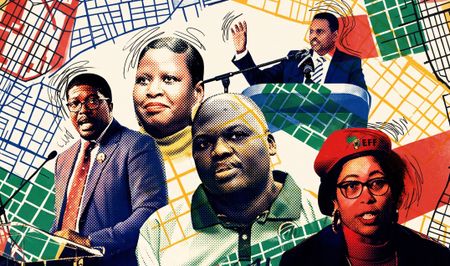
Cape Town:
The ANC will not name its mayoral candidate before the election.
DA: Geordin Hill-Lewis
ActionSA: Dereleen James
PA: Cheslyn Daniels
EFF: Nontando Nolutshungu
Good + Rise Mzansi: Brett Herron runs for both parties together
Bosa: Roger Solomons
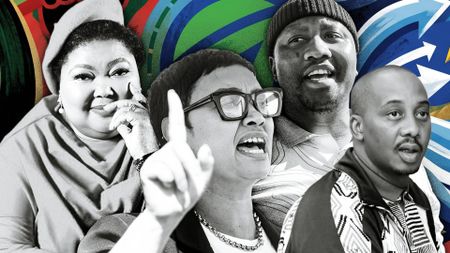
Nelson Mandela Bay:
The ANC will not name its mayoral candidate before the election.
DA: Retief Odendaal
EFF: Sinawo Thambo
MK Party: Mvuleni Mapu
Mangaung:
The ANC is back on Mangaung’s ballot after the Constitutional Court overturned an Electoral Court ruling on 15 October. The ANC will not name its mayoral candidate before the election.
DA: Werner Pretorius
MK Party: Mapaseka Mothibi
EFF: Sam Matiase
Buffalo City:
The ANC will not name its mayoral candidate before the election.
EFF: Mkhululi (Leonard) Dlevu
DA: The DA has announced ward candidates, but it has not selected a mayoral candidate.
MK Party: Mzwandile Vaaiboom
UDM: Nqabayomzi Kwankwa
Have a question about the election?
Ask about political parties, what’s on your ballot, or how to escalate an unresolved service delivery issue. Get a plain-language answer, based on verified sources, with a practical next step. Ask our election guide here.
This article was first published on 1 October 2026 and updated on 3 November 2026. DM
Comments
Scroll down to load comments...