



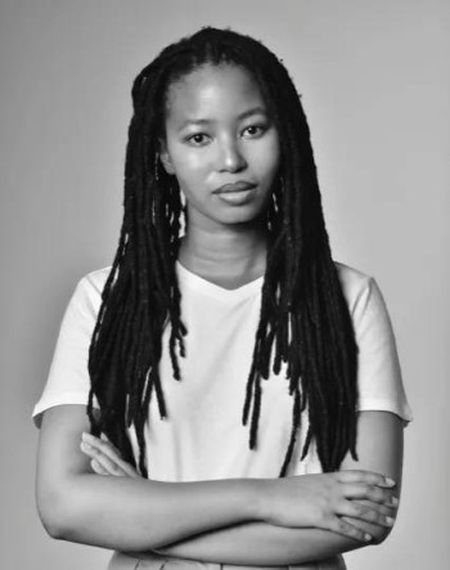
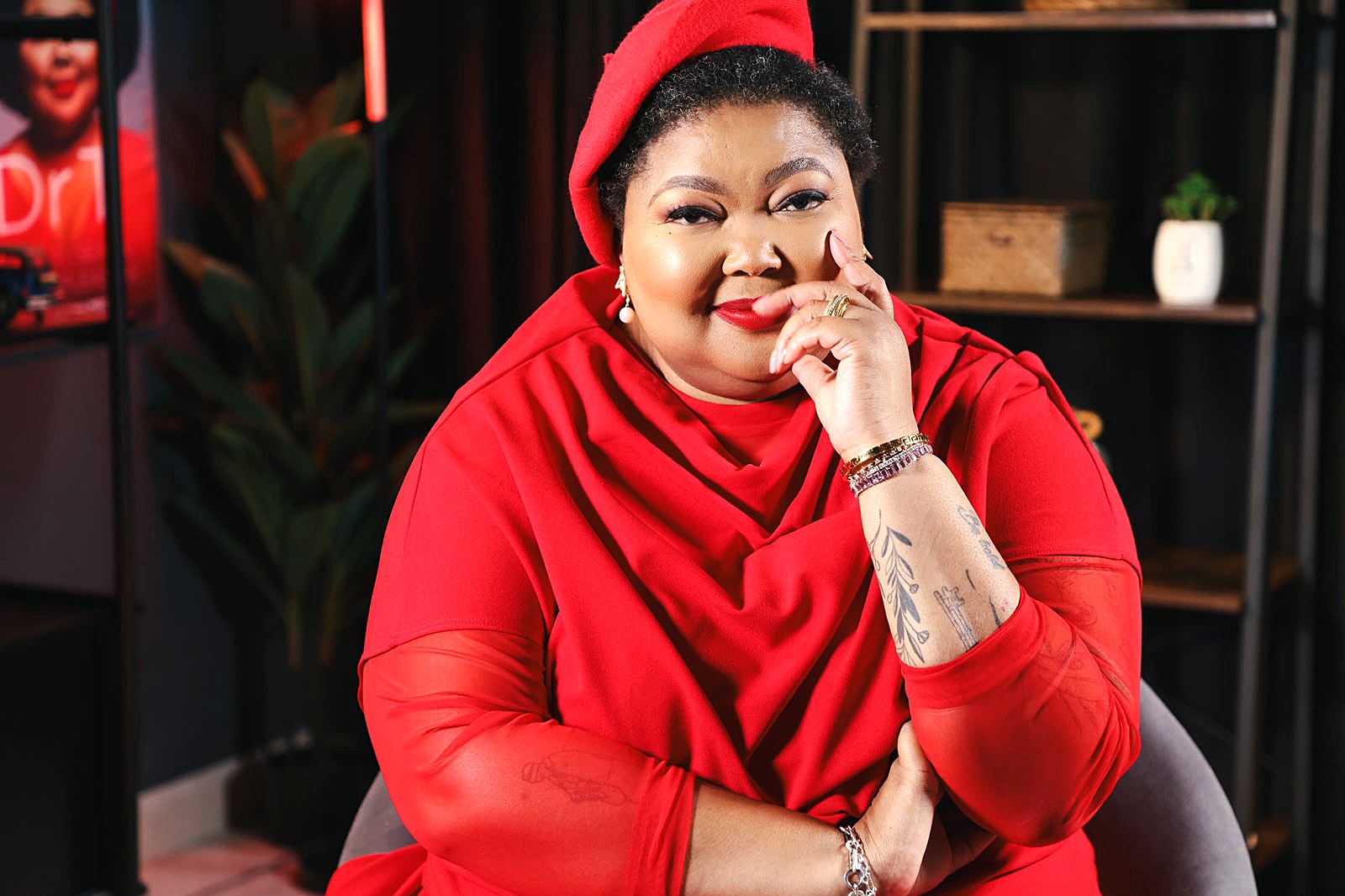
 Dr Tlaleng Mofokeng at the launch of her book Dr T: A Guide to Sexual Health and Pleasure in August 2019. (Photo: Dr Tlaleng Mofokeng)
The EFF’s mayoral candidate for Johannesburg, clinician, author and former UN special rapporteur for the right to health, Dr Tlaleng Mofokeng, is gunning for a 51% majority in the hopes of avoiding a political coalition.
Mofokeng is a fresh choice in a mayoral race dominated by seasoned politicians like the DA’s Helen Zille and ActionSA’s Herman Mashaba. Over the past 20 years, Mofokeng has built a prominent platform advocating for universal health access, HIV care, reproductive healthcare and youth-friendly health services. She served as the commissioner for Gender Equity and was on the boards of local and international health organisations including the Soul City Institute for Social Justice, the Safe Abortion Action Fund and the Global Advisory Board for Sexual Health and Wellbeing.
In 2020, she gained a seat on an international governance stage when the United Nations appointed her as special rapporteur on the right of everyone to the enjoyment of the highest attainable standard of physical and mental health, where she platformed a human-rights-based approach to healthcare.
Now she’s turned her attention to the city where she began her career to bring this approach to local governance. Mofokeng was announced as the EFF’s Johannesburg mayoral candidate by party leader Julius Malema at the party’s 13th birthday celebration in Thohoyandou.
Throughout her campaign, she has consulted with key stakeholders including residents, members of the taxi industry, informal traders and small business owners. All have shaped her core human-rights-based approach, which includes moving away from politically unstable coalitions, eliminating corruption, consolidating municipal services into a one-stop shop where residents can resolve all their billing issues, and regular consultations with residents and key stakeholders.
Daily Maverick sat down with Dr Mofokeng to discuss her policy proposals in more detail.
/file/attachments/orphans/DrTlalengMofokeng1_920212.jpg "Author, clinician, and former UN Special Rappoteur on Health, Dr Tlaleng Mofokeng, is formally contesting the Johannesburg mayoral race in the upcoming local government elections. Photo: Supplied / Dr Tlaleng Mofokeng)")
Q: You have a great deal of experience in global health and little practical experience in governance. What makes you qualified for this role?
A: My career has been in politics and policy and global governance in health. And so, the idea of governance, policy-making, negotiating and the kind of skill sets required to then be a leader in a political party is something that I possess.
In South Africa, my history has been one, even in civil society, as a young doctor, involved with the Department of Social Development in their population unit, when they used to hold those consultations to look at their frameworks for adolescent health, their frameworks on the Trace and Termination of Pregnancy Act, relooking at policy that enables more access to sexual and reproductive health rights to people with disabilities, LGBT+ populations. Then I was appointed as a commissioner at the Commission for Gender Equality at the appointment of the current President. And so, I’ve also served in a Chapter Nine institution; there I was leading various programmes in health, in social development, in gender, LGBTQ+ issues and disability rights.
My work then going global was a natural step in my career development. The exposure to the multilateral system and diplomacy was ... another point of interest. Also, as someone who has been a resource mobiliser for many NGOs, as I’ve been a chair for international NGOs who do a lot of sub-granting. So, I understand the issue of financial granting and then grant-making, but also in the country, also being a chair for other important boards as well. So, understanding how governments and collaborations ... and partnerships can look like and what works and actually what doesn’t work. And I think that variety of experience is what Johannesburg actually needs at the moment.
Q: What are some of the key governance issues you’ve identified ahead of this election?
A: As a Joburger for 18 years, I know the frustrations that I have as a resident of the city. There isn’t enough stability in terms of the executive leadership. There are too many changes, and people are resigning because of corruption; political parties are embattled in coalitions that are unsustainable and that don’t last.
So the inherent difficulty for us will be that we are inheriting a city that has a corporate culture of corruption, where corruption has been normalised at every single service point, whether you are trying to get your electricity not cut off, whether you are an informal trader trying to support your family, whether you are a nurse trying to do her job, and there’s not enough commodities for you to do that. There’s a lot we need to deal with today, like inherited financial mismanagement that we have to extract ourselves out of.
Q: What are some of the reforms you will make to public services?
A: [The EFF] already made major advances with 24-hour clinics, the maternal, maternity and obstetric units in the City of Johannesburg. So we want to expand access to comprehensive primary healthcare. We want to support the entire health system by being a city that actually supports and puts at its core health services that are accessible, that are acceptable, that, of course, people can access depending on what language they speak. If a person is blind or deaf who needs particular assistance with Braille or translation or sign language, those cannot be what impedes people accessing services.
So we are going to be very intentional. Introduction of a digital patient management system is ... key. [For instance,] I may be living in Orange Farm, but I’m working in Sandton or Midrand, and the lunch hour I have is the only time every month where I can go for my repeat medicine for my chronic treatment. Why can’t the nurses in Midrand assist me in that lunch hour, even though I’m a resident in Orange Farm?
We want to ensure that the young people who are emerging artists, and the already established artists, are supported ... in gaining the required skills. They have the required infrastructure through our libraries, the sports facilities that we have, the recreational centres, the stadiums, to be able to express themselves and also use these community facilities with a focus on townships and informal settlements.
Q: The EFF has indicated that unemployed people and Sassa beneficiaries should be given free basic services. How will you balance this against Johannesburg’s escalating debt?
A: One of our commitments as the EFF is that we have to write off historical debt that is owed by indigent households and introduce debt rehabilitation programmes to prevent accumulation. There’s different types of revenue ... collected by the city as part of what is needed because they give particular services, but those services can’t not take into account which tariff level a person falls into.
There are people who are going to default on their accounts because there’s a lack of thinking about the inequality even between particular communities. Even in Sandton, the students attending Emeris or Boston College are being charged the same tariff as a Sandton household that’s worth R4-million. There’s an unfairness there.
If we are charging people for services, why do we not then ask ourselves: why do we ... lose so much to profit-making entities? So we want an integration as the EFF, a one-stop shop, where if you are a Sassa grant recipient, for example, your electricity, your water must already be allocated for you, taking that into consideration. And we must be able to recover tariffs and charges from high consumers.
The city currently and politically and historically does not see itself as a collaborator with its citizens. It sees itself first and foremost as an enforcer and a punisher. And we need to remove that from service delivery.
Q: South Africa has reached record unemployment. How would you address this on a municipal level?
A: To fix that, you insource people, you give them permanent employment that has actual tangible benefits: medical aid, sick leave, family leave, all of the ways that we know that labour protections work in this country. So that’s one thing that we can immediately change and something that the mayor has the power to enforce.
And we have to use the city’s own supply chains to actually plug people in, for example, black-owned businesses, women-led businesses, LGBTQ-led and disability-led businesses. Assisting those people, not as a matter of charity, but understanding the historical context that we come from that had a policy that was deliberately and intentionally excluding them.
We have internships, we have skills development that is linked, one, to our service delivery core work for the city, then are linked to the second thing that is a big topic in Johannesburg, our infrastructure.
Q: Speaking of infrastructure, Johannesburg has a massive infrastructure maintenance backlog. How would you address this?
A: As mayor, I will embark on a massive maintenance project for the city that will require collaborations, partnerships, and a huge amount of resource mobilisation. The water and electricity have the same kind of approach. DM
The local government elections are scheduled for 4 November .
Comments
Scroll down to load comments...