




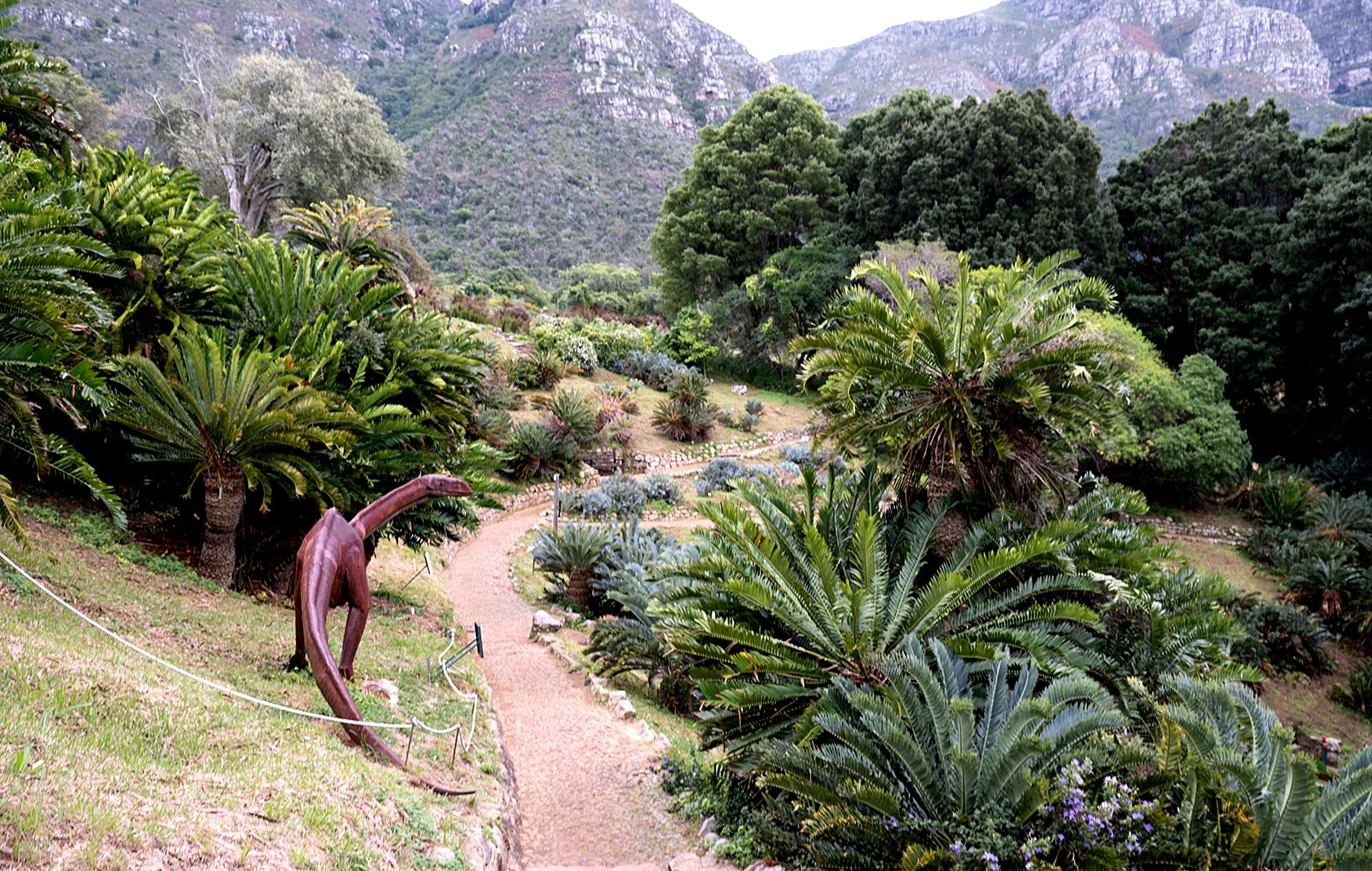
 How will SANBI prevent failures at older parts of Kirstenbosch Gardens such as these established cycads? (Photo: Don Pinnock)
After writing about the deterioration of Kirstenbosch Botanical Gardens, we published a list of questions and possible solutions. As we expected, no answers were forthcoming from the South African National Biodiversity Institute (Sanbi) other than an email requesting alterations and retractions. But, following our articles [here & here] and a probe by Carte Blanche, alarm bells began ringing.
What followed will have come as an unwelcome surprise to Sanbi, which administers the gardens.
Acting on a letter from a concerned Cape Town resident to Parliament’s Portfolio Committee on Forestry, Fisheries and Environment, it was hauled before Parliament to answer tough questions from well-informed MPs.
The committee subsequently required Sanbi to provide written responses by 1 September.
The trigger
Our investigation was triggered by plant specialist and long-time volunteer James Deacon. In a widely shared Facebook post, he wrote that Kirstenbosch was no longer a place that brought him joy, but “pain and sadness”.
Walking through the nursery with us, he said, he saw “neglect, decay and death”. Collections built over decades were slowly dying, the Protea collection was less than a third of what it had been and only a fraction of the Ericas remained.
/file/attachments/orphans/KirstenboschParly-5_810776.jpg "Confiscated succulents lack space, protection and specialist care. (Photo: Don Pinnock)")
Great plantsmen and women, he told us, had left before they should have because working there had become unpleasant and because procurement made their jobs almost impossible. He said Kirstenbosch no longer had a Protea or Erica expert, that staff morale was low and that the garden could not reliably produce durable metal labels for plants.
He said living collections were in decline and many of the thousands of valuable and rare succulents confiscated from plant poachers were deteriorating.
MPs wanted answers
On Tuesday, 11 August, members of the Portfolio Committee used question time to grill Sanbi on a range of concerning issues.
Aware of intense public scrutiny, it put on a brave face, with Sanbi’s board chairperson, Dr Mmaphaka Tau, conceding that public interest in the garden was “both understandable and legitimate”.
In its proposed programme, general manager of National Botanical Gardens, Christopher Willis, wanted MPs to realise that the gardens, formed in 1913, remain internationally recognised with high levels of arboretum accreditation.
However, he said, a further R150-million was needed for outstanding work which included nursery upgrades, completion of its seed bank, signage, irrigation and building repairs.
Following media and other criticism, he said the administration had created Kirstenbosch Operation Excellence to fill critical vacancies, restore horticultural expertise with the help of retired horticulturalists, fast-track procurement, upgrade nurseries and establish monitoring and evaluation.
/file/attachments/orphans/KirstenboschParlyB_762226.jpg "Labels without plants or plants without labels. (Photo: Don Pinnock)")
Evidence, not a ‘management plan’
But DA MP Andrew de Blocq made clear that Parliament wanted evidence rather than another management plan.
“Kirstenbosch is a place that I basically grew up in. I know it very, very well, I care for it very deeply, and I want to see it succeed,” he said. He had visited several times this year and believed it remained “a wonderful place for tourists to visit”.
But he challenged Sanbi’s description of a range of initiatives, saying that his observations suggested that they were no longer operating, or were operating at a substantially reduced level. The plant fair had not been held since 2023, golf-cart tours had stopped, seed transfers had largely ceased, the public seed room had closed, seeds were no longer distributed to Botanical Society members and Kirstenbosch no longer produced its Index Seminum, the catalogue used to exchange seed with other botanical gardens.
He also challenged Sanbi’s account of plant records, labels and pest control, saying that horticulturists described the accession system as “clumsy and uncoordinated” and procurement had failed to supply appropriate biological controls.
About funds
The money question was unavoidable. Kirstenbosch drew about 788,000 visitors and generated roughly R142-million in the latest financial year, most of it from admission fees, leading de Blocq to ask how much returned to the garden under Sanbi’s centralised, cross-subsidising model. “You cannot kill the golden goose because it’ll stop laying eggs,” he said.
The garden’s conservation machinery drew sharper questions – de Blocq asked why the nursery-manager post had been vacant for eight years, a soil steam steriliser had failed for 10, heating benches, fogging and misting systems for seven, and nursery climate control for eight.
He asked about claims that conservation stock beds had become overgrown and critically endangered plants had died, while only a small percentage of the former Erica collection remained.
/file/attachments/orphans/KirstenboschParly-2_742740.jpg "Kirstenbosch – beautiful but in need of urgent help. (Photo: Don Pinnock)")
Earlier warnings echoed
These questions closely echoed warnings from James Deacon and other plant specialists we interviewed for earlier reports: that plants cannot wait for slow procurement, that provenance is lost when records and labels fail and that an extinct-in-the-wild species can disappear entirely if its last cultivated material is neglected.
Willis replied that a contractor had been appointed for nursery upgrades, a Protea specialist would start in September and the long-vacant nursery-manager position was being prioritised.
On the confiscated succulents crowding Kirstenbosch and other gardens, de Blocq was especially forceful. Sanbi put the total at nearly 1.3 million plants and conceded that the influx had strained space, staff and operations. Its national response strategy requires R70-million over five years and, a Sanbi official told MPs, “remains largely unfunded”.
Some estimates suggested only about 100,000 plants remained alive after more than a million accessions, added de Blocq. They were being kept in suboptimal conditions, he said, without sufficient separation to prevent cross-pollination and the loss of genetic provenance.
“On the succulents, is really where my heart starts to break,” he said, “They simply don’t have the space.” He added that the confiscated plant collection is currently at risk following the dismissal of key staff.
ANC MP Nkhensani Bilankulu asked about the funding gap for the succulent response, while committee member Leseletsi Mokoena asked what immediate funding the department and Treasury would provide.
Sanbi replied that it was approaching donors and had submitted a proposal linked to the Global Environment Facility, but the fiscus had largely been unable to fund the strategy.
Other MPs broadened the pressure. EFF’s Dr Lilian Managa asked when vacant posts would be filled and how infrastructure would be maintained across its full life cycle. PA Member Sheila Peters demanded measurable evidence to confirm or refute a five-year decline in Protea and Erica collections, as well as figures showing changes in horticultural staffing, vacancies and budgets.
/file/attachments/orphans/KirstenboschParly-6_510910.jpg "Thousands of confiscated succulents are dying. (Photo: Don Pinnock)")
The BotSoc problem
Returning to the damaged relationship with volunteers and the Botanical Society, de Blocq asked how Sanbi would rebuild the capacity and public goodwill lost when access arrangements changed under instruction from former Minister Barbara Creecy.
Sanbi replied that it had 102 Kirstenbosch volunteers and was revising its policy to offer benefits benchmarked internationally.
One potentially serious financial question remained unanswered – de Blocq asked Sanbi what had happened to a large ring-fenced conservation account, citing information he had received suggesting that funds had been used to pay salaries: “Where did that money go and who authorised the draining of the conservation account?”
The focus now must be on implementation, he said. “Parliament must continue to hold Sanbi to account for delivering the improvements it has identified, while ensuring that Kirstenbosch receives the support it needs to remain one of South Africa’s flagship botanical and conservation institutions.”
At the end of the hearing, he noted that Sanbi had not answered the conservation account question or his equipment-specific questions, and requested written replies. The committee set 1 September as the deadline.
Sanbi acknowledged that there were problems. But Parliament wants proof that the rescue has begun.
The list of comments by MPs
Claimed initiatives are inactive or overstated.
Plant fair and golf-cart tours stopped.
Seed exchange, public distribution and catalogue ceased.
Plant records are poorly coordinated; signage outsourced.
Procurement blocks safer pest control.
How much Kirstenbosch revenue is reinvested?
How will volunteer trust be restored?
Who drained the ring-fenced conservation fund, and why?
Why are key posts and nursery systems long vacant/broken?
Composting and conservation beds are neglected.
Protea/Erica collections have severely declined; rare species died.
Confiscated succulents lack space, protection and specialist care.
Why no succulent specialist?
How will Sanbi fund its R65–68.6-million Kirstenbosch priorities?
How will it address the R741-million infrastructure backlog?
Which projects will be deferred, with what safety/conservation risks?
What are the project priorities, costs, timelines and delay consequences?
How will assets be maintained over their full life?
What share funds maintenance versus new construction?
Are projects resilient to drought, floods, erosion, heat and fire?
How will Sanbi prevent failures at older gardens?
How will income be diversified against weather and tourism losses?
What funding supports the poached-succulent strategy?
What progress, outstanding work and deadlines exist?
Will community jobs become meaningful and long-term?
How have staffing and budgets affected garden standards? DM


Comments
Scroll down to load comments...