




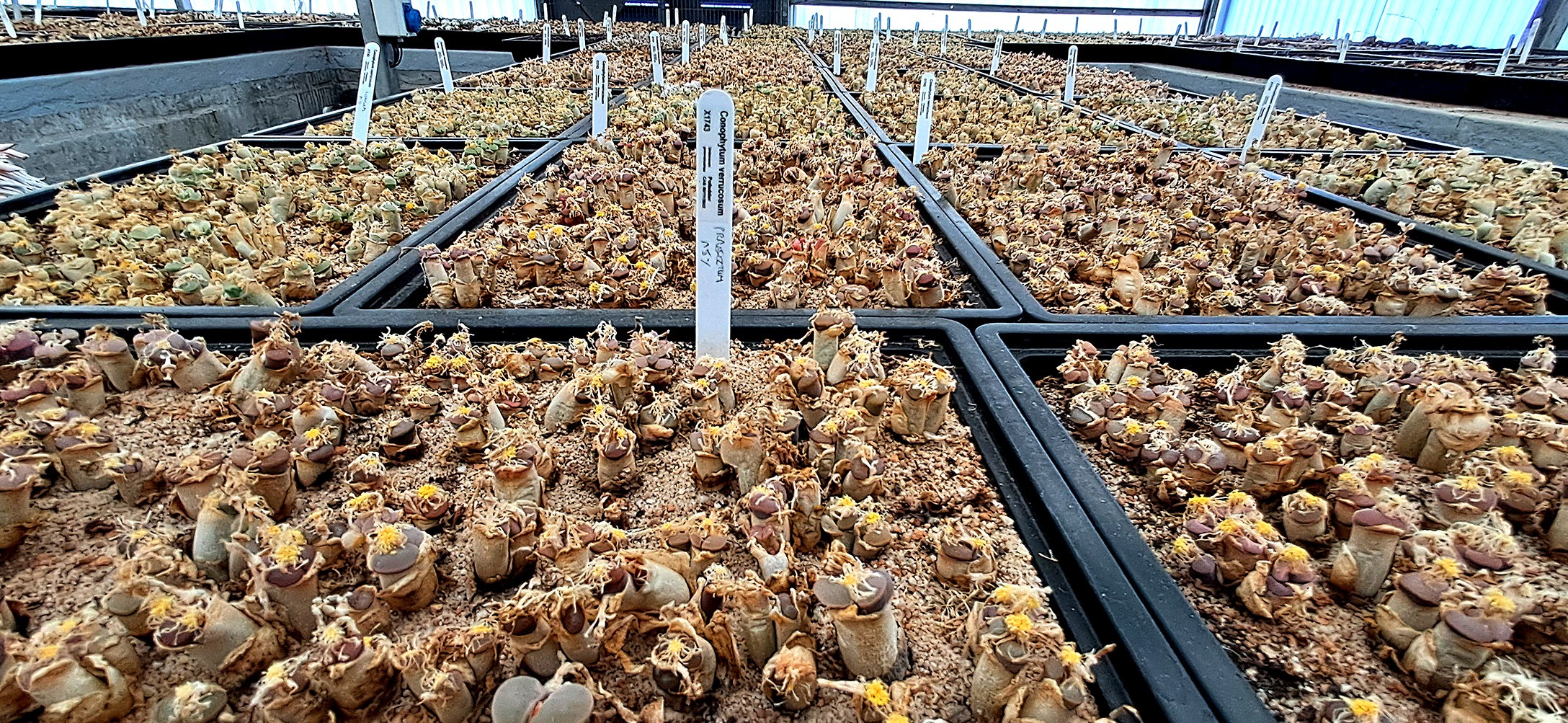
 Poaching has become a crowding problem, a record-keeping problem, a disease problem and a staffing problem. (Photo: Don Pinnock)
Behind the lush lawns and beautiful gardens on the slopes of Devil’s Peak, Kirstenbosch’s extensive greenhouses are drowning in plants confiscated from poachers.
These are not ordinary garden plants. Many are rare, slow-growing dryland succulents, dug out of fragile landscapes and fed into an international trade driven by collectors, syndicates and online demand.
One informed estimate puts the number of confiscated plants at Kirstenbosch as high as 500,000, though nobody seems able to give a precise figure. Even that, plant specialists say, is only a fraction of the number of valuable and rare wild plants being stripped from South African landscapes and exported illegally to foreign markets.
An experienced and senior horticulturist with specialised knowledge of these unique plants repeatedly called on to identify seized plants is now caught up in a complicated court case with two anti-poaching police officers.
The matter has not been decided by a court, and the charges must be tested there. But the fact that people who were critical to succulent conservation and anti-poaching work have been removed from the system, and fired before the outcome, has sent alarm through parts of the plant conservation world. Is there something we’re not seeing?
That’s the backstory. But the place to begin is not in court. It is in the glasshouses.
I was introduced to plant specialist James Deacon after his explosive Facebook post about the state of Kirstenbosch National Botanical Garden. He had been involved with the garden for 19 years, first as a volunteer, then as a student, an intern and later someone who helped with plant collections. Kirstenbosch, he wrote, no longer brought him joy, but pain and sadness.
/file/attachments/orphans/Poachedsucculants-7_346993.jpg "Confiscated dryland succulents in bad shape. (Photo: Don Pinnock)")
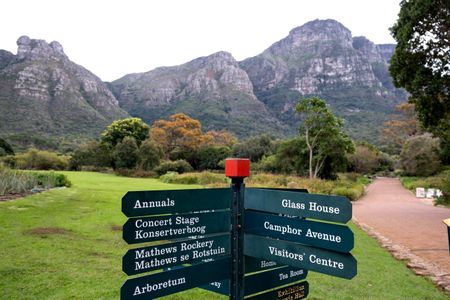
When we met, he took me behind the public face of Kirstenbosch, away from the lawns, the mountain views, the restaurant and the visitors taking photographs, into the greenhouses where the botanical garden’s conservation work should be most visible.
Walking with us was botanist Zoë Poulsen. Both spoke about plants with the intimacy of people who know them not as display items but as living records: where they came from, who collected them, what form or clone they represent, whether they can still be used for conservation, and what is lost if they die.
/file/attachments/orphans/Poachedsucculants-10_178771.jpg "James Deacon looking at a lithop. (Photo: Supplied)")
At first we were not looking at succulents, but Ericas. Deacon stopped at Erica turgida, a species extinct in the wild. If the plants in cultivation are lost, he said, the species is lost, apart from material planted out in places such as Rondebosch Common.
“These plants are part of the last living material in the world,” he said. “They should be actively maintained, replanted and re-propagated. Instead, they are sitting here, getting old. They haven’t even been watered.”
/file/attachments/orphans/Poachedsucculants-6_816331.jpg "A disturbing number of the plants being warehoused at Kirstenbosch are critically endangered. (Photo: Don Pinnock)")
/file/attachments/orphans/Poachedsucculants-9_685128.jpg "Erica turgida, a species extinct in the wild. They had not been watered. (Photo: Don Pinnock)")
Poulsen pointed out what might seem, to a visitor, like small signs of untidiness: weeds in pots, fallen leaves, dry soil, old plants too large for their containers, faded labels. But in a botanical collection these are not small details.
A faded label can mean the loss of provenance. A plant without provenance may no longer be usable for restoration. A pot-bound senescent plant will decline and die. An extinct-in-the-wild species can still be lost if it is kept alive badly.
Then we moved into the succulent areas and the scale of the poaching crisis became overwhelming.
The large greenhouses were filled to capacity with trays and pots of confiscated plants, many of them Conophytum and other dryland succulents. Some had police case numbers. Some were alive. Some were dry. Some were rotting. Some seemed to have no usable provenance. They had been seized from poachers and deposited at Kirstenbosch, where they now occupied space that Deacon said had once been used for propagation.
“What is happening here is not a solution,” he said. “It is storage, and in many cases storage that leads to death.”
The problem is brutal because there’s no simple happy ending after a plant is confiscated. If its exact locality is unknown, it cannot simply be returned to the wild. Putting a plant back in the wrong place can mix genetic material and damage local populations.
Some plants may be evidence in criminal cases. Some may be too rare or uncertain to sell. Some may be common enough to propagate or dispose of differently, but that requires identification, records, staff, space and time.
Without that, confiscation becomes a second conservation failure. First the plants are stolen from the wild. Then, after seizure, they overwhelm the very institution expected to help save them.
/file/attachments/orphans/Poachedsucculants-8_576504.jpg "Many pots contained weeds. (Photo: Don Pinnock)")
/file/attachments/orphans/greenhouse_143222.jpg "One of several greenhouses filled with poached succulents. (Photo: Don Pinnock)")
Deacon’s sadness was not abstract. He loves succulents, not in the decorative sense of Instagram posts and fashionable windowsills, but as strange, highly adapted plants tied to particular soils, slopes, rainfall patterns and fragments of arid landscape. Many of the plants targeted by poachers grow slowly and locally. A hillside may hold a form found almost nowhere else. Once stripped, it cannot quickly recover.
He described the people doing the digging as often vulnerable: young people, poor people, people with few options, people pressured or recruited by local criminal networks. They’re the expendable layer. The money, he said, sits higher up, in the global demand from collectors and in the syndicates that move plants through illegal channels.
Kirstenbosch, meanwhile, receives the aftermath.
In the glasshouses, poaching is no longer a distant rural crime. It has become a crowding problem, a record-keeping problem, a disease problem, a staffing problem, a moral problem. Each tray holds plants that survived long enough to be seized, but not necessarily long enough to be saved.
This is where the story folds into the court case. Adam Harrower, formerly a senior horticulturist at Kirstenbosch, is appearing in the Springbok court with Captain Karel Coetzee du Toit and Warrant Officer Leonard William Landrew. Public reports, citing the National Prosecuting Authority, say Harrower faces charges of corruption, fraud and cyber fraud. Du Toit and Landrew face charges including fraud, theft, defeating the administration of justice, contravention of the Tourism Act and corruption.
/file/attachments/orphans/Poachedsucculants-5_652419.jpg "Poachers are often young people with few income options being exploited by syndicates. (Photo: Don Pinnock)")
The allegations against Harrower relate not to physically poaching plants, but to invoices allegedly submitted for specialist forensic work done for the SAPS Springbok Stock Theft and Endangered Species Unit.
The allegations against Du Toit and Landrew include failures around documenting seized plants and exhibits during investigations. The matter keeps getting postponed and, on the available public record, there has been no finding of guilt.
The allegations are serious and must be tested. But it matters that Du Toit had led many undercover operations against succulent poachers, and that Harrower, the only botanical expert in the country capable of identifying these species, was regularly called on to identify plants.
In a field where expertise is scarce, the removal of such people before the conclusion of the case is not a small institutional event. It creates a vacuum at precisely the point where South Africa needs more capacity, not less. That’s very convenient for poachers with money to spend.
None of this proves innocence. Nor does it prove guilt. But it raises an uncomfortable question: what happens to a conservation system when the people who understand the plants, the cases, the evidence and the terrain are suddenly removed?
Back in the glasshouses, Deacon didn’t sound like a man trying to win an argument. He sounded bereaved. The poached plants were not only evidence of crime. They were evidence of demand, poverty, failed regulation, inadequate capacity and an institution struggling to absorb a crisis it did not create. He’s watching plants that are his life’s work dying before his eyes and he can do nothing about it.
/file/attachments/orphans/Poachedsucculants-4_145656.jpg "Far from home with no plan in sight. (Photo: Don Pinnock)")
/file/attachments/orphans/Poachedsucculants-3_251220.jpg "Elephant’s feet succulents. (Photo: Don Pinnock)")
Kirstenbosch remains beautiful to the public eye. But in the greenhouses, beauty gives way to something more difficult: trays of seized plants, fading labels, uncertain futures and the sense that the conservation engine is choking on the very material it is meant to save.
“This,” Deacon said, looking across the benches, “is the tragedy. The poaching crisis is destroying wild populations, and then the confiscated plants absorb resources and space from the living collections and propagation work of the garden. It becomes a second conservation failure.” DM
/file/attachments/orphans/Poachedsucculants-2_897594.jpg "An empty propagation room that should be filled with new plants for the botanical garden. (Photo: Don Pinnock)")
This is a Kirstenbosch series. Read Part 1 here. Upcoming: Kirstenbosch - hunting for solutions


Comments
Scroll down to load comments...