




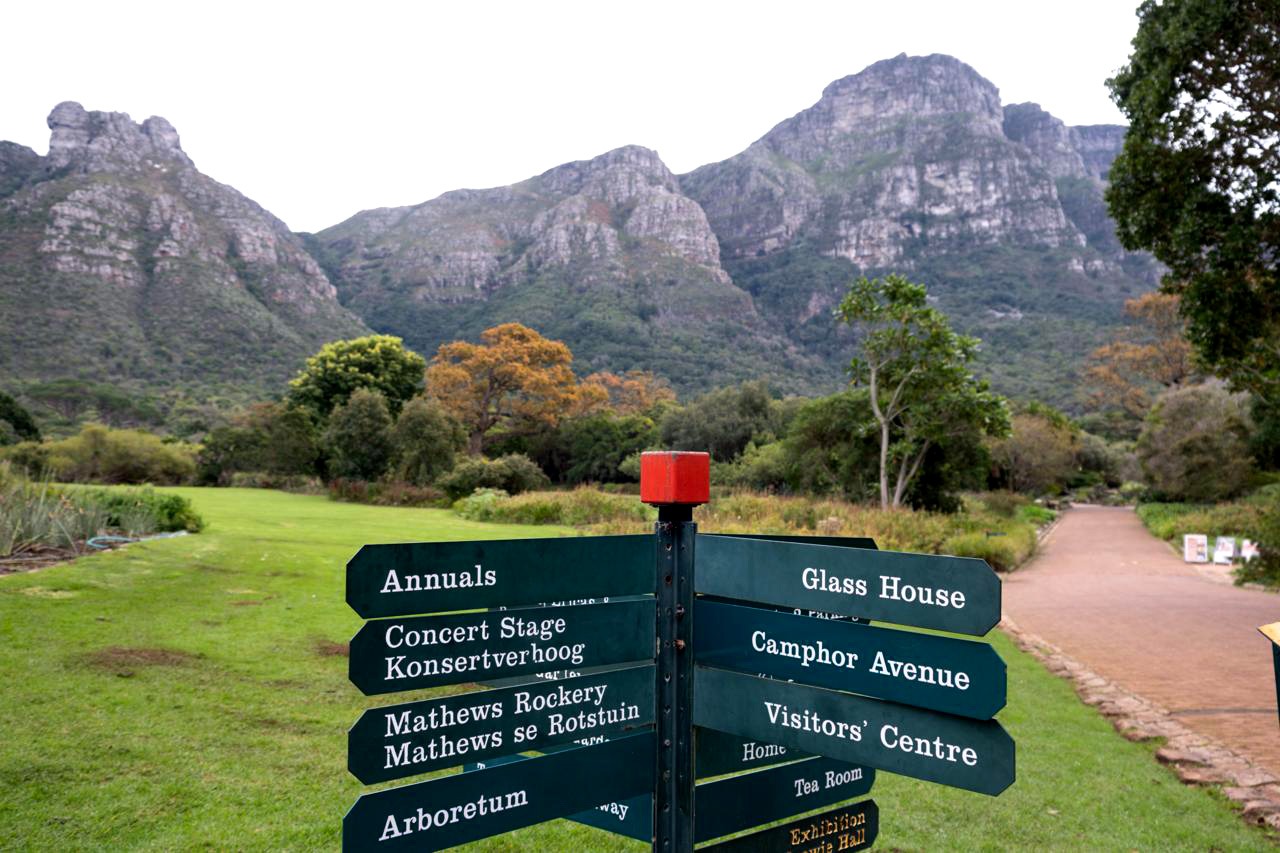
 The breathtaking view from Kirstenbosch’s lower gate. (Photo: Don Pinnock)
Depending on who you speak to, there are two Kirstenbosch National Botanical Gardens, almost unrecognisable as the same place.
In the first, tourist numbers are strong, the gardens beneath Table Mountain remain spectacular, the lawns and public areas are largely presentable, and the administration says the systems needed to run the gardens are in place, with improvements under way.
/file/attachments/orphans/Kirstenbosch1_259790.jpg "Kirstenbosch is cherished by visitors who come to socialise and de-stress. (Photo: Don Pinnock)")
In the second, beds are untended and filling with weeds, procurement of vital equipment and plant products takes months, cultivation and propagation have slowed, key horticulturalists have left or been fired, volunteer support has plummeted and specialist knowledge has drained away.
/file/attachments/orphans/Kirstenbosch-19_555040.jpg "A soft trifid-leaf pelargonium waiting for leaves. (Photo: Don Pinnock)")
At the centre of the dispute is a sharp contradiction between the account by the South African National Botanical Institute (Sanbi), which administers the gardens and that of plant specialists, citizen scientists and volunteers who know the gardens well.
A tour of the gardens united the two narratives, and a disturbing picture emerged: Kirstenbosch indeed remains magical in its setting, but in its botanical details something is amiss.
The fynbos section of the gardens higher up the mountainside, for example, seemed to be totally neglected. Proteas were over-wooded (in the wild, fires solve this problem), little had been planted out around them, beds were filled with weeds, and there was no evidence of cultivation (regular pruning and replacement management). In the greenhouses, a shock awaited.
/file/attachments/orphans/Kirstenbosch-7_532808.jpg "A bed in urgent need of care. (Photo: Don Pinnock)")
A gardener we encountered said the gardens were very short-staffed and there was not enough time to weed, trim, rake and replant beds. “There used to be more, but now we are less. Maybe it’s not enough money.”
The public alarm was triggered by a plant specialist and long-time volunteer who trained at Kirstenbosch, James Deacon, who has been involved with the gardens for 19 years. In a widely shared Facebook post, he wrote that Kirstenbosch was no longer a place that brought him joy, but “pain and sadness”. Walking through the nursery, he said, he saw “neglect, decay and death”. Collections built over decades were slowly dying; the Protea collection was less than a third of what it had been, and only a fraction of the Ericas remained, he wrote.
The glasshouses and confiscated poached plants will be dealt with in a following article, but they offer a glimpse of the deeper problem. During a walk through nursery areas, Deacon (who has a plant, Albuca deaconii, named in his honour) and botanist Zoë Poulsen pointed to ageing, dry or poorly labelled threatened plants and to confiscated material that had placed new pressure on already strained systems. Their concern was not only that some plants looked bad, but that the institutional machinery needed to maintain rare living collections was failing. Many rare succulents were shrivelled or rotting.
/file/attachments/orphans/Kirstenbosch-17_815587.jpg "Here was once an African stachys. (Photo: Don Pinnock)")
Deacon claimed that great plantsmen and women had left before they should have because working there had become unpleasant and because procurement made their jobs almost impossible. He said Kirstenbosch no longer had a Protea or Erica expert, that staff morale was low and that the garden could not reliably produce durable metal labels for plants. He added that living collections were in decline.
Sanbi responds
Sanbi pushed back. In an email, its senior marketing manager, Nontsikelelo Mpulo, disagreed that collections were in decline. She said they required constant collecting and propagation from wild-sourced material, and that Covid-19 had created a lag during which collections could not be made as intended.
“Annual fluctuations in living collections are normal and reflect active collection management rather than poor performance,” she said, adding that a remediation programme had since been instituted, including upgrades to nursery facilities.
She said annual changes can reflect active collection management rather than poor performance, and that “moderate fluctuations may indicate collections are being curated, scientifically updated and aligned with conservation priorities”.
Several specialists who have long experience of Kirstenbosch, and who for professional reasons asked not to be named, say the issues are greater than the state of collections.
Central problems cited were painfully slow procurement, loss of expertise, weak knowledge transfer, frozen or long-to-fill posts, ongoing cost-containment measures, poor database functionality and an administrative culture in which audit compliance has come to matter more than horticultural health and botanical integrity.
‘A leadership problem’
Professor Richard Cowling, an internationally respected fynbos ecologist, said he began observing signs of decline in the early 2010s. In his view, the problem lies not in ordinary horticultural fluctuation, but in leadership.
Sanbi, he believes, is now led by “career civil servants who lack the insight and passion needed to maintain an internationally significant botanical garden”. Untidy beds are one thing, he said, but “it’s another matter entirely to allow priceless collections to degrade”.
Professor Eugene Moll, a botanist who has visited Kirstenbosch since the 1970s, shares the concern. He says the gardens have become less diverse and more homogeneous. The old permanent structure remains, he says, but the richness and intensity of cultivation have declined. Trees are not always pruned as they once were, lawns are not what they were, and the display gardens need constant refreshing. “It’s declining,” he said.
For Moll, the issue is not simply formal qualifications. “Having the qualification and then doing the job are two different things,” he said. What is needed is dedication, continuity and passion for plants. Once things slide, he warned, rebuilding is slow. “To rebuild what’s been lost in 20 years is going to take another 10 years. It doesn’t happen overnight.”
/file/attachments/orphans/Kirstenbosch-4_531037.jpg "Felicia aethiopica missing in action. (Photo: Don Pinnock)")
On staffing, Sanbi confirmed three vacant horticultural positions: a general gardens horticulturist, a Protea garden horticulturist, and a succulents horticulturist. Mpulo said recruitment for the Protea post had been “completed and was awaiting appointment”, the general gardens post had been advertised, and the recruitment of a succulents horticulturist was “in progress”.
She said no other horticultural posts had been abolished or frozen, and that two full-time horticulturists and associated teams were dedicated to nursery production and living collections.
For critics, those confirmations are revealing. A garden of Kirstenbosch’s scale and botanical importance, they argue, cannot afford long gaps in specialist posts. It is not enough to have general staff. Threatened fynbos, Ericas, Proteas, bulbs and succulents often require highly specific cultivation knowledge, much of it built through years of observation and field experience.
Procurement problems
The same bureaucratic lacunae apply to procurement. Sanbi said it follows procurement prescripts under the Public Finance Management Act and is “pursuing continuous improvements so that day-to-day resources are sourced in line with national processes”.
Critics say that may satisfy compliance, but it can fail a living garden. Plants cannot wait months for pots, soil, growth products, irrigation repairs, labels or functioning machinery. Moll recalled a case when a water pump broke and the Botanical Society of South Africa stepped in to buy and install a replacement quickly.
The garden kept being watered, he said, but the botanical society got into trouble because it had not followed the proper procurement process. For Moll, this illustrated the absurdity of applying slow administrative systems to urgent horticultural needs.
Record-keeping
Another issue is the keeping of botanical records. One former senior horticulturalist said a botanical garden without a functioning living-collections database is effectively reduced towards a park.
In his account, Sanbi allowed an older working system to become obsolete before a replacement was properly usable. He said a Brahms-based system was promised, but years later, horticulturists still lacked the practical database they needed for day-to-day collections work.
Sanbi disputes that, saying Kirstenbosch’s Brahms is functional. The system, Mpulo said, is “managed by a dedicated biodiversity information management team and constantly being improved for living collections”. She insisted labels are available and in use, and that Sanbi keeps records of collections, including provenance information. This was rejected by several horticulturalists who called the system dysfunctional.
But the disagreement points to a deeper distinction: whether a system exists administratively, or whether it works for the horticulturists who need to track living plants in real time.
/file/attachments/orphans/Kirstenbosch-18_540814.jpg "A label but where is the pelargonium? (Photo: Don Pinnock)")
The issue of BotSoc
The Botanical Society of South Africa (BotSoc) once formed a crucial part of Kirstenbosch’s support system. Its members paid subscriptions, supported projects and, importantly, supplied a pool of skilled and committed volunteers. A major benefit of membership was free access to Kirstenbosch and other national botanical gardens.
/file/attachments/orphans/Kirstenbosch-13_752269.jpg "Kirstenbosch is one of the most beautiful botanical gardens in South Africa and draws millions of visitors. (Photo: Don Pinnock)")
According to a specialist who worked at Kirstenbosch for many years, Sanbi ended that free-entry arrangement after the Covid period, apparently because large numbers of BotSoc members were entering the gardens without paying at a time when international tourism income had collapsed.
The decision appears to have had serious consequences, and many affected parties tried to warn Sanbi. Predictably, BotSoc membership fell heavily. Many people had joined precisely because of the garden access benefit and cancelled once it was removed. Moll estimates BotSoc once had around 25,000 members and now has about 2,200.
BotSoc was much more than a club for garden lovers. It was a support structure, a funder of urgent interventions and a source of volunteers. Kirstenbosch depended on people who weeded, potted, propagated, labelled, observed and brought long memory to the garden. Some were amateurs in the best sense: deeply knowledgeable people motivated by a love of plants rather than salary or promotion.
Moll argues that rebuilding that volunteer base should be part of any recovery. But, he says, volunteers need meaningful work, not only menial tasks. Younger people, students, retired specialists and serious plant enthusiasts could be drawn into horticulture if the garden created a structure for real participation.
Recovery urgent
Kirstenbosch’s public beauty depends on a hidden ecosystem of expertise: horticulturists, nursery staff, plant recorders, volunteers, field collectors, taxonomists, conservation partners and outside specialists. If those relationships are broken, the decline may not be obvious at first. The mountain remains. The lawns remain. Tourists still take photographs. Concerts still happen. But the conservation engine behind the garden appears to be weakening.
Sanbi says there is a recovery plan for the gardens. Asked whether there is a funded plan to restore the nursery, propagation systems, specialist expertise, labels, records and threatened-plant collections, Mpulo answered yes, saying management, development and maintenance were continuous mandated processes for national botanical gardens. She did not spell out the details.
The question is whether that answer is adequate to the scale of concern now being voiced.
Kirstenbosch remains one of Cape Town’s great public places. But a botanical garden is not only scenery. It’s a living archive, a conservation institution and a storehouse of knowledge that builds the base for education and research.
/file/attachments/orphans/Kirstenbosch-10_588988.jpg "Devil’s Peak is a magnificent backdrop to the gardens. (Photo: Don Pinnock)")
If records fail, labels fade, specialists leave, volunteers disappear, and procurement cannot respond to horticultural urgency, beauty can remain on the surface while the system underneath it frays.
That’s the warning from those now speaking out. Kirstenbosch is far from collapse, of course. But they fear that while it’s being administratively managed, botanically it’s being hollowed, with a risk of botanical extinctions. DM
Tomorrow: Kirstenbosch: Drowning in neglected poached plants


Comments
Scroll down to load comments...