



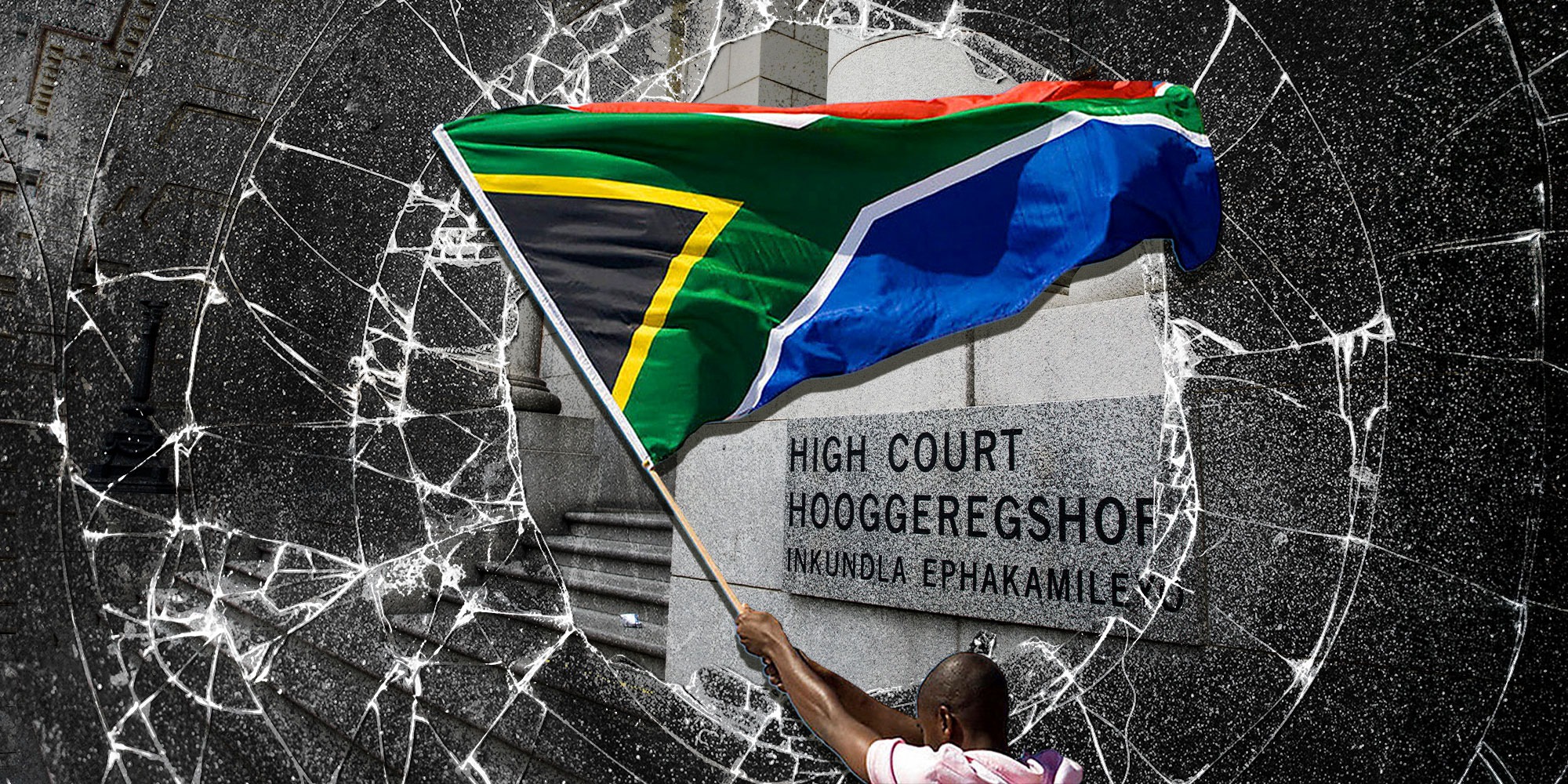
 Illustrative image: Cape Town High Court. (Photo: Gallo Images / ER Lombard) | Young person with flag. (Photo: africantravelcan)
There can be no doubt that our criminal justice system is broken. No one will argue that it is not.
Virtually every day comes news of another suspected criminal either being released, or using ill-gotten gains to mount some nonsensical court action or even just a police spokesperson muttering after a mass shooting that “investigations are ongoing”.
This is despite the best efforts of many well-meaning people who work as police officers, in the leadership of the SAPS, as prosecutors and as judges (and of a very thoughtful police minister).
But last week’s resignation of former Investigating Directorate Against Corruption (Idac) head Andrea Johnson and the testimony against her must be the final nail in the coffin of any hopes that our current system can be reformed.
Consider what has been tried since 2018.
First, President Cyril Ramaphosa brought in an outsider to run the National Prosecuting Authority (NPA). Shamila Batohi arrived with an impeccable record. And despite bringing in some other outsiders, such as Anton du Plessis, she was unable to reform an institution that had been broken.
And it has been broken, usually deliberately, by politicians. Thabo Mbeki appointed his own ally, Bulelani Ngcuka, as the first National Director of Public Prosecutions (NDPP), who abused his power against Jacob Zuma. Kgalema Motlanthe ensured the final removal of the first independent NDPP we had, Vusi Pikoli. Zuma himself abused the NPA in all sorts of ways, particularly through weak appointments.
Ramaphosa, to his credit, has not tried to interfere in how it runs or the cases it prosecutes.
But even with presidential backing, Batohi and those around her were not able to fix it.
When Idac was formed, an insider was brought in to run it. Johnson had immense experience. She was the bright new hope.
It ended badly.
Dying for justice
Anyone who has spent any time in our courtrooms would think our courts are so busy – justice must be dispensed at a rapid rate.
They may be full, but remarkably little justice is dispensed.
Instead, there are endless delays. People are literally dying while waiting for justice.
This is because the court system is overburdened with various applications, applications for delays and endless problems.
And Stalingrad is not just a city. It now surrounds us.
Those with deep pockets, with every interest in avoiding justice are able to spin out appeals for years.
Even those cases where there is a Constitutional Court judgment, a final judgment, someone like advocate Busisiwe Mkhwebane, with no understanding of the law, will bring a rescission application.
It is time to face the fact that reforms, new people, tweaks or nudges will not work. We need something more drastic.
Limiting appeals
What is to be done?
First, it must be accepted that in a country with our history of oppression before 1994 and our history of rampant injustice after that, it cannot be fixed through simply throwing suspects in jail and throwing away the key.
The presumption of innocence is sacrosanct and must remain so. Any weakening of that will eventually contain the seeds of its own revolution.
That said, our system of appeals needs a dramatic change.
Currently, should someone lose a case in the high court, they can petition the provincial judge president for an appeal (which would be heard in the same high court but with three judges), they can appeal to the Supreme Court of Appeal, they can appeal directly to the head of the Supreme Court of Appeal, they can appeal to the Constitutional Court and also directly to the Chief Justice.
In the case of specialised issues, such as a labour matter, there are even more forums, including the labour courts, the Labour Appeal Court and then the Constitutional Court.
It should be commonplace that in every criminal case there is just one option of an appeal. Whether it’s a person caught stealing cellphones repeatedly or a former president, it should be the same for everybody.
Then there needs to be a limit of some kind to the number of applications that can be made to stop a trial from proceeding. For the moment, the only limit is the amount of money a suspect can pay their advocate.
Once a trial starts hearing evidence against a suspect the process is very difficult to stop. And in political cases the suspect will now want to give their version, meaning they suddenly have an interest in the case continuing.
This is why there are so many applications to stop the trial from hearing evidence in the first place.
This must be aligned with a dramatic increase in the number of courts, magistrates and judges to hear cases. One of the reasons people wait so long for justice is that the number of resources to hear cases has not increased in proportion to our population.
At the same time, our prosecutors need a rapid increase in resources as well.
Currently the NPA has a budget of just more than R6-billion. That is to manage the entire prosecutorial system. Considering the resources of the people they are trying to hold legally accountable, that can be nowhere near enough.
By way of contrast, the government’s current budget for “VIP protection” is about R2.3-billion plus another R1.4-billion for static protection.
Just taking a portion of that would dramatically increase the NPA’s budget.
Confronting factionalism
It is an unfortunate fact that despite the intense work put in by prosecutors and their staff, the problems in the NPA seem so deep-rooted that it may be impossible to properly reform the institution.
It might be hopelessly factionalised and even politicised.
The testimony about Feroz Khan and Johnson also shows that even where politics is not a factor, senior people in the SAPS and the NPA have become hopelessly criminalised.
We need a new prosecutorial authority. Not just a name change, something genuinely new.
This could take the form of a new institution, with a complete rethink about its mandate, its structure and the legal roles and powers it has.
This would also be a convenient moment to make a change which could be fundamental at the same time.
Currently, the President has the power to appoint a National Director of Public Prosecutions. Zuma’s interest in avoiding justice is one of the reasons the NPA is the way it is.
As part of these changes this power should be removed, and a new method of appointment should be created.
While this could be a complex discussion, our history shows this is a power too important to remain in the hands of one person.
There are many other measures that could be considered to change and improve our justice system. All of them should be considered and discussed.
But the gravity of this moment must not be underestimated.
As more and more people lose faith in our criminal justice system, in the courts, in judges and in prosecutors, so we and our children will go from living under the rule of law to living where might is right. Where those who are prepared to use the most violence will win every argument, whether it be for your car or the power of the presidency.
These changes are not as difficult as they might seem.
After apartheid it was obvious that our justice system needed to change. The result was the formation of the NPA and a single court system under one Constitution.
This is not nearly as difficult as that.
We must face the fact that our current system is not working. Thirty years of tinkering, reforming and politicking has not worked.
We need something much more radical. Our criminal justice system needs a revolution. DM
Comments
Scroll down to load comments...