



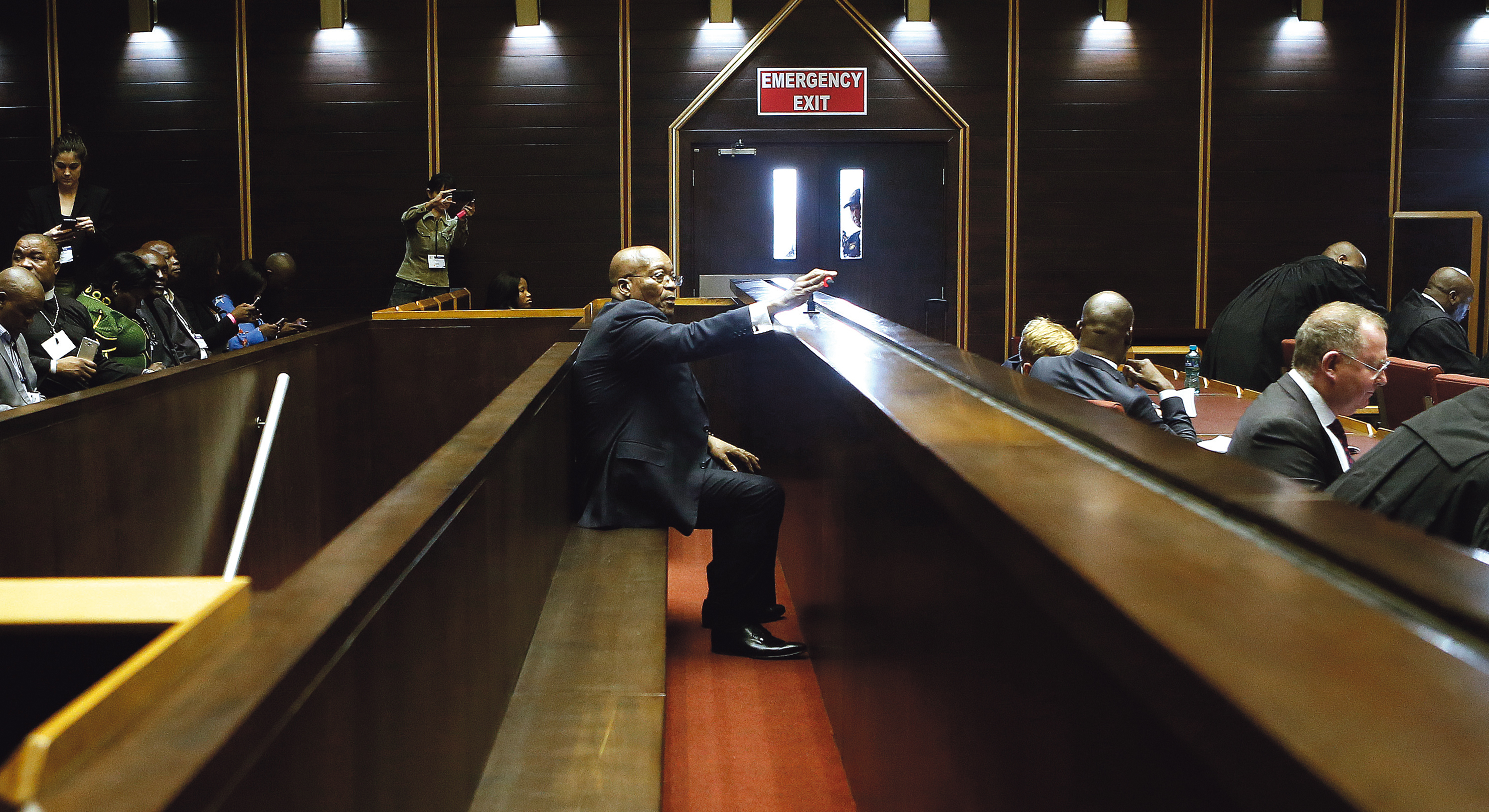
 Jacob Zuma appears in the KwaZulu-Natal Division of the High Court in Pietermaritzburg on 27 July 2018. (Photo: Phil Magakoe / EPA-EFE / Pool)
For almost three decades, former President Jacob Zuma avoided prosecution in relation to the 1999 arms deal, but the KwaZulu-Natal Division of the High Court in Pietermaritzburg has now ruled that the trial must proceed without further delay.
Judge Nkosinathi Chili handed down the order on Thursday after the State applied for the matter to proceed to trial despite any pending interlocutory applications.
In his ruling, Chili agreed with the State and said Zuma and the French arms company Thales had used the “Stalingrad defence” to delay the start of the trial.
He cited a judgment that described the Stalingrad defence as a legal tactic used to postpone criminal proceedings through civil court applications, ultimately undermining the constitutional right to a speedy trial.
“I need hardly add that this is of a particular benefit to those who are well resourced and able to secure the services of the best lawyers,” he said.
Zuma and Thales are accused of corruption, racketeering, money laundering and fraud related to the 1999 arms deal. Zuma is accused of receiving payments totalling R4.1-million between 1995 and 2004 from his former financial adviser, Schabir Shaik, and Shaik’s companies to further Thales’ interests.
Furthermore, Chili said: “Without this court’s intervention, it is my view that there is a likelihood of grave injustice or the administration of justice being brought into disrepute. It is not only the interest of Mr Zuma and Thales that the court has to take into account when considering the State’s application, but also the interests of the society. A court has an obligation to guarantee public confidence in the judicial authority and administration of justice.”
Delays galore
In June 2025, Zuma and Thales sought to have criminal charges against them dropped, but their application was dismissed by the same court and judge.
/file/dailymaverick/wp-content/uploads/2024/08/Nkosinathi-Chili.jpg "Judge Nkosinathi Chili during court proceedings in the Zuma vs Downer case on 20 March 2024. (Photo: Darren Stewart / Gallo Images)")
At the time of their application, they argued that the deaths of key witnesses Pierre Moynot and Alain Thétard, both former employees of Thales, significantly affected the case.
The company’s legal team and Zuma’s legal team, led by advocate Dali Mpofu, relied on the deaths of the two witnesses as the basis for their application for acquittal. Mpofu also argued that without those witnesses, their team could not challenge the evidence, essentially rendering the trial unfair.
Chili, however, disagreed. “I am not persuaded either that Mr Zuma’s right to a fair trial will be prejudiced by the non-availability of Mr Thétard and Mr Moynot. There is no justification for the granting of the order sought by Mr Zuma in the alternative in accordance with section 172 1 (b) of the Constitution. I therefore make the following order: the application by both Mr Zuma and Thales is dismissed.”
In 2021, Zuma sought the removal of advocate Billy Downer as the public prosecutor from the trial. First, he challenged his title to prosecute, using section 106 of the Criminal Procedure Act.
Then he went for a more personal attack, choosing to privately prosecute Downer and News24 journalist Karyn Maughan, alleging Downer leaked medical records to Maughan. Most recently, he has challenged Downer's impartiality, saying the ongoing litigation that he (Zuma) started had created bias.
It did not end there. In 2022, Zuma launched private prosecution proceedings against Downer and Maughan, which they successfully opposed.
Thereafter, several related applications were filed, including one in which Zuma applied for leave to appeal the interdict, while Maughan and Downer applied to have the interdict enforced despite that appeal, under section 18(3) of the Superior Courts Act.
/file/dailymaverick/wp-content/uploads/2023/09/Hugh-Cherish-judges-2.jpg "The National Prosecuting Authority's advocate Billy Downer with journalist Karyn Maughan, against whom Zuma tried to bring a private prosecution. (Photo: Darren Stewart / Gallo Images)")
The court later rejected Zuma’s leave to appeal. His further appeal against the enforcement order was then dismissed by the Supreme Court of Appeal.
These are only two of several attempts Zuma made to avoid standing trial. Chili found: “Mr Zuma has challenged many decisions adverse to him in the past, usually invoking the entire appeal process to the highest court in the land, and in many instances has been unsuccessful, which resulted in inevitable delays. He is on record through previous counsel representing him, that he will continue exercising all rights available to him.”
Politically motivated
For years, Zuma has consistently denied any wrongdoing in the arms deal case and maintained that the charges against him are politically motivated. He has also slammed the delays in the matter, saying he wanted his day in court, which it now seems he will have.
Chili has ordered that the trial must proceed regardless of any interlocutory applications brought by the State, Zuma or Thales.
While the State intended to proceed soon, the defence’s unavailability led to the trial being scheduled to begin on 1 February 2027.
The National Prosecuting Authority’s spokesperson, Kaizer Kganyago, said: “We are very happy that we were granted this order so that we are able to stop the Stalingrad tactics that were happening, but also the fact that this will serve as a precedent for all the other cases going forward.”
It remains unclear what Zuma’s next move will be, or whether he will again rely on legal avenues he has previously used to challenge the start of the trial proceedings. Umkhonto weSizwe’s party national spokesperson, Nhlamulo Ndhlela, referred queries to Mzwanele Manyi, the spokesperson for the Jacob Zuma Foundation. He had not responded at the time of publication. DM
Comments
Scroll down to load comments...