



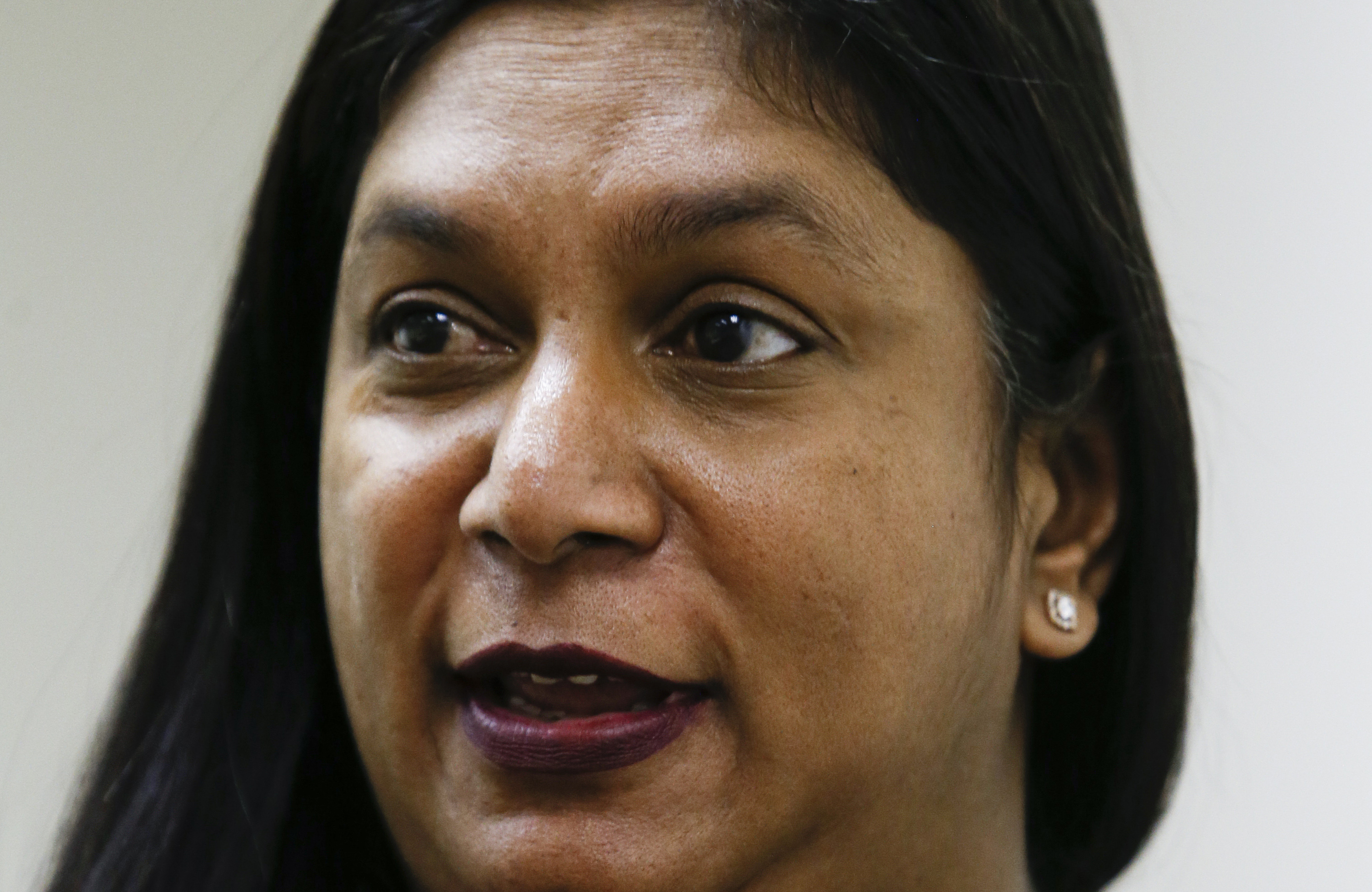
 Former Idac boss Andrea Johnson has been accused of leading an investigation into top police without following the proper procedures. (Photo: Felix Dlangamandla / Daily Maverick)
By the close of last week’s proceedings at the Madlanga Commission, the evidence of Investigating Directorate Against Corruption (Idac) senior investigator Mantsha Raphesu and prosecutor Drushantha Ramsamy had fundamentally altered the character of the inquiry.
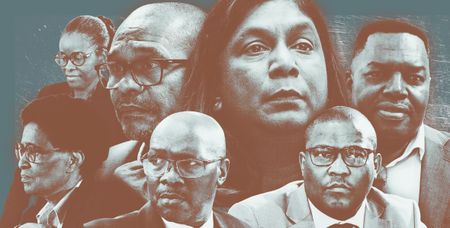
At the heart of their testimony were questions over former Idac boss Andrea Johnson, who also testified last week, and her role in pursuing charges against the country’s top cops.
Ramsamy, during her evidence on Thursday, 30 July, told the commission that Johnson was in charge of “Project Diversion”, an investigation directed at building cases against suspended police commissioner Fannie Masemola and former Crime Intelligence boss Dumisani Khumalo.
The allegation lands at the centre of one of the commission’s most contested issues. Throughout weeks of hearings, evidence leaders have questioned how an investigation triggered by National Coloured Congress (NCC) MP Fadiel Adams’ protected disclosure expanded so rapidly to target some of the country’s most senior police officials.
Masemola was formally charged with contravening the Public Finance Management Act in April. The charges relate to the alleged irregular awarding of a R360-million contract to Medicare 24, a company owned by Vusimuzi “Cat” Matlala.
The commission has heard that Project Diversion ultimately led to criminal proceedings against Khumalo and other senior Crime Intelligence officers. Those charges centred on allegations that Brigadier Dineo Mokwele, a former BMW mechatronics engineer, had been unlawfully appointed to head Crime Intelligence’s Technical Support Services and had been placed there to facilitate the capture of the division.
However, Johnson’s own evidence before the commission substantially weakened that narrative. Documentary evidence presented during her testimony showed that Mokwele met the qualifications for the post, undermining one of the central premises of the investigation.
The NPA has since provisionally withdrawn the fraud and corruption charges against Khumalo and his co-accused arising from the alleged irregular appointment, following mounting questions over the evidential basis of the prosecution.
Ramsamy’s evidence follows weeks of intense scrutiny of Johnson. The pressure on the former Idac head intensified when WhatsApp messages between her and suspended Crime Intelligence deputy head Major General Feroz Khan were submitted as evidence.
The messages formed part of the commission’s examination of Johnson’s relationship with Khan and added another layer to the growing questions around her conduct
Investigating without evidence
The combined evidence of Ramsamy and Raphesu moves the inquiry into far more consequential territory.
Although they occupied different roles, Ramsamy, as the prosecutor responsible for legal processes, and Raphesu, as the lead investigator, their evidence repeatedly intersected on key events and painted a remarkably similar picture of how Idac’s Project Diversion unfolded.
The most significant issue concerns the sequence of the investigation itself. Both described an investigation in which investigative powers appeared to precede evidential justification.
Ramsamy testified that Johnson instructed her to prepare Section 28 authorisations to begin the investigative process using a handwritten list of suspects that could not, in her view, be justified by Adams’ Section 27 disclosure.
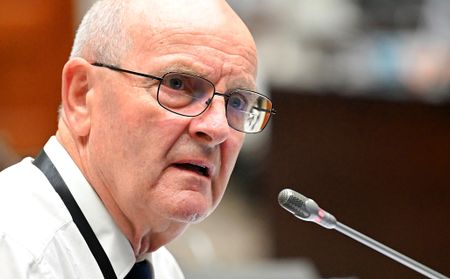
/file/attachments/orphans/ED_617219_669234.jpg "Mantsha Raphesu, senior Idac investigator, testified at the Madlanga Commission of Inquiry in Pretoria on 31 July 2026. (Photo: Gallo Images / Frennie Shivambu)")
Raphesu described similar concerns when instructed to prepare subpoenas for Crime Intelligence Major General Philani Lushaba’s bank records, despite, as he put it, there being nothing in the docket to justify such an intrusive investigative step. Lushaba was charged after allegedly covering up the theft of his work computer, firearm and phone by a sex worker.
Ramsamy and Raphesu said their objections were rejected. Their evidence also converged on the quality of Adams’ complaint. Raphesu gave perhaps the bluntest assessment heard during the commission.
Fadiel Adams yielded ‘fokol’
His evidence cast fresh doubt on the foundation of Project Diversion, telling the Madlanga Commission that the 6 January 2025 consultation with Adams produced little to justify expanding an investigation that would later implicate some of the country’s most senior police officials.
He said he travelled to Cape Town with Ramsamy and Perumal to obtain four supplementary affidavits after investigators found Adams’ original complaint lacked sufficient detail.
“We went there to get further particulars,” Raphesu told the commission, stressing that the objective was not to coach Adams, but to determine whether he possessed evidence that could substantiate his claims.
“He basically gave us the same thing that was in his sworn statement. If it was the normal way, I would tell you he gave us fokol. The problem is that he is a Member of Parliament. To tell the truth, we went there for nothing,” Raphesu assessed.
Adams has been criminally charged in an unrelated matter.
/file/attachments/orphans/ED_607947_777733.jpg "National Coloured Congress leader Fadiel Adams at Pinetown Magistrates’ Court on 7 May 2026. Adams faces charges of fraud and defeating the ends of justice in relation to his alleged interference with the murder probe into former ANC Youth League secretary-general Sindiso Magaqa. (Photo: Gallo Images / Darren Stewart)")
Raphesu’s assessment of Adams’ evidence remained unchanged. He said Adams spoke largely from a third-hand perspective rather than from direct personal knowledge, struggled to answer detailed questions and failed to produce the supporting documentation investigators had hoped would corroborate his allegations.
Justice Mbuyiseli Madlanga then questioned Raphesu about one aspect of the meeting that has featured prominently throughout the commission’s hearings: alleged WhatsApp messages relating to the proposed disbandment of the Political Killings Task Team (PKTT).
Raphesu downplayed the significance of the alleged messages about the PKTT, saying Adams merely flashed a phone at him, allowing him to read only a single line. He could not verify who sent the messages and relied solely on Adams’ explanation of their origin.
Mystery affidavit
One of the most significant procedural disputes to emerge from Raphesu’s testimony concerned what happened to the affidavits obtained during the 6 January 2025 consultation with Adams. At issue is whether affidavits commissioned in Cape Town were later replaced or supplemented without the knowledge of the lead investigator.
According to Raphesu, only four supplementary affidavits were commissioned during the 6 January consultation in Cape Town, all in his presence. Yet he later discovered an additional affidavit in the Brigadier Dineo Mokwele docket, purportedly commissioned on the same day at the Brooklyn Police Station in Pretoria.
“I have since seen an affidavit in the Mokwele docket which was purported to have been commissioned on 6 January 2025 at Brooklyn. That affidavit was not obtained or commissioned in my presence,” he testified.
Raphesu stressed that he spent the entire day with Adams, Perumal and Ramsamy in Cape Town, maintaining that the only affidavits obtained that day were the four supplementary statements he personally commissioned.
He went further, arguing that the contents of the disputed affidavit could not have originated during that consultation because Adams had not raised those issues.
Madlanga Commissioner advocate Sandile Khumalo, SC, took the issue a step further, observing that if Raphesu’s affidavits were absent from the docket disclosed to an accused while different affidavits appeared instead, it would suggest that the originals had either been replaced or withheld.
“That is correct,” Raphesu replied, adding that it was not simply a question of affidavits being swapped, but that some may also have been concealed.
The O’Sullivan consultation
Another significant aspect of Raphesu’s testimony concerned Idac’s interactions with controversial forensic investigator Paul O’Sullivan, evidence that appeared to conflict with former Idac head Johnson’s account of her dealings with him.
Raphesu told the Madlanga Commission that on 13 January 2025, he was instructed to meet O’Sullivan to establish whether he had begun investigating the allegations and whether he had opened a criminal case with the South African Police Service.
The meeting took place two days later. According to Raphesu, O’Sullivan said he had not yet opened a criminal case, but was in the process of initiating his own investigation.
/file/attachments/orphans/ED_595175_343051.jpg "Forensic investigator Paul O’Sullivan testifies at the Parliamentary Ad Hoc Committee inquiry into alleged corruption and political interference in the criminal justice system at Good Hope Chambers in Cape Town on 10 February 2026. (Photo: Gallo Images / Brenton Geach)")
More significantly, O’Sullivan handed Raphesu documents that would later feature prominently before the commission, including a letter from now sidelined minister of police Senzo Mchunu to now suspended police commissioner Masemola, and material relating to the Mokwele matter.
The significance of that consultation emerged during questioning by evidence leader, advocate Thabang Pooe.
Pooe contrasted Raphesu’s evidence with Johnson’s earlier testimony that she had no dealings with O’Sullivan on the Mokwele matter. She then referred Raphesu to email correspondence suggesting Johnson had, in fact, been copied on communications from O’Sullivan.
The emails included correspondence dated 13 January 2025, attaching the minister’s directive to freeze hirings at Crime Intelligence, and the disbanding of the PKTT. She also referred to an earlier email dated 5 January 2025 in which O’Sullivan questioned former police spokesperson Lieutenant General Solomon Mokgole, copying in Johnson, suspended Lieutenant General Shadrack Sibiya and Mchunu.
Raphesu confirmed that O’Sullivan had given him the minister’s directive during their meeting. However, when asked how O’Sullivan had obtained the document, he said no explanation was offered.
The exchange is significant not only because it proves Johnson’s evidence was incorrect, but because it introduces documentary material that appears difficult to reconcile with her account that she had no dealings with O’Sullivan concerning the Mokwele matter.
After meeting O’Sullivan, Raphesu said he reported his findings to the investigative team, completing the task he had been assigned.
Why was Raphesu sidelined?
Raphesu told the commission he believes he was disciplined for questioning the evidence and direction of Project Diversion.
He said tensions with Idac chief investigator Dylan Perumal escalated after he challenged the investigation. On 10 February, he was informed of disciplinary proceedings, ordered to hand over all case files and removed from the probe.
Accused of leaking confidential information to Cedric Nkabinde, chief of staff to suspended Police Minister Senzo Mchunu, Raphesu denied the allegation, claiming Perumal orchestrated the accusation. He said he offered to undergo a polygraph test and provide his cellphone records to prove his innocence.
Advocate Pooe noted that Johnson had previously testified that the allegations were ultimately not substantiated.
Raphesu also questioned the independence of the disciplinary investigation, alleging the investigator had close ties to Perumal. Raphesu said he was never given records of the alleged call. He has since lodged a formal grievance and intends to lay criminal charges.
The commission resumes on Tuesday, 4 August, with Ramsamy. Her second statement is expected to focus on the controversial R228-million Medicare24 contract. DM
Comments
Scroll down to load comments...