




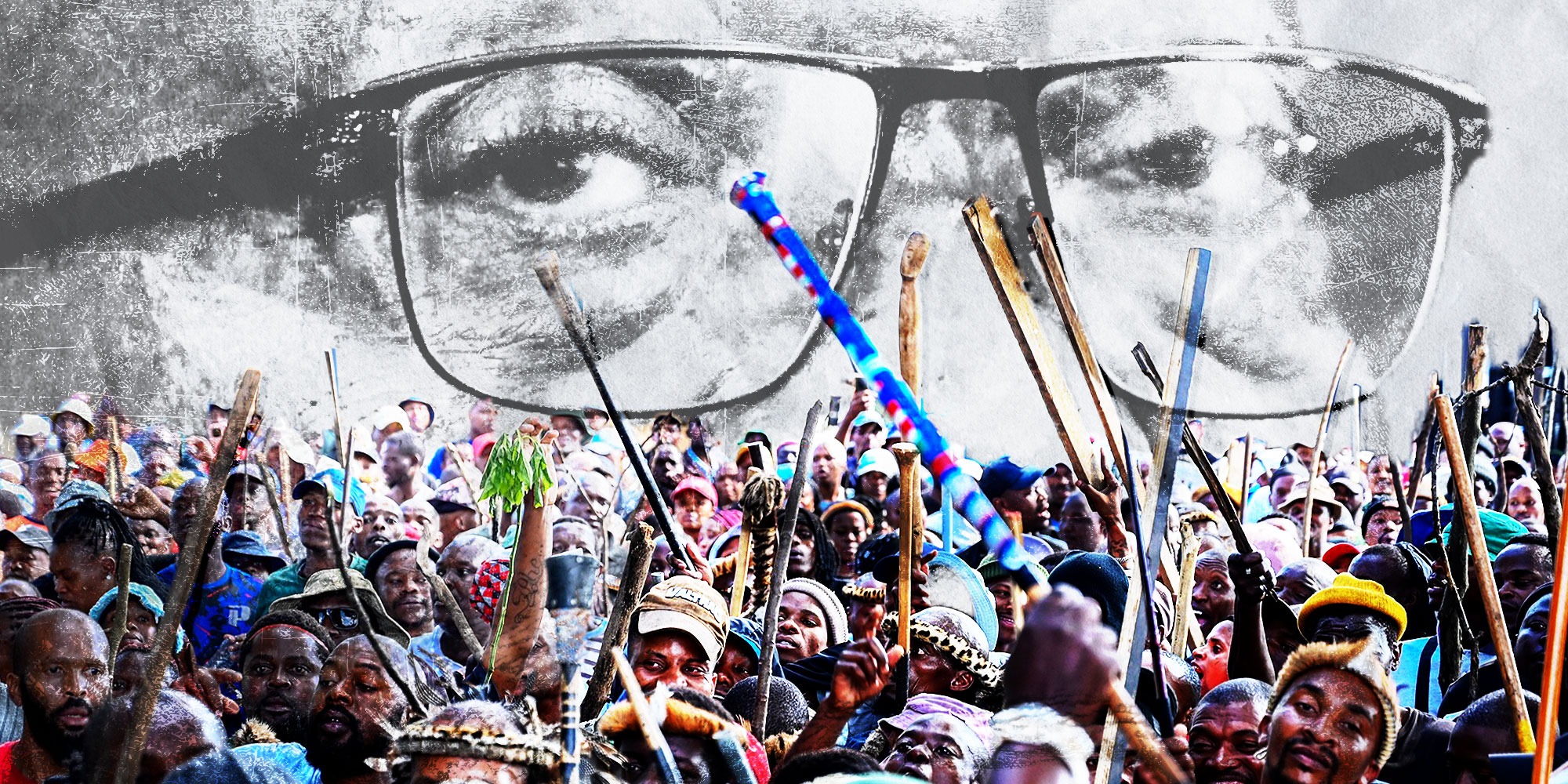
 Illustrative Image: Jacob Zuma. (Photo: Luba Lesolle / Gallo Images) | A protest against illegal immigration in Durban on 20 May. (Photo: Gallo Images / Darren Stewart)
 /file/dailymaverick/wp-content/uploads/2025/10/label-analysis-2.jpg)
The decision by the ANC to suggest that MK leader Jacob Zuma is responsible for the current wave of anti-immigration protests may well change the national discussion on this issue. While Zuma and MK will surely deny this, much of the agitation on this issue does follow a pattern he established long ago.
The statement by the ANC’s National Working Committee on the immigration issue, specifically referring to the July 2021 violence, is a deliberate attempt to explain our current situation. It is also a reminder to voters of Zuma’s previous history.
While he has always personally denied responsibility for the 2021 violence, his own lawyers have said, in court, that if he were to be jailed, there would be a repeat of that violence.
Also, the sequence of events — that it started so soon after he was arrested, along with public comments by many of his supporters — shows that violence was all about him.
Of course, his supporters will say there is no proof that MK or Zuma are involved with the March and March grouping.
However, MK members and leaders have attended most of March and March’s events and offered public support many times. This is exactly the kind of nod-and-wink politics that Zuma has excelled at.
/file/attachments/orphans/ED_561240_129894.jpg "MK party leader Jacob Zuma. (Photo: Darren Stewart / Gallo Images)")
Also, while he began his presidency in 2009 claiming to be a president for everyone in the country, by the time he was forced to resign, Zuma had already started retreating into identity politics.
And there can be no doubt that MK has many of the features of an ethnonationalist movement.
However, tensions over migration are about much more than Zuma.
Many South Africans, like people in the US, the UK and much of Europe, have seen their standard of living decline over the last generation. They are poorer than they were.
This simple point has been a major factor in the UK’s Brexit vote, the rise of Donald Trump and the wave of populism that has swept parts of Europe.
In South Africa, this sentiment has lacked a major political platform, largely because the ANC and the DA have traditionally dominated the landscape. It seems only a quirk of history — specifically that so many senior ANC leaders once lived in exile across the continent — has kept this from becoming a flashpoint until now.
Strength in diversity
But actually, the biggest guardrail against consistent and widescale xenophobia is our inherent diversity and our history of internal migration.
Barring those in the richer and more insular suburbs of Cape Town, virtually everyone’s grandparents grew up in a place different to where they live now. And the experiences of our grandparents as South Africans are often much more diverse than the differences between people born on different sides of the Limpopo.
Bluntly, so many of us in southern Africa share languages, surnames, ethnic identities and intertwined histories, that it is very difficult to treat people differently based on where they were born according to borders imposed by Europeans.
That said, the economic conditions of so many in South Africa make them desperate to blame the “other”, to find a simple solution to problems, in the same way Europeans and Americans do.
This is why the ANC is stuck in a political vice.
As a party of the moderate middle representing diverse constituencies, it is caught in a bind: many of its leaders want to defend human rights and protect migrants, while some potential voters hold a completely different view.
This might also explain the ANC’s reference to “formations in our politics that have embraced an open ethno-nationalism and that have sought to hijack the proud heritage of the amabhuto … bending them to a reckless and destructive agenda”.
It is essentially trying to make the point that Zuma and MK are responsible for this, and that it is not about migrants at all, but about the very identity of South Africa.
By reminding voters of this, it is also reminding them that the ANC stands for the majority, for all groups in the country.
However, there may also be some generational division in the ANC, as older leaders are much more likely to have fond memories of being helped by people from other parts of Africa. Younger leaders may believe they are giving up votes on this issue and have had a very different lived experience.
For the DA, this is a battle in which it is not really a protagonist. Most of its voters, being diverse and sometimes with relatively short family histories in South Africa, probably tolerate or even welcome foreign nationals. They don’t really see what all the fuss is about.
However, it is an opportunity for the DA to remind its constituency that it will champion the rule of law. The party could also leverage the state resources under its control in areas it governs to demonstrate a clear commitment to protecting its supporters.
A difficult position
The IFP, which lost a large portion of its votes to MK in 2024, is in a very difficult position.
Being a party that used to appeal primarily to KwaZulu-Natal voters, it has a huge amount to lose. This might well explain the decision by the KZN premier and KZN IFP leader, Thami Ntuli, to share a platform with the March and March movement this week.
/file/dailymaverick/wp-content/uploads/2024/05/ED_501033.jpg "KZN Premier Thami Ntuli. (Photo: Gallo Images)")
He might well be trying to have it both ways: positioning himself as the premier of moderate authority while simultaneously signalling that he understands the demands of anti-migrant protesters. When politicians attempt to straddle such massive divides and appeal to two conflicting constituencies, they usually fail, as it requires exceptional skill to avoid falling through the cracks.
Meanwhile, the EFF has stuck resolutely to its belief in pan-Africanism. This means that while it is playing no part in any of these protests, it has tried to convince people not to take part.
EFF leader Julius Malema has been consistent on this issue. It may be to his cost, but it is also to his credit that he is not changing his tune now.
Within all of this, it should not be forgotten that the nature of our society is such that the views of many politicians will not matter.
The strongest anti-migrant sentiments are often concentrated among those working in the informal economy or living with no income at all.
Calls from people in the middle class, whether they be politicians, academics, English-language journalists or anyone else, are unlikely to have much effect.
Those in the informal economy believe those in the middle class have not had their lives affected by immigration in any material way. Instead, it is those who don’t have a job, who use government hospitals, who believe foreign nationals have taken something from them.
This means that the scope for middle-class people to change the minds of those who might march against immigrants is limited — unless those who argue against these marches have some form of legitimacy with those who are marching.
That said, these protests still require organisation. And it is surely true that since the end of apartheid, very few groups have been able to hold large-scale protests in several cities at the same time. Most of those who have been able to do this are union movements, groups supported by business bodies (such as the anti-Zuma protests) or long-running organisations, such as the Treatment Action Campaign.
This makes it unlikely that March and March and its associated groups will be able to stage large-scale marches in many places simultaneously.
However, if they manage to do this, it may mark a very real change in our politics and will demonstrate how important the migration issue has become.
While the ANC has made many mistakes over the years, and still tolerates malgovernance and corruption (look no further than Joburg…), it must be correct on one central point.
The current agitation around migration is rooted in our domestic politics — just before the local elections. DM