




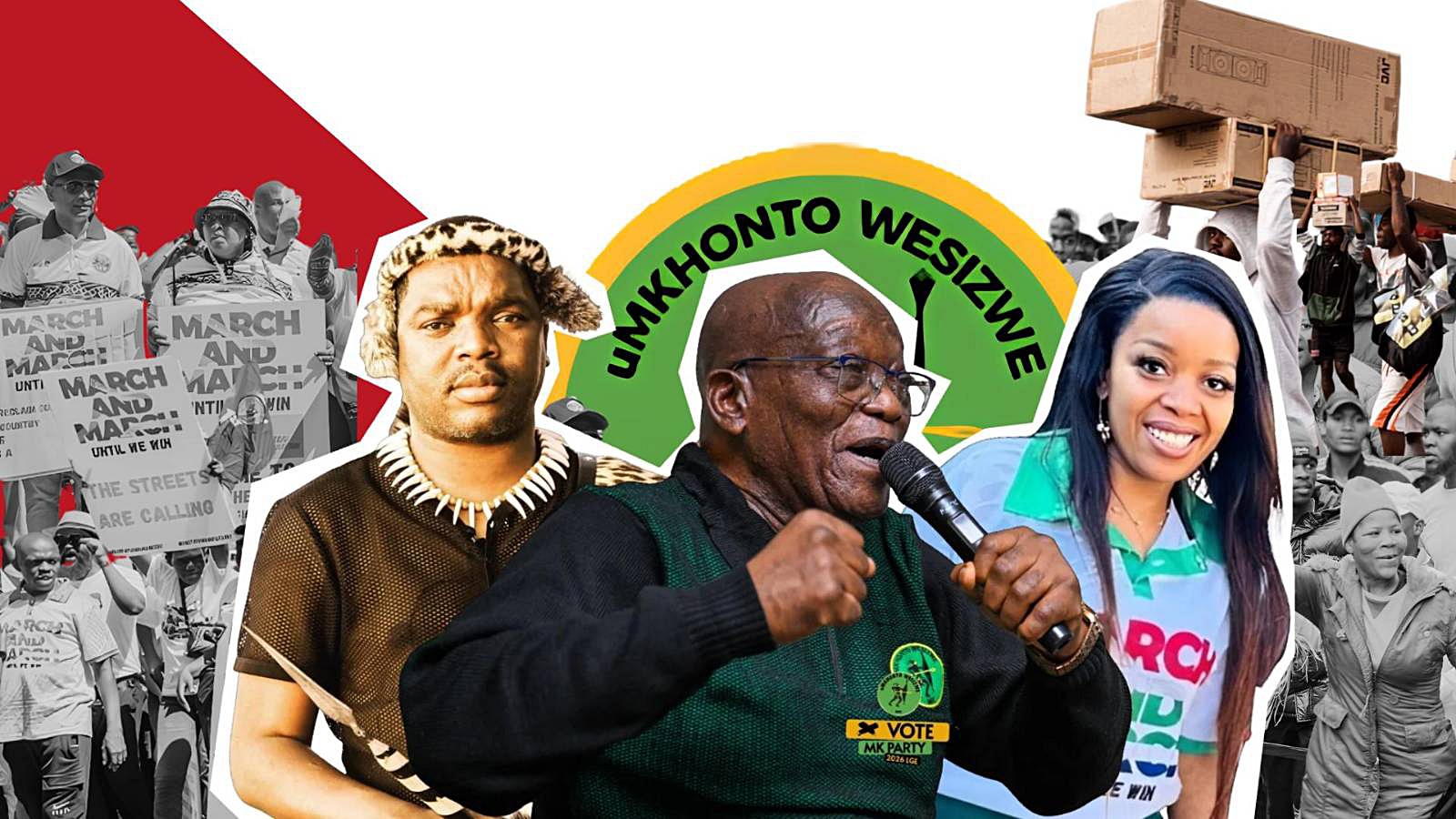
 Ngizwe Mchunu (left), Jacob Zuma (centre) and Jacinta Ngobese-Zuma (right). The anti-immigrant mobilisation around March and March has drawn in Zuma-linked networks and prominent public figures ahead of the movement’s planned 30 June shutdown. (AFP, Wikus de Wet / MK Party website)
The shadow of former president Jacob Zuma hangs over the anti-immigrant movement and its leading protagonists in the run-up to their planned 30 June shutdown – just as it hung over the coordinated 2021 unrest that broke out after his jailing for contempt of court.
While there is no evidence that Zuma himself is involved in manipulating the anti-immigrant sentiment, family networks and associates of the former president are at the heart of the loose alliance of entities driving the increasingly violent anti-immigrant movement spreading outwards from KwaZulu-Natal.
They include March and March, and Ngizwe Mchunu and his Amabhinca Nation – as well as Zuma’s uMkhonto weSizwe (MK) party itself, which has indicated its support for Tuesday’s protest. It also includes other parties such as ActionSA that have mobilised in a populist way around what are genuine grievances about illegal immigration.
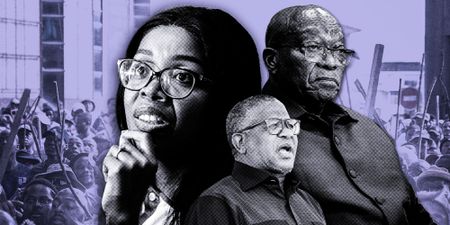
ANC secretary-general Fikile Mbalula has lambasted the movement and in particular, singled out Zuma as, according to him, stoking the fires to unleash chaos on South Africa – making a specific reference to 2021.
Most of the attention given to March and March has fixated on its charismatic leader Jacinta Ngobese-Zuma, ignoring the two other directors of the company that was registered in August last year: Sanele and Nozibusiso Khambule.
Zuma family orbit
AmaBhungane can reveal that both Khambules move within the Zuma family orbit via the late Thokazile Jennifer Mbambo, who died in 2021.
Companies and Intellectual Property Commission (CIPC) records show that Mbambo, who hailed from the Nkandla area, served as a director in five companies, alongside one or both of Zuma’s late brothers, Ngekengithule and Michael.
Nozibusiso Khambule, who is described as the convenor of March and March, and seemingly receives donations to the movement in her own personal cheque account at ABSA, is Mbambo’s daughter.
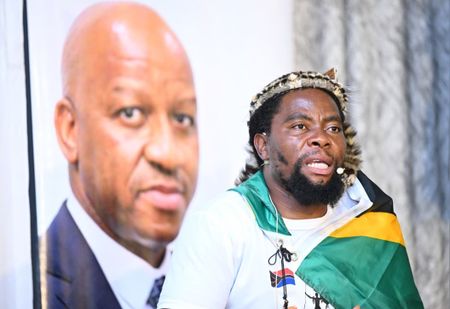
Nozibusiso and her mother were directors of a company called Sisano Business Consultant Services and on a barebones LinkedIn account that references Sisano, she appears to refer to herself as Nozi Zuma.
According to a 2014 news report about a break-in at Mbambo’s home, she was the parent of one of then-president Zuma’s “staff members” – though it is not clear whether the report was referring to Nozibusiso or her brother Thabani Khambule, who died in late 2014.
March and March treasurer Sanele Khambule, a Durban University of Technology graduate and businessman, appears to be Mbambo’s grandson.
Sanele was incidentally also on the MK party’s election list in the last national elections, albeit at the very low position of 100th.
/file/attachments/orphans/MandM-1_565095.png "(Photo: LinkedIn / Facebook / Instagram / DUT / Northern Natal New)")
Who is Jacinta Ngobese-Zuma?
The frontwoman of March and March, Ngobese-Zuma was, until last year, best known as a radio personality. Long before her rise into the national limelight, her potential as a political influencer was identified in at least one quarter: the US diplomatic corps in SA.
In 2021 Ngobese-Zuma was personally invited to the home of the US consulate-general “as part of a panel of women in the media and entertainment field to discuss the role of women in the media and entertainment space”.
In 2023 her stature rose as she participated in the US Department of State’s invitation-only International Visitor Leadership Program, which according to its website “advances U.S. national security priorities and builds long-term relationships between Americans and international leaders in government, business, academia, and other fields”.
The irony…
To be fair, Ngobese-Zuma has since made at least one long social media post decrying American president Trump and erstwhile confidant Elon Musk’s disinformation campaigns and the local US embassy’s parroting of the official line.
The irony is however that Ngobese-Zuma’s stint in the US was dedicated to a programme about “Media Responsibility in an Age of Disinformation”.
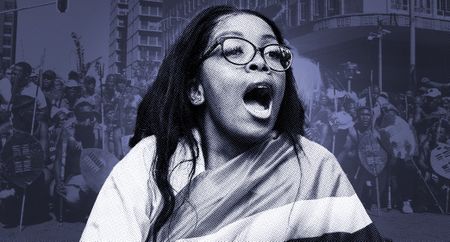
Despite this, Ngobese-Zuma has recently disseminated and amplified inflammatory videos and claims of non-South Africans’ alleged depravity, for instance, reposting comments about Boko Haram kidnappings and implying that this reflects the character of Nigerians in general.
Ngobese-Zuma’s husband, attorney Xolani Christopher Zuma, has legally represented March and March and at least one other person in the broader network, Ngizwe Mchunu. This client brings the couple closer to the orbit of the former president, as well as the 2021 riots that some view as a warning about what the current anti-migrant campaigns can lead to.
Who is Ngizwe Mchunu?
Mchunu is a known supporter of former president Zuma.
Before Zuma’s arrest and imprisonment, Mchunu was seen on guard outside the former president’s Nkandla homestead, insisting that the president would not go to jail.
Following the 2021 riots, Mchunu was accused of instigating others to commit violence during a press conference in Johannesburg, and was subsequently charged with incitement to commit public violence.
Zuma frequently attended the Randburg Magistrate’s Court to support Mchunu during his two-year trial. When Mchunu was ultimately acquitted of all charges, Zuma was present in the courtroom.
The two men have maintained a relationship and a phone conversation between them in May went viral on social media, after unknown men allegedly torched two rondavels at Mchunu’s homestead.

Mchunu has been active in anti-immigrant mobilisation and has aligned himself with Ngobese-Zuma, who has had to warn him against using aggressive language.
Xolani Zuma represented Mchunu in a dispute with Economic Freedom Fighters leader Julius Malema. The Pretoria High Court ordered Mchunu to apologise, following a defamation lawsuit after Mchunu had publicly accused Malema of protecting undocumented migrants and accepting bribes from cartel elements.
Meanwhile other links with former president Zuma are visible through the MK party.
Labour and Civic Organisation — and MK
The Labour and Civic Organisation (Laco), registered in January this year, shares directors with the uMkhonto Labour Desk and the uMkhonto weSizwe Labour and Civic Organisation.
Laco has been accused of leading groups of unemployed youth and local residents to confront businesses, demanding that management hire locals over foreign nationals.
The organisation says it is merely exposing the exploitation of illegal foreign labour – but it has also been a feature of recent marches alongside March and March, including one in Pietermaritzburg which later turned violent, leaving at least one person dead.
Meanwhile MK’s national spokesperson Sifiso Mahlangu attended the March and March media briefing on 24 June ahead of the 30 June deadline and told MDNtv their role was to “support the mission of March and March”.
He stressed that their message to South Africans was that “on the day in particular we are not looting, we are not hurting anyone, there will not be murder”.
While claiming that MK was not part of the movement, he said the party’s position was focused on better border control, documentation and the repatriation of undocumented foreign nationals.
He also attacked claims by veteran political journalist Hajra Omarjee that “high-level sources close to former president Jacob Zuma” had told her there were discussions about a possible repeat of the July 2021 unrest.
Mahlangu called this claim “speculative, divisive, provocateering”, stressing that the MK party expected to take over KZN after the November local government elections, and wanted to preserve stability in the province.
Organic and manipulated?
Will there be another 2021? Many assume so, but it is impossible to tell.
Government, security companies and the South African Police Service say they are better prepared this time round.
But it does not go unnoticed that, in 2021, the response of the police in KZN was muted, and that today the conflict and divided loyalties within the criminal justice system are exponentially greater, especially given the powerful role and influence of KZN provincial commissioner General Nhlanhla Mkhwanazi, for better or for worse.
It is hard not to view the 30 June deadline as a test of strength.
The movement that has arisen however has many faces, from street mobs to professionals of all sorts pledging support.
Supporters are a ‘broad church’
AmaBhungane has seen a database collating messages of support as well as offers of – and pleas for – assistance directed at March and March.
The more than 1,000 messages provide a unique snapshot of the movement’s support.
Many, if not most, are generic variations of “Make South Africa Great Again” or the popular rallying cry “abahambe” (let them go).
Judging by the people leaving messages, March and March is however a broad church: mechanics to plumbers through to councillors, ex-cops, retired government spokesmen, bank employees, street vendors, students, a content creator for a SPAR franchise, pensioners, and at least one pastor, have pledged support.
As is generally the case online and on the streets, there is often little to no distinction drawn between “illegal” undocumented migrants and those who have full legal status.
One dangerous thread running through the database is allegations being made about specific named individuals whose addresses are provided – a clear implied threat.
Some supporters make allegations against specific companies, implicitly calling for action against them.
One of these is ActionSA councillor in the City of Tshwane, Kgosietsile Kgosiemang, who left a message offering to organise in the area, specifically singling out a handful of employers in Centurion and Andeon.
Other pledges of support run the gamut of South African society.
Some come with very specific pleas for help, for instance with evicting a tenant from a property somebody owns. Some supporters seemingly expect March and March to get them retail space in cities.
There is a recently retired policeman who says he wants to help with events and legalities.
One left an allegation about a named individual he claims is the “kingpin” running, among other things, a shawarma restaurant.
A number of South African expats have ironically vowed support, including ones employed in Saudi Arabia, Korea, the UK and Germany. Among these is someone studying in Ghana.
Suggested actions: door-to-door to ‘death penalty’
Actions that are suggested range from door-to-door searches for immigration or citizenship documents through to the death penalty for alleged drug dealers.
The managing director of a consulting firm says he wants to advise and collaborate with the movement with regards to skills development programmes.
Some say things like “July unrest is the only tool we can use to change this situation”, a clear reference to the deadly uprising in 2021.
A manager in the Department of Sports, Arts and Culture’s South African Cultural Observatory, says, “I am a social science researcher and in addition to advise, I would assist in research work and attend events.”
A retired deputy director for communication and media from the KZN Department of Agriculture says, “I have compiled a comprehensive article/opinion piece on the matter of illegal economic migrants and illegal foreign nationals and how this impacts adversely on South African socio-economic and political situation… I can also help the organization to advance your media and communication advocacy and work in general…”
A gospel artist says, “Thank you March and March for standing for a good course. Making our province great again.”
There is a Navy staff officer in the Defence Legal Services Division who says, “I am a Military Veteran with 22 years of service in the SANDF. I am also a legal academic with links at DIRCO and the ICRC. I am ready to serve this movement for the betterment of the Republic.”
In contrast to the thinly veiled and often explicit threats of violence circulating on social media, these relatively benign sentiments are not congruent with the terror gripping immigrant communities in KZN and elsewhere, with thousands now gathered in makeshift refugee camps.
Some individuals close to the centre of the March and March campaign have however adopted a hard line that stands in stark contrast and demonstrates the spectrum of sentiment.
Who is Nkosikhona Ndabandaba?
Journalist, actor and Zulu cultural activist Nkosikhona Ndabandaba, widely known by his nickname Phakel’umthakathi has been described as a “co-leader” of March and March and in that capacity has met with the KZN government, alongside Ngobese-Zuma, to discuss the protests and March and March demands.
He has also led anti-immigrant marches around the country: a video widely shared on social media shows Ndabandaba, who has 1.4 million followers on Facebook, approaching a man standing by the roadside and asking him his nationality. When he replies that he is Congolese, Ndabandaba tells him: “30 June is the deadline, but it’s not that you have to leave on 30 June. Leave now.”
It remains to be seen which end of the anti-migrant movement has the upper hand come 30 June. Hopefully the centre holds. DM
This story was produced by the amaBhungane Centre for Investigative Journalism. Sign up for their newsletter.
Correction and apology:
In the initial version of this story, we quoted a statement purporting to be from Tshepo Mathibela, an investment associate at the Public Investment Corporation (PIC). We accept the PIC associate made no such remarks. This was a case of misidentification, for which amaBhungane unreservedly apologises to Mr Mathibela for the distress and embarrassment this must have caused him.
Comments
Scroll down to load comments...