




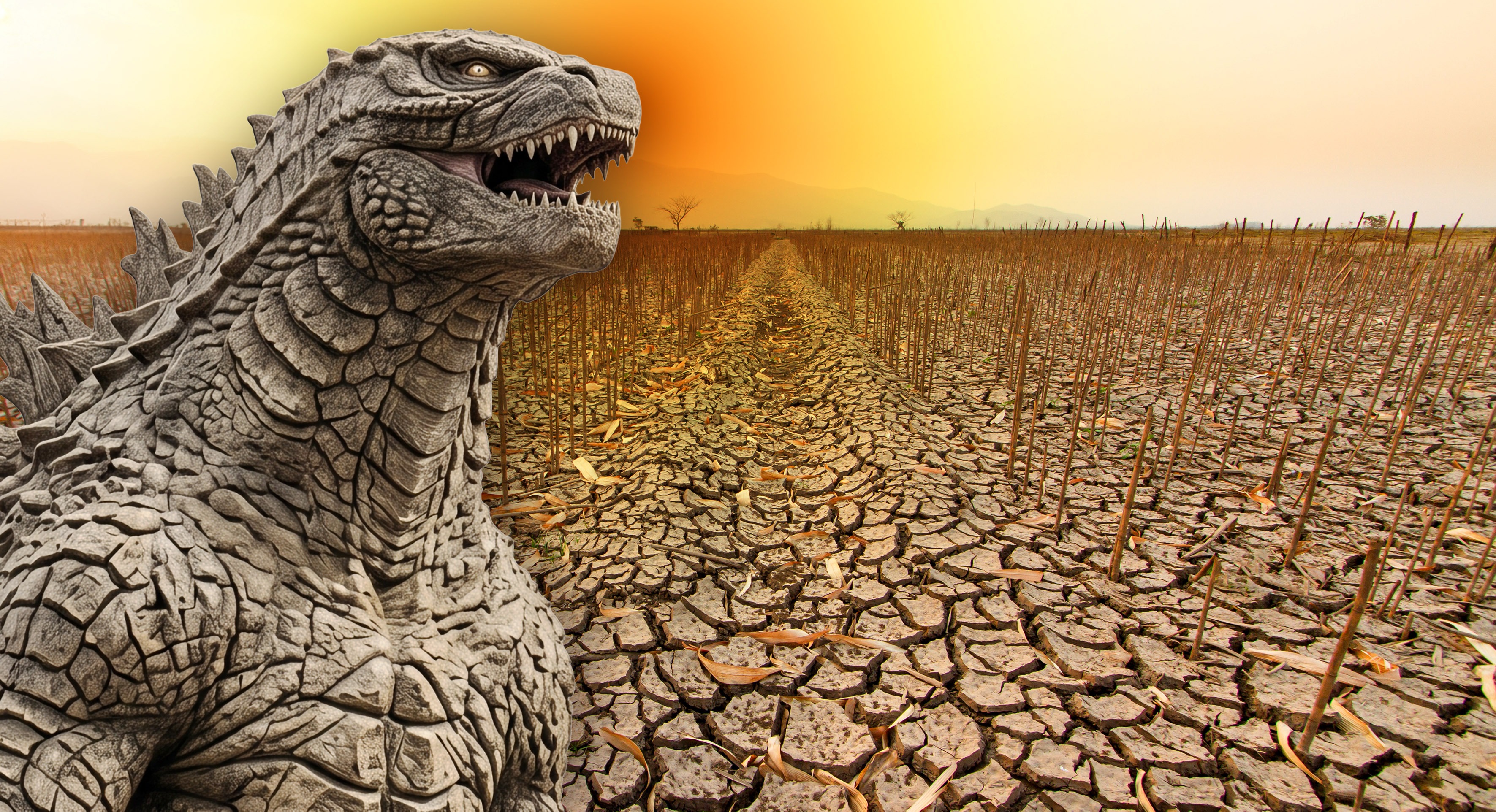
 Illustrative image: Dead maize under an orange sky, capturing the eerie silence of a once thriving agriculture crippled by climate change. (Background: iStock; Godzilla: Gemini AI; Design: Jocelyn Adamson)
 Southern Africa’s history is heavily marked with the spoor of the El Niño weather phenomenon. And with a potentially monster version expected to emerge in the coming weeks, the trail it points to is mostly one of hunger, economic hardship, environmental woes and calamity.
No two El Niño events are the same, and even intense ones in the recent past have not always heralded crippling drought. But climate scientists warn that the signs this time round are extremely concerning.
This El Niño, they say, could rival the intense event of the late 19th century that triggered “the Great Famine” on a global scale, killing millions of people. And its scythe sliced through southern Africa.
“The 1876-78 Great Famine impacted multiple regions across the globe, including parts of Asia, Nordeste [Northeast] Brazil, and northern and southern Africa, with total human fatalities exceeding 50 million people, arguably the worst environmental disaster to befall humanity,” a team of scientists said a decade ago in a ground-breaking paper presented at a meeting of the American Geophysical Union.
“This extremely severe and widespread drought was largely caused by an El Niño that exceeded the extreme intensities of the 1982-83 and 1997-98 El Niños...
“The climatic conditions associated with the Great Famine arose from natural variability, indicating a similar event could occur in the future and simultaneously induce drought conditions across multiple major grain-producing areas.”
/file/attachments/2992/04elnino_896782.jpg "The El Niño condition explained. (Photo: Supplied)")
Climate change adds to fears
This ominous forecast has taken on an alarming sense of urgency as scientists warn that the looming El Niño – pegged to emerge between now and July – could be a “super” or “Godzilla” event that will rival the colossal one in the late 19th century.
El Niño arises from a warming of surface sea temperatures in the equatorial Pacific.
“The El Niño event now likely to develop... has a high chance of becoming strong to very strong,” said Daniel Swain, a climate scientist at the California Institute for Water Resources. Swain said this would be amplified by climate change, which has now seen global temperatures rise about 1.5°C above pre-industrial levels – a threshold regarded as a tipping point into catastrophe.
“In modern human history, we’ve never experienced a strong or very strong El Niño event amid pre-existing conditions that were this warm globally; therefore, it would not be surprising to see some unprecedented global impacts by later in 2026 into 2027 in terms of flood, drought and wildfire-related extremes,” he said.
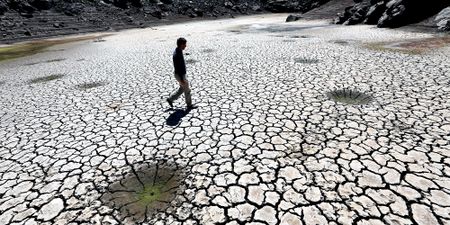
In response to Daily Maverick’s queries, Swain added: “Because of the Earth’s long-term warming trend, caused by the accumulation of greenhouse gases in the atmosphere, each subsequent strong to very strong El Niño event in recent decades has occurred amid warmer and warmer baseline temperatures... Higher global temperatures up the ante on extreme weather events in general by adding extra moisture and energy to the atmosphere.”
Given El Niño’s historical record in southern Africa, this is a grim prospect and the alarm bells are ringing.
Climate change linked to the burning of fossil fuels and other human activities, combined with a powerful El Niño, is a toxic tandem. The World Meteorological Organization (WMO) warned in a report released on 28 May: “Global average temperatures are likely to continue at or near record levels in the next five years. There is an El Niño predicted for 2026, which increases the chances of the following year, 2027, being the next record-breaking year,” said Leon Hermanson, the lead author of the report.
The 1876-78 event did not result in starvation in this region on the scale that occurred in other regions such as in India and China, where tens of millions perished. But it led to droughts and hunger – and to record rainfall in Cape Town.
/file/attachments/2992/04RC2D6EA6971I_750727.jpg "A firefighting helicopter battles a mountain fire burning across large areas of the Table Mountain National Park, in Silvermine, Cape Town, on April 27 2025. (Photo: Nic Bothma / Reuters)")
“Although 1877-78 is described as a ‘great drought’ in SA, 1878 is identified as the wettest year in the 176-year instrumental rain record for Cape Town,” scientists wrote in a 2023 paper in the academic journal Weather.
The researchers compared that event with the intense El Niño of 2015-16, which sparked southern Africa’s worst drought in more than three decades, decimating the staple maize crop and cattle herds.
“Both 2015 and 2016 had lower than average precipitation in Cape Town. The most striking differences with 1877-78 are found in May: extremely wet in 1877 and 1878, and very dry in 2015 and 2016, so that the beginning of the wet season was effectively delayed by a month,” said the researchers.
This, of course, led to stringent water rationing in Cape Town as fears mounted over a looming “Day Zero”.
Varied spoor
The floods that have just lashed the Western Cape, bringing record rainfall in Ceres and causing billions of rand in damage in several parts of the province, preceded this El Niño by possibly just weeks.
El Niño’s impact in the winter months in this region is usually muted. It really bares its fangs in the summer, with its biggest impact during the rainfall season in the maize belt – spanning the Free State, Mpumalanga and North West.
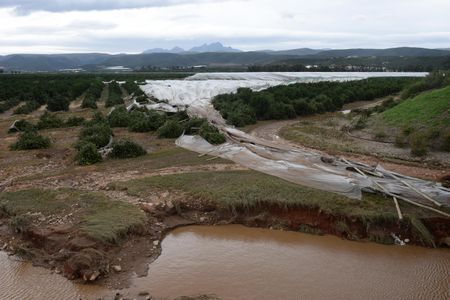
But this comparison is instructive as it underscores that no two El Niños are the same. The spoor it has left in the historical trail varies, leading down divergent paths.
Indeed, the 1997-98 event – regarded as the most intense in the 20th century – did not cause the anticipated droughts in SA and neighbouring countries.
Two of the worst droughts in the region in the previous century occurred during the 1982-83 and 1991-92 El Niños, and these were fresh in the minds of governments, farmers and environmentalists as the 1997-98 version was spawning in the Pacific.
“Expectations of widespread drought across southern Africa were justifiably heightened following the development of the strong 1997-98 El Niño, particularly given that many seasonal climate forecasts made at the time were indicating an enhanced probability of below-average precipitation,” scientists noted in a subsequent paper in The Lancet.
“In a notable exception to the canonical El Niño rainfall response pattern, widespread drought generally failed to materialise in southern Africa in 1997-98, with seasonal rainfall in many areas observed to be near or even above average.”
As the next one emerges amid warnings that it will be a blazer, memories of the 2015-16 and 2023-24 El Niños remain vivid. Both had devastating impacts on the staple maize crop, leaving millions in countries such as Malawi and Zambia reliant on food aid.
/file/attachments/2992/04ED_275385_447952.jpg "The carcass of a sheep on a farm between Calvinia and Williston on 28 December 2020 in the Hantam Karoo district of the Great Karoo in the Northern Cape, South Africa. (Photo: Nardus Engelbrecht / Gallo Images)")
Livestock herds were culled, an especially painful process for subsistence and small-scale farmers on communal lands for whom cattle are a key household measure of wealth. Their asset had cruelly been transformed into a liability by parched grazing fields.
In the late 19th and early 20th centuries, such El Niño events, combined with livestock disease outbreaks, forced many subsistence African farmers off the land and into the exploitative industrial meat grinder of the migrant labour system that defined the mining sector under colonialism and apartheid.
Veld and forest fires also took a grim toll in the most recent events, while dam levels evaporated, posing a threat to water security and restrictions on use that went well beyond Cape Town and its Day Zero scare.
In SA, the average monthly annual inflation rate surged to 6.4% in 2016 from 4.6% in 2015, according to Statistics South Africa data, underlining the point that El Niño is fuel for inflation. And this one will coincide with surging fuel and fertiliser prices stoked by the US-Israel war on Iran.
The Reserve Bank pointedly made mention of El Niño in its Monetary Policy Committee statement on Thursday, 28 May, when it raised interest rates by 25 basis points. It said the bank had looked at three scenarios, and one of them was the potential impact of El Niño.
“All these scenarios imply higher inflation and lower growth... With El Niño added, rates stay high for longer,” it said.
Geopolitical clouds are swirling into a mist of uncertainty that will exacerbate the consequences of this El Niño. If no two are identical, that is also because of other acts on the grand stage of history.
It is also important to point out that El Niño’s claws in the 21st century have been blunted by technological advances. The rise of precision farming, which uses GPS technology to precisely apply inputs and seeds, in SA’s hi-tech and capital-intensive commercial farming sector has greatly boosted yields. The stunted harvests linked to the recent El Niños would have been much worse without these techniques.
/file/attachments/2992/04ED_561087_435066.jpg "Firefighters battle intense flames fanned by strong northerly winds as a fire that began above Boyes Drive in Muizenberg spread rapidly toward St James on 15 June 2025 in Cape Town, South Africa. (Photo: Brenton Geach / Gallo Images)")
This throws into sharp relief the growing gulf between commercial and subsistence farming in the region. Whereas SA’s maize harvest fell about 22% as a result of the 2023-24 event, Zimbabwe’s plunged 60% and Zambia’s was halved. Precision farming and other methods available to the commercial sector made the difference.
The anomaly in recent history was the 1997-98 El Niño, which shows that this weather pattern – even in exceptionally strong phases – does not always leave a trail of destruction in the region.
No two are mirror images of the other, and the historical spoor also contains signs of hope – or at least not of impending disaster. But the tracks generally bode ill and the path they lead to remains to be seen.
A timeline of intense El Niño events
El Niño is one of three phases of the El Niño-Southern Oscillation (Enso), a natural climate cycle whose effects are now amplified by climate change. It is triggered by a warming of surface sea temperatures in the equatorial Pacific. Its polar opposite, La Niña, is the cool phase of Enso. In between is the neutral phase. La Niña usually enhances rainfall in southern Africa, whereas El Niño typically heralds drought.
Following is a brief timeline of some of the intense El Niños and their impacts. According to the Oceanic Niño Index, only three have been classified as “very strong”: 1982-83, 1997-98 and 2015-16. Some scientists have also classified the 1876-78 event as particularly intense.
1876-78
Some scientists and historians regard this El Niño as the worst environmental disaster to befall humankind. The global death toll from droughts and famine has been estimated at about 50 million – more than 3% of the world’s population at the time. Southern Africa suffered droughts, but not hunger and starvation on the scale that struck Asia and South America. It was known as a “Godzilla” event.
1982-83
This event had a devastating impact on SA’s maize crop and is regarded as the “big one” that raised awareness about El Niño. Maize production plunged more than 50% to fewer than five million tonnes, forcing SA – typically a net maize exporter – to rely on imports. This also highlighted the danger of the region’s dependence on white maize as the caloric staple. Outside southern Africa, the variety is only grown commercially in Mexico and the US.
1997-98
Awareness of El Niño was entrenched in SA’s agricultural sector and farmers were bracing themselves. But in much of the summer rainfall region and maize belt, precipitation levels were close to normal, underscoring the point that El Niño does not always unleash drought here.
2015-16
This one was a whopper, and 2015 was the driest year on record in SA. A high temperature of 38°C on 7 January 2016 in Johannesburg set a record. Maize production in SA fell 16% in 2015 and 38% in 2016. Zimbabwe’s plunged 63%, fuelling inflation and hunger. DM
This story first appeared in our weekly DM168 newspaper, available countrywide for R35.
/file/attachments/2992/DM-290526_998749.jpg)