



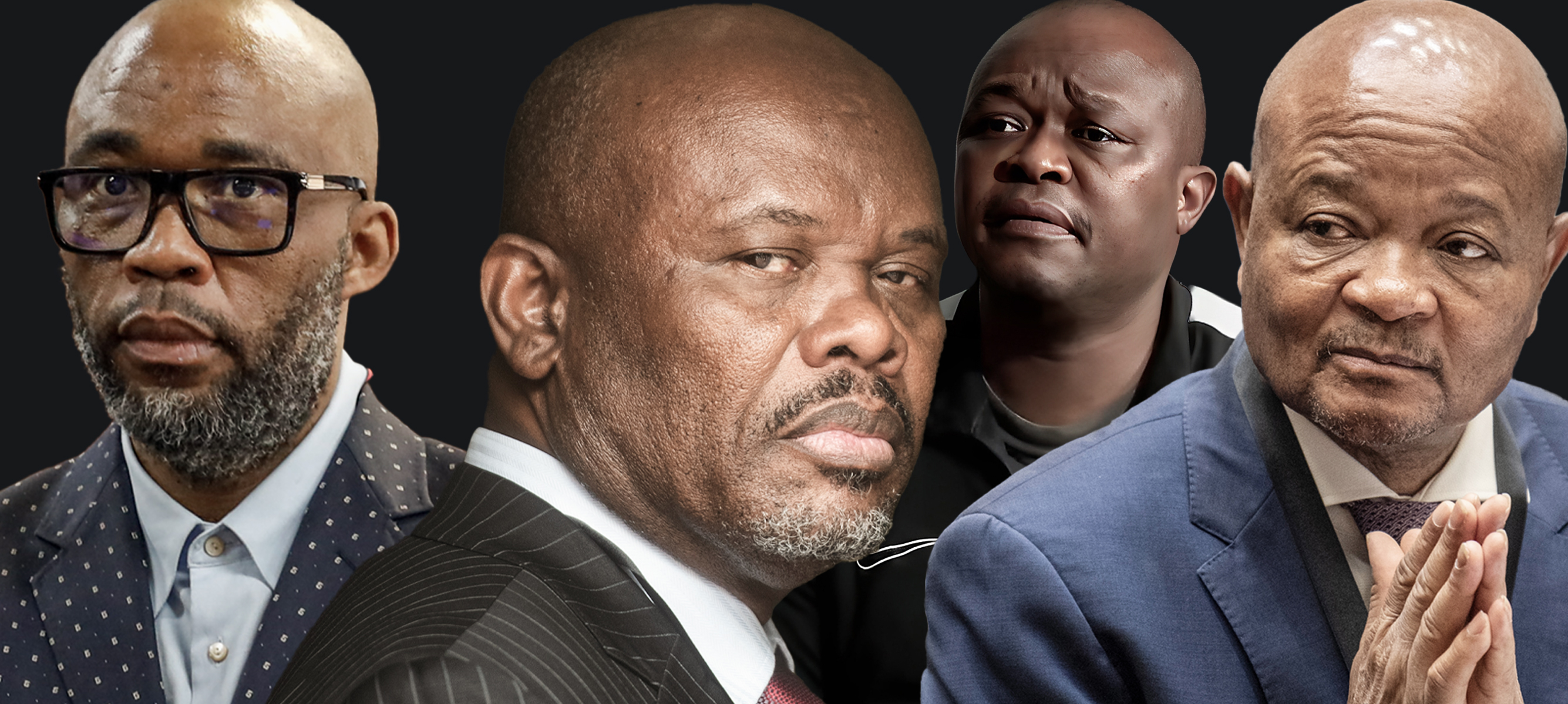
 Illustrative image: From left — Vusimuzi ‘Cat’ Matlala, suspended deputy national police commissioner Lieutenant General Shadrack Sibiya, ANC businessman Brown Mogotsi and suspended police minister Senzo Mchunu. (Photos: Sharon Seretlo / Gallo Images | Brenton Geach / Gallo Images | Screengrab / SABC | Brenton Geach / Gallo Images)
Evidence heard at the Madlanga Commission of Inquiry and Parliament ad hoc committee recently has cast a long shadow over the record of suspended deputy national police commissioner, Shadrack Sibiya, exposing troubling questions about his methods, alliances and the uneasy intersection of policing and power.
The most damaging testimony against Sibiya came from a protected witness, identified only as Witness C – a member of the elite Political Killings Task Team (PKTT). Testifying on Thursday, 30 October, Witness C alleged that the deputy commissioner had received illicit payments from alleged organised crime figure Vusimuzi “Cat” Matlala, a central player in the so-called Big Five cartel.
/file/dailymaverick/wp-content/uploads/2025/09/ED_557542.jpg "Vusimusi ‘Cat’ Matlala. (Photo: Luba Lesolie / Gallo Images)")
Witness C told the commission that Sibiya “was expected to shield Matlala from investigation”. However, evidence before the Madlanga Commission suggests that when Sibiya refused to comply, Matlala turned on him, disclosing details of the alleged transactions now under scrutiny.
Read more: Witness C details ‘Cat’ Matlala’s claims to have bribed minister, top cops
These allegations demonstrate the possible rot within the top brass of South African Police Service (SAPS) and how the Big Five cartel allegedly infiltrated political and law enforcement circles.
Read more: SAPS commissioner accuses police minister of derailing probe into political killings
The Madlanga Commission is hearing evidence of alleged criminality, political interference and corruption within law enforcement, following explosive claims by KwaZulu-Natal police commissioner Lieutenant General Nhlanhla Mkhwanazi, who claimed that top officials had conspired to obstruct investigations into criminal syndicates.
Sibiya was placed on special leave by National Police Commissioner Fannie Masemola – a move that, ironically, stems from allegations that he interfered with the work of the Political Killings Task Team (PKTT).
/file/dailymaverick/wp-content/uploads/2025/11/ED_582226.jpg "Deputy National Police Commissioner, Lieutenant-General Shadrack Sibiya at the Parliamentary Ad Hoc Committee inquiry into alleged corruption and political interference in the criminal justice system at Good Hope Chambers on October 13, 2025. (Photo: Gallo Images / Brenton Geach)..")
This was after Mkhwanazi held a press conference on 6 July where he made a series of astounding allegations against individuals, including Sibiya and the then police minister, Senzo Mchunu.
Read more: Mkhwanazi fallout intensifies as Sibiya told to ‘step aside’ after political killing accusations
Tentacles of the Big Five cartel
During recent testimony at the Madlanga Commission, Crime Intelligence head Lieutenant General Dumisani Khumalo detailed how the Big Five drug-trafficking cartel allegedly infiltrated political and law enforcement circles, as well as private security. He used WhatsApp messages to back up his claims.
Read more: Big Five cartel’s dark web of political ties and criminal operations unveiled by Dumisani Khumalo
/file/dailymaverick/wp-content/uploads/2025/11/ED_585149.jpg "Lieutenant-General Dumisani Khumalo testifies at the Madlanga Commission of Inquiry on 4 November 2025. (Photo: Gallo Images / Frennie Shivambu)")
The Big Five cartel (five key individuals) was connected to various syndicates that specialised in certain crimes. However, Khumalo named only two key individuals – Vusimuzi “Cat” Matlala and Katiso “KT” Molefe.
/file/dailymaverick/wp-content/uploads/2025/09/ED_565542.jpg "Katiso ‘KT’ Molefe. (Photo: Gallo Images / News24 / Rosetta Msimango)")
Matlala faces a string of serious charges, including attempted murder, conspiracy to commit murder, fraud and defeating the ends of justice, linked to incidents that allegedly unfolded in Johannesburg between 12 and 17 October 2023.
He is accused of plotting the murder of his socialite girlfriend, Tebogo Thobejane, and two other complainants. His co-accused – wife Tsakani Matlala, Nthabiseng Nzama, Musa Kekana and Tiego Floyd Mabusela – are also charged alongside Katiso “KT” Molefe over the April 2024 murder of Q Tech engineer Armand Swart in Vereeniging.
A murkier picture about Matlala emerged when the Madlanga Commission heard that Matlala, through his security company, had an agreement with the Ekurhuleni Metropolitan Police Department (EMPD) to supply surveillance technology, suspect-tracking tools and tactical support in pursuing violent repeat offenders.
/file/dailymaverick/wp-content/uploads/2025/11/Metro.jpg "Suspended Ekurhuleni metro police chief Jabulani Mapiyeye. (Photo: Facebook)")
On Thursday, 6 November, suspended Ekurhuleni metro police chief Jabulani Isaac Mapiyeye told the Madlanga Commission that a memorandum of understanding between the metro police department and Matlala’s company, CAT VIP Protection Services, was unlawful.
“Our members don’t have the power to investigate. The activities that the document suggests CAT VIP Protection Services has undertaken with EMPD are illegal activities in the sense [that] they do not have the legislative powers.”
Read more: Vusimuzi ‘Cat’ Matlala and the ‘unlawful deal’ with Ekurhuleni metro cops
Sibiya the crime fighter
Sibiya’s policing career began in 1989 as a 20-year-old student constable at the Hammanskraal Police Academy.
Over nearly four decades, he climbed through the ranks, serving in the detective branch and later leading elite Hawks units in Gauteng and Commercial Crimes.
/file/dailymaverick/wp-content/uploads/Marianne-Hawks-questions.jpg "The former Hawks' head General Berning Ntlemeza (Photo: Lucky Nxumalo/Netwerk24)")
But on 13 August 2015, the first red flag was raised. Sibiya was dismissed by Major-General Berning Ntlemeza, following attempts by Ntlemeza to suspend him and a disciplinary inquiry in which Sibiya had been charged with the illegal rendition in 2010 of Zimbabwean criminal suspects to the Zimbabwean authorities.
Sibiya appealed the dismissal, and evidence presented before the Labour Appeal Court in Johannesburg revealed that he consistently maintained his innocence.
The Labour Court heard that during his disciplinary inquiry, Sibiya claimed he was the victim of a conspiracy to remove him from office. He linked the alleged plot to his earlier efforts to prosecute former Crime Intelligence boss Lieutenant General Richard Mdluli on charges of fraud, corruption, money laundering, murder and kidnapping.
/file/dailymaverick/wp-content/uploads/2022/10/ED_171869.jpg "Former Crime Intelligence boss Richard Mdluli. (Photo: Felix Dlangamandla / Gallo Images / Netwerk24)")
Mdluli – together with the former SAPS supply chain manager, Heine Barnard, and its former chief financial officer, Solomon Lazarus – faces 15 charges of fraud, corruption and contravening the Prevention and Combating of Corrupt Activities Act for allegedly looting Crime Intelligence’s Secret Services Account between 2008 and 2012.
The case was first registered in 2011 — 13 years ago. In May this year, Mdluli and his co-accused pleaded not guilty during the start of their corruption trial in the Pretoria High Court.
Read more: Analysis: The rise and fall of Richard Mdluli, a man who damaged our society
After winning his appeal, the Labour Court ordered Sibiya’s reinstatement on 12 May 2022, effective from 1 July.
/file/dailymaverick/wp-content/uploads/2025/10/WhatsApp-Image-2025-10-14-at-11.33.59_fff9618a.jpg "Lt Gen Shadrack Sibiya in Parliament on 14 October 2025. (Photo: Zwelethemba Kostile / Parliament of RSA)")
He later joined the City of Johannesburg as head of the Group Forensic Investigation Services, leading anti-corruption probes in local government.
But his tenure there soon drew controversy over alleged political interference and irregular procurement of spy equipment – claims Sibiya has denied, insisting the counterintelligence purchases were lawful.
Read more: Shadrack Sibiya and Mayor Phalatse hit back at claims of counterintelligence equipment purchase
In 2023, Sibiya returned to the SAPS and was promoted to the rank of Lieutenant General following his appointment as Deputy National Commissioner for Crime Detection.
Sibiya’s fall from glory
Explosive testimony before the Madlanga Commission and Parliament’s ad hoc committee has cast a dark shadow over Sibiya’s name. Though unproven, the allegations have shaken his once-sterling image as a symbol of integrity within the police ranks.
The allegations include:
- The ad hoc committee has heard that at the end of last year, Mchunu sent out a directive to freeze the filling of vacancies in the Crime Intelligence unit and to disband the PKTT, which was created six years earlier. This was corroborated by Crime Intelligence head Khumalo on Tuesday, 4 November, who said that several police intelligence posts have not been filled because of a stalemate with Sibiya over the appointment of a panel. What is odd is that before Mchunu issued the directive on 31 December 2024 to immediately halt the filling of key crime intelligence posts, the stalemate between Sibiya and Khumalo already existed;
- Witness C alleged that Matlala paid Sibiya up to R1-million a month in bribes, including R2-million to purchase a plot and 20 impalas, which have since died;
- Khumalo also added detail to allegations that Sibiya received kickbacks from criminals. It is Khumalo’s evidence that Sergeant Fannie Nkosi, a detective in Sibiya’s office, served as the go-between for Sibiya and murder accused Molefe. Nkosi’s alleged links to the cartel were underscored when CCTV footage played before the commission showed him stepping out of a state-owned vehicle at Molefe’s Sandhurst home. Within 10 minutes, he reappeared, carrying a white bag and walking back to the car alongside Molefe; and
- Sibiya used a Toyota double-cab bakkie owned by convicted criminal Stuart James Scharnick. Of the 34 criminal charges Scharnick faced, he was found guilty in 18 cases, 11 were withdrawn and he was acquitted on five.
Another explosive issue was the removal of PKTT dockets. At a press briefing, Mkhwanazi revealed that on 26 March 2025, 121 case files were seized from the task team on the orders of Sibiya – allegedly acting under direct instruction from the police minister to disband the unit. This comes after Mkhwanazi accused Sibiya of being part of an overall plot to thwart investigations into a crime cartel.
/file/dailymaverick/wp-content/uploads/2025/10/ED_572295-1.jpg "KwaZulu-Natal police commissioner Lieutenant General Nhlanhla Mkhwanazi. (Photo: Gallo Images / Frennie Shivambu).")
However, during an appearance in Parliament on Tuesday, 14 October 2025, Sibiya accused Mkhwanazi of playing with the emotions of South Africans as part of a plot against him.
During the proceedings Sibiya was asked if he was a corrupt cop, to which he replied: “I am not.”
Another flashpoint is Sibiya’s alleged dealings with two figures at the centre of the law enforcement scandal — ANC businessman Brown Mogotsi and Matlala.
/file/dailymaverick/wp-content/uploads/2025/11/ED_582658-1.jpg "Police Minister Senzo Mchunu at the Parliamentary Ad Hoc Committee inquiry into alleged corruption and political interference in the criminal justice system at Good Hope Chambers on October 17, 2025. (Photo: Gallo Images / Brenton Geach)")
Mogotsi, a political insider from North West, has been described as an information peddler with ties to Mchunu. Mkhwanazi previously alleged that Matlala was financially supporting Mogotsi and Mchunu’s political aspirations.
Read more: Registration of ‘Cat’ Matlala’s private security company sparks shakeup at industry watchdog
But speaking before Parliament’s ad hoc committee, Sibiya insisted he had “never been a rogue officer” in his 37 years of service, flatly denying every allegation against him.
For now, it’s a matter of waiting as more evidence surfaces before the Madlanga Commission. The inquiry’s revelations have already forced uncomfortable questions about who truly holds the line between law enforcement and organised crime – and how easily that line can blur when power and loyalty collide. DM