




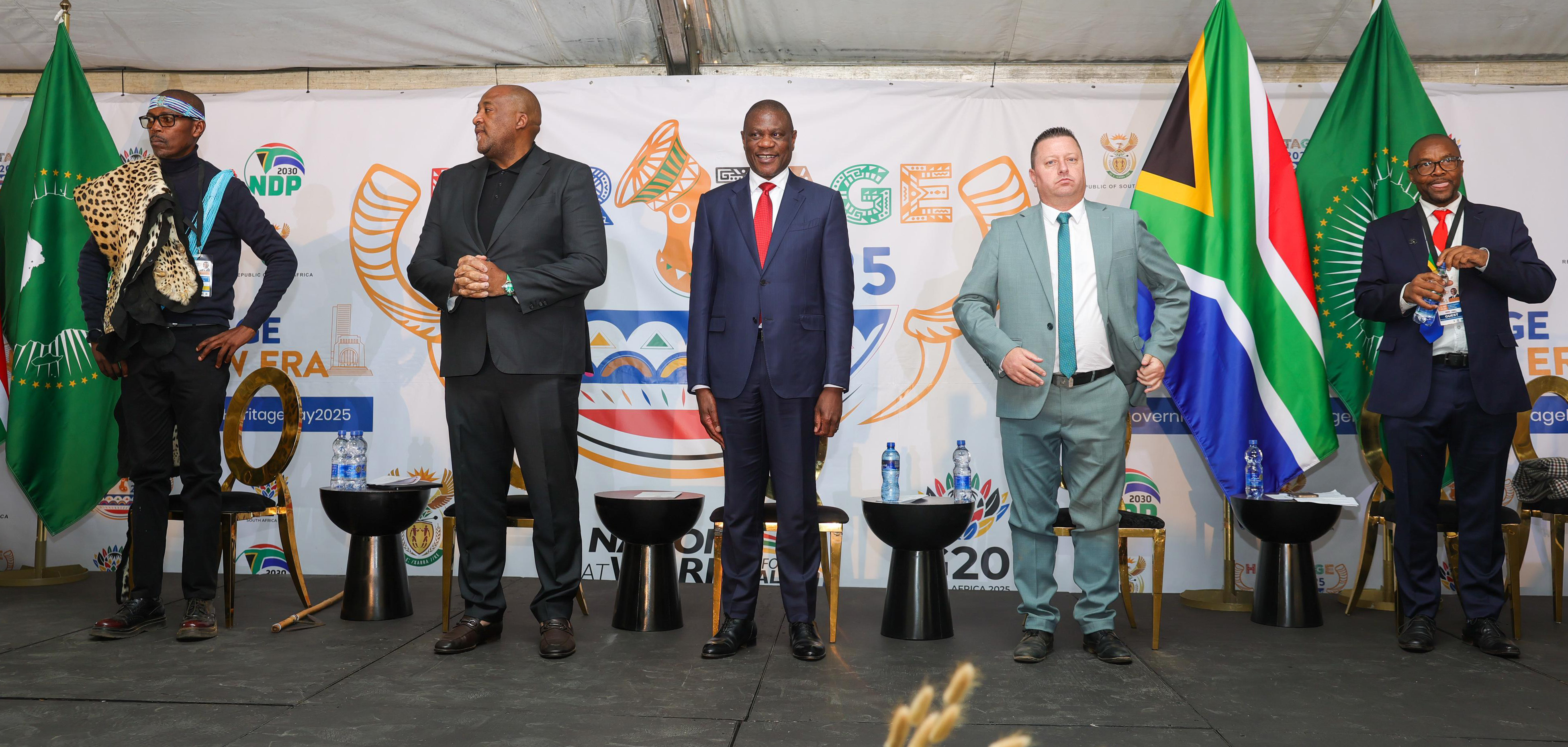
 Deputy President Paul Mashatile (centre) and Minister of Sport, Arts and Culture Gayton McKenzie (second from left) at the Heritage Day celebrations at the Dysseldorp Sekondêr Skool in Oudtshoorn, Western Cape. (Photo: Fikile Marakalla / GCIS)
As millions of people in South Africa celebrated Heritage Day on Wednesday, 24 September, Deputy President Paul Mashatile took to the podium at Bridgeton Sports Grounds in Oudtshoorn, in the Western Cape, to deliver his Heritage Day commemorative speech.
Acting President in President Cyril Ramaphosa’s absence, Mashatile called for a “radical reimagining” of South Africa’s heritage institutions and a renewed commitment to national dialogue, urging South Africans to see heritage not only as a link to the past but also as a foundation for an inclusive future.
Mashatile framed the day’s theme – Reimagine our heritage institutions for a new era – as both a challenge and an opportunity.
“It encourages us to honour our history while looking to the future. It is a call for fresh perspectives on how we can preserve and showcase our history in the ever-evolving landscape of our society,” he said.
“As we celebrate our heritage, may this moment serve as a time of activation; let it be an opportunity to reimagine our heritage institutions not as remnants of a past era, but as beacons of possibility in a changing and globalising world,” Mashatile said.
Heritage as a force for unity and innovation
Mashatile emphasised that heritage institutions such as museums should not remain static or confined to the past, but must adapt to the realities of the 21st century.
“They serve as a bridge between the past and the present, allowing us to connect with our roots and understand where we come from. It is in the understanding of our roots that we can lay a solid foundation for our future as a society.’
Invoking the words of President Nelson Mandela, Mashatile reminded his audience, clad in traditional attire, that inclusive and accessible museums and monuments can strengthen democracy. Quoting Mandela, he said: “When our museums and monuments preserve the whole of our diverse heritage, when they are inviting to the public and interact with the changes all around them, then they will strengthen our attachment to human rights, mutual respect and democracy and help prevent these ever again being violated.”
This, Mashatile noted, underscores the need to transform museums and cultural sites into “spaces of cultural diplomacy, inclusivity, intergenerational conversation, laboratories of creativity and incubators of opportunities for our people, particularly the youth”.
While Mashatile emphasised the important role museums play in preserving South Africa’s heritage, he said nothing about the financial challenges these heritage institutions face to keep their doors open or the government’s plan to help them along the way.
Over the past five years, there have been multiple reports about popular and important museums finding themselves in financial dire straits and facing closure.
These challenges are not new and can be traced back to the Covid-19 pandemic, when museums were forced to close their doors as a result of the lockdown. However, when the country opened up again, the heritage institutions were plagued by low visitor numbers and a lack of financial support.
Earlier this year, Ditsong Museums of South Africa (DMSA) reported a loss of R6.4-million in the 2024/25 financial year. In fact, the institution has failed to record a profit in the last five years.
Ditsong Museums is a collection of eight national museums in Pretoria and Johannesburg, managed by the Department of Sport, Arts and Culture. The museums cover diverse fields including natural and cultural history, military history and historical figures and landmarks.
In 2021, the Apartheid Museum was forced to close its doors, albeit temporarily, as it reopened in 2022 and continues to be operational.
Lilieslief Farm in Rivonia, the birthplace of uMkhonto we Sizwe (the original armed wing of the African National Congress, not Jacob Zuma’s party) and the site of the 1963 raid that resulted in the arrest of Mandela, Walter Sisulu, Govan Mbeki and other struggle heroes, also suffered a situation similar to the Apartheid Museum.
A City Press report suggested that the heritage site is under threat once again, as funding is drying up following the passing of CEO Nicholas Wolpe in August last year.
Additionally, heritage sites such as the Robben Island Museum and Winnie Mandela House in Brandfort have been mismanaged or neglected for years, yet no plan of action has been communicated to the public.
Despite not highlighting the constraints faced by heritage institutions, Mashatile closed with a call to action that captured the essence of his address.
“As we celebrate our heritage, may this moment serve as a time of activation; let it be an opportunity to reimagine our heritage institutions not as remnants of a past era, but as beacons of possibility in a changing and globalising world. Together, let us turn memory into momentum and heritage into hope for a new era of bold imaginings.”
National dialogue as a tool for healing
In his address, Mashatile argued that Heritage Day is not only about looking back but also about building unity in the present.
Key to this vision, the acting president said, is the National Dialogue, which he described as a platform for all South Africans to collectively shape the country’s future.
Read more: Preserving our heritage — embracing indigenous knowledge for future generations
“The National Dialogue is a citizen-led process and is an opportunity for all South Africans to confront uncomfortable truths about our democracy and reimagine a shared future for South Africa, where no one is left behind,” he said. “It is a crucial platform for all voices, regardless of age, location, race, class or culture, to shape the future of our democracy through meaningful, inclusive dialogue.”
He reminded the audience that South Africa has long relied on dialogue in moments of national transition, from the Convention for a Democratic South Africa to the Truth and Reconciliation Commission. DM