




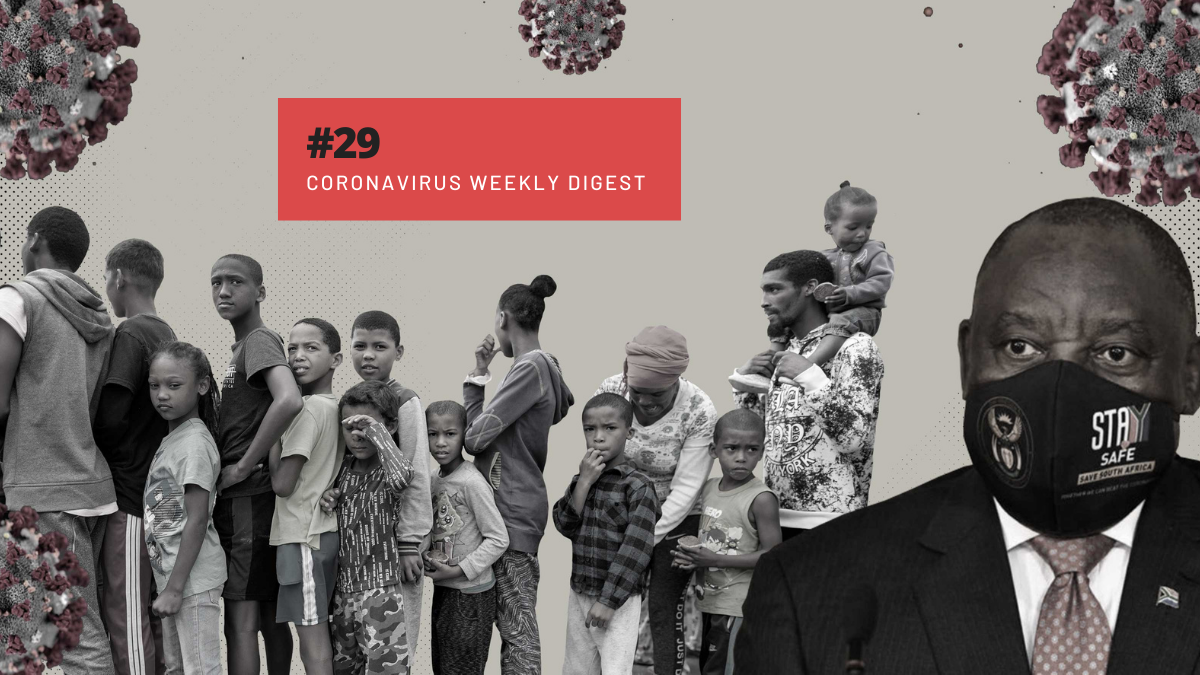
 Compilation image by Sahra Heuwel.
One of SA’s biggest Covid ICU wards closed after fire
/file/dailymaverick/wp-content/uploads/Greg-charlottemaxekefire01.jpg "The entrance to the parking garage at Charlotte Maxeke Academic Hospital. (Photo: Shiraaz Mohamed)")
Over 800 patients were evacuated from the Charlotte Maxeke Academic Hospital in Johannesburg last weekend after a fire broke out. The hospital remains closed. It is the second-largest tertiary hospital in the southern hemisphere and has one of the country’s biggest Covid-19 ICU wards. In addition, about R40-million worth of personal protective equipment was lost in the blaze. Greg Nicolson unpacks how a series of failures led to this situation.
Read more: Fire and Vice – Mismanagement, poor planning and corruption spark disastrous blazes
Sisonke Protocol expected to restart
/file/dailymaverick/wp-content/uploads/Shiraaz-vaccines-northwest15.jpg "A healthcare worker is vaccinated at Klerksdorp Hospital as part of the Sisonke (Together) programme. Sisonke will be rolled out to as many as 500,000 healthcare workers across the country. (Photo: Shiraaz Mohamed)")
The South African Health Products Regulatory Authority recommended last weekend that the Sisonke Protocol can continue to vaccine – if a set of new conditions are met. No healthcare workers have been vaccinated since it was suspended on 13 April. The regulatory authority’s president, Prof Glenda Gray, has assured that “extremely rare” side effects are unavoidable but there are systems in place to detect and analyse them. Read more here.
As a result, the health department will soon announce when the trial will be resumed, said Khumbudzo Ntshavheni, acting minister in the presidency, told the media on Thursday 22 April. She said: “The reviewed data confirmed that South Africa has not experienced any rare blood clots with the already vaccinated healthcare workers.”
Read more: How South Africa’s Covid-19 vaccine injury fund will work
Read more: Hit me with your best shot – Covid-19 vaccine safety is strictly monitored – here’s how
Western Cape pleads with residents to push back third wave
/file/dailymaverick/wp-content/uploads/OD-Sune-WindeCovidVac.jpg "Premier Alan Winde. (Photo by Gallo Images/Brenton Geach)")
Western Cape authorities have told residents that a third wave of Covid-19 infections is “a given”, but that non-pharmaceutical interventions can delay it. Premier Alan Winde lamented the fact that “far too many people are behaving as if this thing is over”. There are currently 2,034 active Covid-19 cases in the province and is said to be “in-between” peaks of Covid-19 infections. Read more here.
Gqeberha hospital CEO believes the hospital will come out stronger after the pandemic
/file/dailymaverick/wp-content/uploads/MC-Living-EE.jpg "Dr Mtandeki Xamlashe who has been acting as the CEO for the Livingstone Tertiary Hospital in Gqeberha. (Photo: Deon Ferreira)")
Doctor Mtandeki Xamlashe became the CEO of Livingstone Hospital in Gqeberha just after the first wave of Covid-19 infections brought it close to collapse and closure. Seven months later, he is still working on helping the hospital to recover – he estimates that a full recovery will take five years. In a “brutally honest” interview with Estelle Ellis, he details how the hospital went from near collapse to managing to survive — even if just from day-to-day. Read the interview here.
Wastewater surveillance for Covid-19 continues
/file/dailymaverick/wp-content/uploads/MC-spotlightWastewater.jpg "A team from the South African Medical Research Council collects samples from wastewater treatment plants in Cape Town. (Photo: SAMRC / Wikipedia)")
Since July 2020, the South African Medical Research Council has been analysing wastewater samples from the Eastern Cape, Western Cape, Limpopo and Gauteng for traces of Covid-19. This method gives researchers another way to determine the amount of Covid-19 in the population. Read more about this study here and view the data dashboard here. DM/MC.
Comments
Scroll down to load comments...