




 Solar panels on top of a warehouse near the hydrogen electrolysis plant at Energiepark Mainz, Germany. South Africa must strive to grow its green hydrogen economy, says Minister of Trade, Industry and Competition, Ebrahim Patel. (Photo: Bloomberg via Getty Images)
“That is a big deal,” said Luiza Demoro, a Brazil-based BNEF analyst. “It shows that we are going in a good direction. It’s good for the climate.”
In terms of total power produced, renewables technologies including hydro last year accounted for 27% last year, up from 20% in 2010, according to the report.
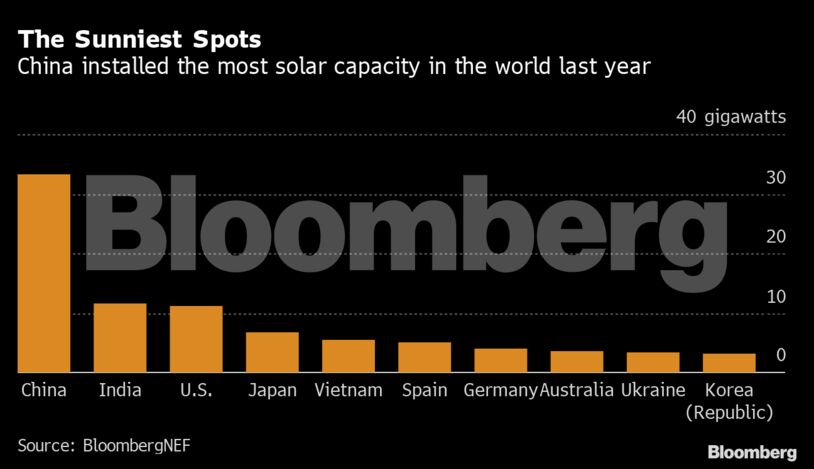
Global installations of natural gas-fired power -- which in 2010 was the No. 1 technology installed in more than one-third of the world -- fell to a 10-year low in 2019. Meanwhile, 81 countries installed at least 1 megawatt of solar last year, with China and India being the top markets for new capacity.
Read more: Utilities Are Slowing Down the Clean Energy Transition
Still, the world added 39 gigawatts of net new coal capacity, up from a 10-year low of 19 gigawatts in 2018.
“This is a good start, but it’s not enough in the long run,” Demoro said in an interview. “Coal still represents a big share -- 29% of installed capacity globally, and 35% of all the power produced last year. There is a lot of work to be done to replace that capacity.”
Comments
Scroll down to load comments...