



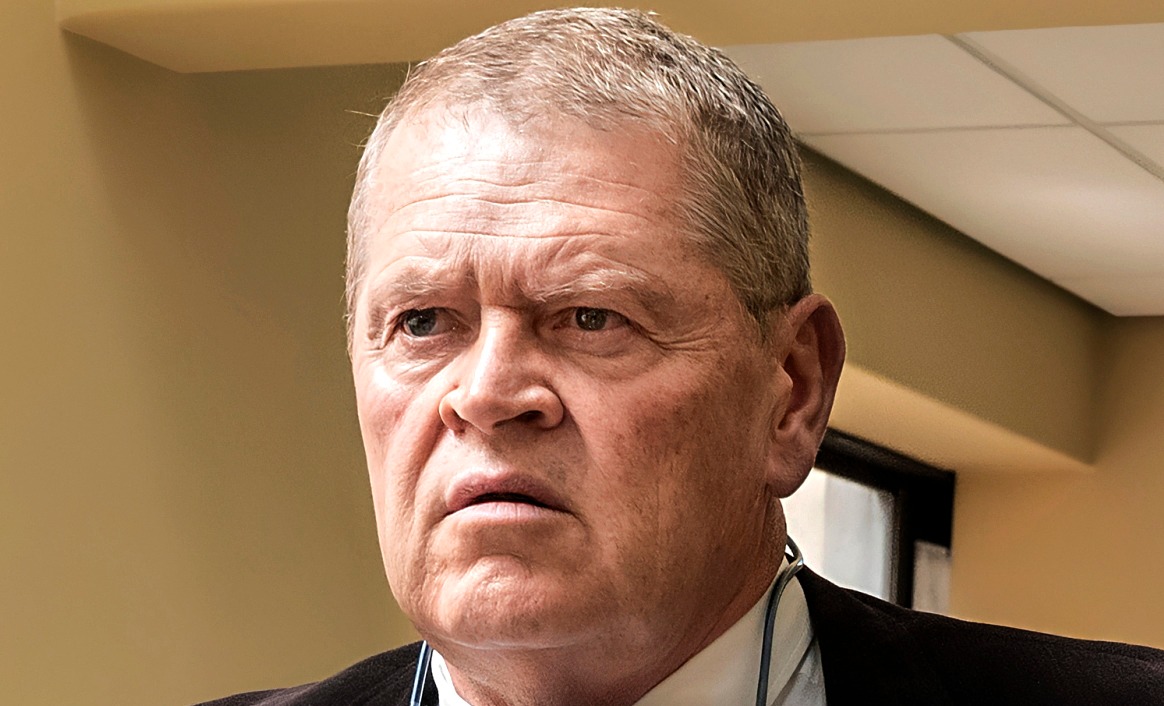
 Veteran investigator Andrew Leask has revealed shocking connections between high-ranking officials, including former police leadership, and apartheid-era atrocities. (Photo: Gallo Images / Beeld / Deaan Vivier)
Correction:
We have made a number of edits to this article since publication to clarify an error which has caused a number of inaccuracies.
The Executive Director of the Foundation for Human Rights, Zaid Kimmie, has pointed out that our coverage of the evidence of the man who tried to unravel the knot of those implicated, investigator Andrew Leask, incorrectly situated Holmes at the pointing out of a planted weapons cache in 1991 and Bambo’s subsequent killing.
Kimmie pointed out that our reporting that Bambo was “taken” out while being “escorted” by a Captain Koekemoer of the East Rand Robbery Unit and Mike Holmes was inaccurate. He is right.
Below is the testimony of Leask pertaining to Bambo’s murder.
“So in the course of the investigation I managed to establish that members of Vlakplaas assisted a colleague of Captain Mike Holmes, I think at the time it was a Lieutenant Koekemoer, he was Lieutenant Koekemoer at the Murder and Robbery Unit who was, they assisted him to go and set up a DLB, dead letter box or an arms catch [sic] in the area of Nelspruit.”
The assertion is that a colleague of Mike Holmes, Koekemoer, was working with members of the Vlakplaas unit. It ought to have been clear that Leask was not implying that it was Holmes who was working with the Vlakplaas unit.
Leask’s testimony continues:
“So the Murder and Robbery Detective Koekemoer, accompanied by a Vlakplaas operative, Duiwel Brits, took certain explosives and weapons, went to Nelspruit, set up the DLB, drove back, and on the next day Strong Man [Bambo], who had been rearrested was in detention, booked him out, took him out on a pointing out that he was going to do pointing outs on an arms cash, took him to the same arms cash, reported that he was attacked by the suspect. If I remember correctly a hand grenade went off, he shot the man and they killed him.”
Three people, Eugene de Kock, Duiwel Brits (who supplied the above information to Leask), and Lionel Snyman received amnesty for the murder of Adrian Bambo. Mike Holmes is not mentioned in the Amnesty Decision, but Koekemoer (who did not apply for amnesty) is extensively referenced.
Adv Varney, perhaps concerned that the testimony had indicated some sort of link between Holmes and Vlakplaas, revisited this issue during his cross-examination:
Adv Varney: "And we are concerned that there might be a link or some kind of question mark over Mike Holmes, given that, according to you and your evidence-in-chief, members of Vlakplaas consulted a colleague of Mike Holmes, a certain Lieutenant Koekemoer, at East Rand Murder and Robbery.”
Kimmie said it was clear that Bambo was removed from custody without informing Holmes, that in fact the Vlakplaas team “feared that Mike Holmes was involved”, Leask says. He also says “Mike Holmes, because he discussed it with me at the stage and said, ‘I knew nothing about this’.”
Kimmie said while he had no link or relationship with Mike Holmes, “nor do I have any interest in protecting his reputation. I do, however, think that the Khampepe Commission’s work is important and that sensationalist and erroneous reporting detracts attention from that work.”
We agree. We have corrected the references and added Varney’s cross-examination and Leaks’ elucidation. We regret the error.
***
Andrew Leask, one of the first investigating officers to assist the Directorate of Special Operations (the Scorpions) with TRC probes, spent years trying to piece together who was responsible for the kidnapping and murder of student and covert ANC courier, Nokuthula Simelane, in 1983.
And while his investigations were conducted more than 22 years ago and came to nothing, Leask’s memory of the atrocity and those implicated remains clear. He began investigating the matter in 1996, and was later instructed in 2011 to hand over the comprehensive docket to none other than Captain Mike Holmes.
Gunning for ANC leadership
On Wednesday, 25 January 2026, at the Khampepe Commission of Inquiry into TRC prosecutions delays, the investigator also set out how former SAPS Commissioner Johan van der Merwe had contacted him in 2004 wanting to offer “an opportunity to make available information or evidence that could assist in establishing a criminal case against the leadership of the ANC”.
/file/dailymaverick/wp-content/uploads/Kevin-Bloom-An-apartheid-murder-reckoning-part-III.jpg "Nokuthula Simelane. (Photo: Courtesy of the family)")
Van der Merwe and a Mr Wagenaar, legal representative of the implicated generals and former senior apartheid SAPS officials, had told Leask that documents and statements had been obtained and that Wagenaar was working on these. However, Leask was never contacted again by either man.
Asked whether Advocate Chris Macadam – who replaced Advocate Anton Ackerman at the Priority Crimes Litigation Unit (PCLU investigating TRC cases) – had instructed Leask to obtain any documents mentioning former president Thabo Mbeki from Van der Merwe, Leask replied that Mbeki’s name had never come up.
Leask also informed the panel that many of those involved in atrocities, including the murder of Simelane, were still alive.
Eliminating the witness
Leask told the inquiry that in 1991, two years before the Hani assassination by Janusz Waluś, suspicions had been raised about Holmes’ knowledge of the killing of Adrian “Strongman” Bambo, who had witnessed the horrific torture of Simelane.
The 23-year-old student at the University of Swaziland had first been held captive for a week in a rooftop room used by the security police at the Norwood police married quarters in Johannesburg. She was guarded 24 hours a day while security policemen Willem Coetzee and Anton Pretorius took turns assaulting her.
When her screams grew too loud, disturbing the neighbours, Simelane was driven to a remote farm in Westonaria where she was held in a small outbuilding for more than a month under 24-hour armed guard.
A bag was placed over her head, she was given electrical shocks and was dragged one night and thrown into a “Zinc dam” to recover between bouts of assaults. She was last seen in December – bound, battered and bruised – in the boot of Coetzee’s car.
Bambo, an askari (a turned liberation fighter), was “taken out” – shot dead – while being “escorted” by a Captain Koekemoer of the East Rand Robbery Unit to point out a “planted” arms cache in 1991.
Just hanging around
The late Holmes had once headed the notorious Brixton Murder and Robbery Unit and had had links to Koekemoer as the two had worked together in the past.
Koekemoer, once described by Vlakplaas Commander Eugene de Kock as a “good investigator”, was approached by members of Vlakplaas about eliminating Bambo, said Leask.
While Holmes was not the assigned investigating officer in the Simelane matter after Leask had been asked to hand over his extensive dockets to Priority Crimes Unit head Inspector Neville Thoms, the detective seemed to hang around the office, which was “a nodal point” for TRC investigations at the time.
Leask had hoped his investigations into Simelane would be taken further to link high-ranking officials to apartheid-era atrocities, including a broader probe into General Izak Johannes “Krappies” Engelbrecht, the former head of Counter Intelligence.
Years later, when the original Simelane docket was relocated after having gone “missing”, it was found that no statements had been taken by Captain Holmes.
Asked whether he had expected the matter to proceed swiftly after handing over to Holmes, Leask said: “Absolutely. In fact, I thought that the Bambo matter was at an even more advanced stage than the Nokuthula matter.
“Obviously the difficulties of at the time, in the 90s, was the: was it a missing person or a murder? But the Bambo matter was, in my view, clear-cut. We had witnesses, we knew what happened, there was just a version of the main perpetrator indicating that he had acted in self-defence, whilst we had witnesses that said it was nothing else but a set-up to assassinate the man,” he said.”Taken out” while allegedly pointing out an arms cache.
Bambo, who was a well-known criminal and armed robber, had been initially arrested by Koekemoer. He had somehow escaped, perhaps aided, said Leask, committed a further robbery and had been rearrested.
There was a fear that Bambo’s arrest date might pose a “potential risk” to those in the security police responsible for Simelane’s abduction and murder.
“What happened is that Koekemoer had arranged on a Monday for a warrant officer, a junior, to book Bambo out, saying he had information that he was involved in arms smuggling and needed to do a point-out.”
On the previous Sunday, preparation for a Dead Letter Box – a secret location used to pass on items or information, such as one used for a hidden arms cache – was done before Bambo was booked out by the warrant officer accompanied by Koekemoer. Bambo was “taken out” – murdered – while allegedly pointing out the cache, with Koekemoer claiming the suspect had attempted to detonate a hand grenade and attack him.
/file/dailymaverick/wp-content/uploads/2021/05/08-8.-Eugene-de-Kock-by-marco-pieterse-Wiki-Commons-1.jpg "Eugene de Kock. (Photo: Marco Pieterse / Wiki Commons)")
Eugene de Kock was the former commander of the Vlakplaas unit that employed asakaris and who ran the Vlakplaas killing headquarters.
De Kock was sentenced on 121 charges of murder. He was released on parole in 2015. The Zondo Commission of Inquiry into State Capture heard how former president Jacob Zuma’s government had supported De Kock financially, paying him R40,000 a month and providing a safe house on his release.
Apart from De Kock, Duiwel Brits (who supplied the above information to Leask) and Lionel Snyman received amnesty for the murder of Adrian Bambo. Mike Holmes was not mentioned in the Amnesty Decision, but Koekemoer (who did not apply for amnesty) was extensively referenced. “Operation Lock” was overseen by Zuma’s Minister of State Security, David Mahlobo, the Zondo Commission heard. Mahlobo has since distanced himself from these allegations.
Advocate Gerrie Nel, for Leask, told the commissioners: “We are concerned there is a link or a question mark over Mike Holmes given that, according to your evidence-in-chief, members of Vlakplaas consulted with Koekemoer.”
Asked by Nel whether there had been any arrest or movement on the Bambo matter, Leask replied that he had been informed that the Director of Public Prosecutions in Pretoria had declined to prosecute.
“As we speak to you today, we are not aware of any arrests or movement in that matter?”
“No,” replied Leask.
Advocate Howard Varney, for the families, later during Leask’s cross-examination asked whether there was a concern “that there might be a link or some kind of question mark over Mike Holmes, given that, according to you and your evidence-in-chief, members of Vlakplaas consulted a colleague of Mike Holmes, a certain Lieutenant Koekemoer, at East Rand Murder and Robbery?”
To which Leask replied: “When I said a colleague of Mike Holmes, Koekemoer worked in the very Murder and Robbery Unit, the East Rand Murder and Robbery, where Mike Holmes worked. I can indicate that – and I am speaking from my knowledge of how the Murder and Robbery units worked – what stood out is that detectives would come to a police station and involve themselves in a matter where you were the investigator. Come to question them, it should not happen.”
He said what stood out in the Bambo matter “is that my understanding was that they feared Mike Holmes was involved. He was a Senior Captain in the Murder and Robbery. He was closely involved in the matters that were bringing Strongman to book.”
“So the whole reason for that inquiry was established on the Sunday and the Monday the man gets booked out, taken away and the detectives, including Mike Holmes, because he discussed it with me at the stage and said, "I knew nothing about”.
The commission was told that despite clear evidentiary links between the Bambo and Simelane cases, the Directorate for Priority Crime Investigation (the Hawks) and the National Prosecuting Authority had been reluctant to cooperate with the Simelane’s lawyers regarding Bambo, claiming the family lacked a formal power of attorney from his family. DM
Comments
Scroll down to load comments...