



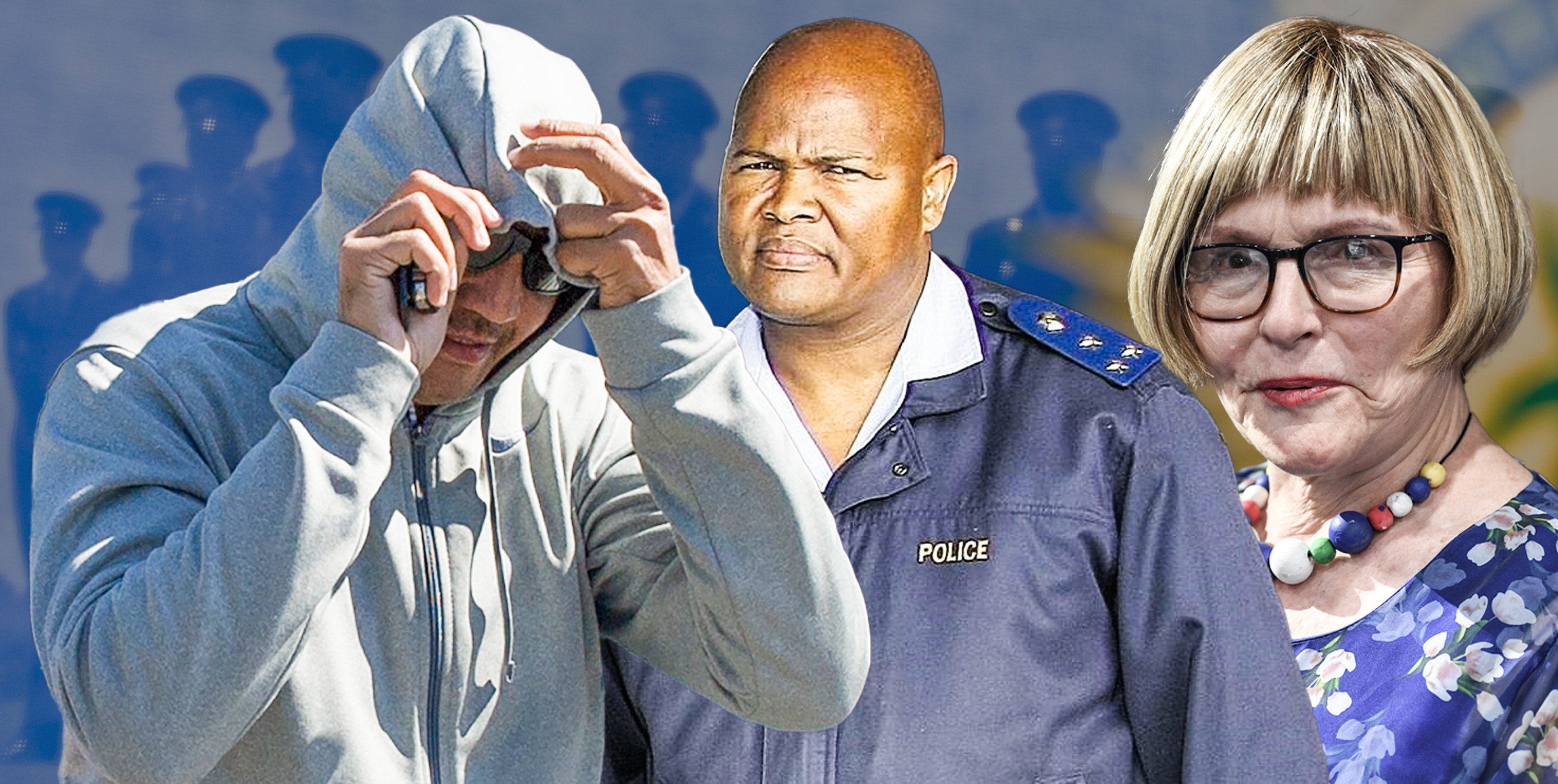
 Illustrative image: Background: Police parade at the SAPS college in Pretoria West. (Photo: Gallo Images / Foto24 / Craig Nieuwenhuizen) | From left, former Crime Intelligence police officer Paul Scheepers. (Photo: Jaco Marais / Netwerk24) | Former Western Cape Crime Intelligence head Mzwandile Tiyo. (Photo: Facebook) | Former Western Cape premier Helen Zille. (Photo: Gallo Images / Lefty Shivambu)

Two raids were carried out in quick succession at the private properties of police officers in South Africa’s gang violence epicentre, the Western Cape, in 2015.
Both these policemen went on to face a pile of controversy and legal issues.
Now one, former Crime Intelligence officer Paul Scheepers, has been convicted of various crimes and faces a possible jail sentence.
The case against Scheepers has dragged on for nearly 11 years, and while it may now be in its final stages, several unanswered questions linger over him and his former employer – the South African Police Service (SAPS), notably its Crime Intelligence unit.
These questions tie into unsettling suspicions relating to dirty politics and underhanded plots targeting, or concocted among, police officers.
The Scheepers convictions
On 30 January 2026, Scheepers was convicted in Cape Town of various crimes.
This included fraud, money laundering and the contravention of legislation involving the Private Security Industry Regulatory Authority (Psira) and the Regulation of Interception of Communications and Provision of Communication-related Information Act (Rica).
The Psira conviction is because he ran a private investigations company, Eagle Eye Solutions, without the necessary registration, while the Rica conviction is because he procured and sold a surveillance device – a grabber – without authorisation.
According to the Western Cape’s National Prosecuting Authority, these convictions are the first of their kind. Scheepers will be sentenced in April.
The raids
The former policeman started up Eagle Eye Solutions in 2003 while actively employed as a Crime Intelligence officer (the State viewed this as him moonlighting as a private investigator without proper approval from the police service).
In 2010, Eagle Eye obtained a contract to provide debugging services for the Western Cape’s DA government.
This essentially connected Scheepers to the DA, an issue that later surfaced as controversial.
Fast-forward five years.
/file/attachments/orphans/scheepers-guilty-caryn2_450159.jpeg "Former Crime Intelligence officer Paul Scheepers. (Photo: Jaco Marais / Netwerk24)")
In April 2015, police officers raided policeman Mzwandile Tiyo’s home in the Western Cape town of Paarl.
He had previously acted as the Western Cape’s Crime Intelligence head. It was alleged that he was under investigation for drunk driving, but his lawyer had countered that there was no basis for this.
About two weeks after the Tiyo raid, police officers also searched and seized items from Scheepers’ Eagle Eye office in Cape Town.
Tiyo went on to head Crime Intelligence in the Western Cape, but controversy and accusations later resurfaced against him.
Scheepers, meanwhile, was arrested after the 2015 Eagle Eye raid and criminally charged.
The cop-gang accusations
In a 2015 affidavit to try to have the Eagle Eye raid search warrant declared unlawful, Scheepers detailed his version of what led to that police action.
He had said: “During early 2015, three of my informers reported to me on various occasions that a high-ranking officer in the SAPS regularly attends meetings with very well-known drug-lords and criminal gang bosses… in the Western Cape.
“During such meetings, discussions took place about undermining rival gangs and the way of ensuring distribution of drugs in the Western Cape.
“The senior officer, on several occasions, received huge amounts of money for the exchange and delivery of drugs.”
Scheepers said he had supplied this information to his provincial police commander, and two months later, his Eagle Eye office was raided in May 2015.
He also alleged that he had heard that the senior police officer, the person his informers said was colluding with gang bosses, had ordered the raid.
The DA and the ANC
A few months after the Scheepers office raid, the DA’s Helen Zille, then the premier of the Western Cape, weighed in on the case.
“[He] alleges that his equipment and documents were unlawfully seized, after three of his informers had provided him with sensational information asserting the involvement of high-ranking police officers in corruption, and of links between the drug trade, gangs, and politics in the Western Cape,” she wrote in a newsletter.
Zille added that if the “validity of the informers’ allegations can be established”, it would answer her questions.
/file/attachments/orphans/ED_556143copy_484311.jpg "Former Western Cape Premier Helen Zille. (Photo: Gallo Images / Fani Mahuntsi)")
“Could it be that there is a deliberate political strategy, involving high-ranking police officers and politicians, to ensure that gangs, drugs and crime continue to destabilise the Western Cape?” Zille asked.
In November 2015, the month after Zille’s newsletter was published, the Western Cape’s ANC announced it was lodging a criminal complaint against her “for employing a private covert intelligence investigator to execute illegal communications surveillance work on state land and property”.
This was seemingly related to Scheepers’ 2010 Western Cape government debugging contract.
The ANC had essentially accused Zille of spying on it, via Scheepers.
She hit back, saying: “The ANC should be in the dock, answering very serious allegations about intercepting people’s calls, and of collusion with police and ganglords, to influence the 2016 election in this province.”
The policeman and the info peddlers
Back to Scheepers’ claims.
In his 2015 affidavit, Scheepers said three informants told him about a police officer colluding with gangsters – in policing circles, it was widely believed that this officer was Jeremy Vearey.
Vearey, previously the Western Cape’s detective head, has a deep ANC background.
About a decade ago, Vearey accused Dan Plato, then the Western Cape’s community safety MEC, of running a smear campaign against him, which Plato denied.
Plato was then a DA politician under then premier Zille.
In the run-up to Vearey’s accusations, three self-styled informants had made claims against him.
/file/dailymaverick/wp-content/uploads/2024/05/12-ED_400005.jpg "Former policeman Jeremy Vearey was involved in investigating gang cases, especially in the Western Cape, as well as cases involving police officers funnelling firearms to gang suspects. (Photo: Leila Dougan)")
This appeared to tie in with what Scheepers had alleged about three of his informants reporting on a high-ranking police officer linked to gangsters.
In the Vearey saga, the three “informants” were:
- Pierre Wyngaardt, who in 2012 and 2013 made claims, some outlined in an affidavit, including that Vearey was working with 28s gangsters. Wyngaardt’s credibility came into question when he told a reporter that he was “guided by angels” and that he had once been a top spy who worked for the National Party and subsequently the ANC. Plato had forwarded Wyngaardt’s accusations to the Public Protector.
- Pierre Theron, known for peddling an array of claims to journalists. Some of the allegations he made included that Vearey was working with Czech criminal Radovan Krejčíř. Theron also later claimed Plato paid him sums of money for information on nine occasions between 2012 and 2013. Plato told Netwerk24 he gave money to Theron for medical care.
- Seveno Hendricks, a transgender gangster who went by the name Queeny Madikizela Malema, deposed an affidavit about a murder. In it, Hendricks said Vearey was close to a suspected gang boss. A part of the stamp on this affidavit said, “Department of Community Safety Western Cape”, which implied it was linked to Plato’s office. Hendricks had a reputation for spreading misinformation. (She was murdered in a shooting in the Western Cape town of Worcester in January 2025.)
In a 2016 affidavit, relating to what he deemed an unfair transfer in the police service, Vearey had stated: “It appeared to me that the MEC’s [Plato’s] office was conducting intelligence operations in which informants were being paid from public funds for information gathering…
“I view the false statements as having been made by persons linked to gangs with a view [to] discrediting me.”
Plato denied wrongdoing.
The Kinnear complaints and killing
Vearey, meanwhile, had previously also said Crime Intelligence members, along with other police officers, were conspiring with politicians and gangsters to tarnish his name because of police investigations he had been conducting.
This is where another Cape Town police officer, Charl Kinnear, fits in.
In December 2018, Kinnear sent a letter of complaint to his bosses about certain officers in the Western Cape, some linked to Crime Intelligence.
/file/dailymaverick/wp-content/uploads/2025/01/Caryn-Ex-cops-death-threats-4.jpg "Senior police officer Charl Kinnear was murdered outside his home in Bishop Lavis, Cape Town. (Photo: Noor Slamdien)")
He alleged they were working to frame him and some colleagues, including Vearey.
Kinnear also referred to Scheepers in this letter.
He claimed that his phone calls were illegally tapped after he exposed something relating to Scheepers (he did not accuse Scheepers of bugging his calls).
Kinnear was subsequently assassinated outside his home in the Cape Town suburb of Bishop Lavis in September 2020.
At the time of his murder, he had been investigating, among other matters, fellow police officers allegedly involved in providing fraudulent firearm licences to suspects.
The converging Crime Intelligence controversies
The Independent Police Investigative Directorate (Ipid) had looked into issues surrounding Kinnear’s killing, including his claims about rogue officers linked to Crime Intelligence in the Western Cape.
Daily Maverick previously reported that Ipid later found “there is a serious case to be made … that the unit acted as a rogue unit within [the] Crime Intelligence environment.”
This matter also loops back to Mzwandile Tiyo, who was then heading Crime Intelligence in the Western Cape.
(Issues surrounding his 2015 home raid, which happened around the same time as the Scheepers business raid, had seemingly fizzled out.)
Ipid found that, in terms of Kinnear’s complaints about being targeted by officers linked to Crime Intelligence, Tiyo’s failure to “acknowledge or even attempt to arrest the suspicion of a rogue unit is questionable”.
Tiyo had been the subject of an expeditious process – an internal disciplinary matter into Kinnear’s lack of security at the time of his murder, and was cleared.
Ipid had therefore found that any recommendation it made against him would be academic and amount to “double jeopardy” as he had already been acquitted.
Tiyo was subsequently dismissed from the police service in another controversy.
His lawyer had described this action against Tiyo as “a political witch-hunt”.
The current crisis
Other critical issues have emerged around these Crime Intelligence-connected scandals.
In 2022, Judge Daniel Thulare, in a judgment in a gang-related matter, warned that evidence suggested the 28s gang had infiltrated the Western Cape’s police management structure, including Crime Intelligence.
“This includes penetration of and access to the sanctity of the reports by specialised units like the Anti-Gang Unit and Crime Intelligence, to the Provincial Commissioner,” Thulare’s judgment said.
It is not yet clear whether any police officers have been held to account in relation to this unprecedented 2022 judgment that prefaced what happened in July last year, when KwaZulu-Natal police commissioner Nhlanhla Mkhwanazi alleged a drug cartel had infiltrated South Africa’s criminal justice system, politics, and private security.
Mkhwanazi’s accusations roughly mirrored, on a national level, what Thulare had warned about years earlier at the Western Cape level.
There are now some suggestions that the staggering law enforcement scandal that Mkhwanazi sparked actually hinges on the national Crime Intelligence unit’s slush fund.
/file/attachments/orphans/dkb-parli-caryn_662428.jpg "KwaZulu-Natal Police Commissioner Lieutenant General Nhlanhla Mkhwanazi testifies at the Madlanga Commission of Inquiry. (Photo: Gallo Images / Lefty Shivambu)")
There have been accusations for years that senior officers are looting this secret fund.
It is among all this that the case against Scheepers has slowly developed over 11 years.
Regardless of what happens – whether he is sent to jail or appeals against the court’s findings – questions will remain about what he got up to as a Crime Intelligence officer in a province where gang violence is prevalent and where politicians have accused each other of spying, where suspicions of police collusion with gangsters are rife and where a rogue policing unit tied to Crime Intelligence was found to have operated. DM