


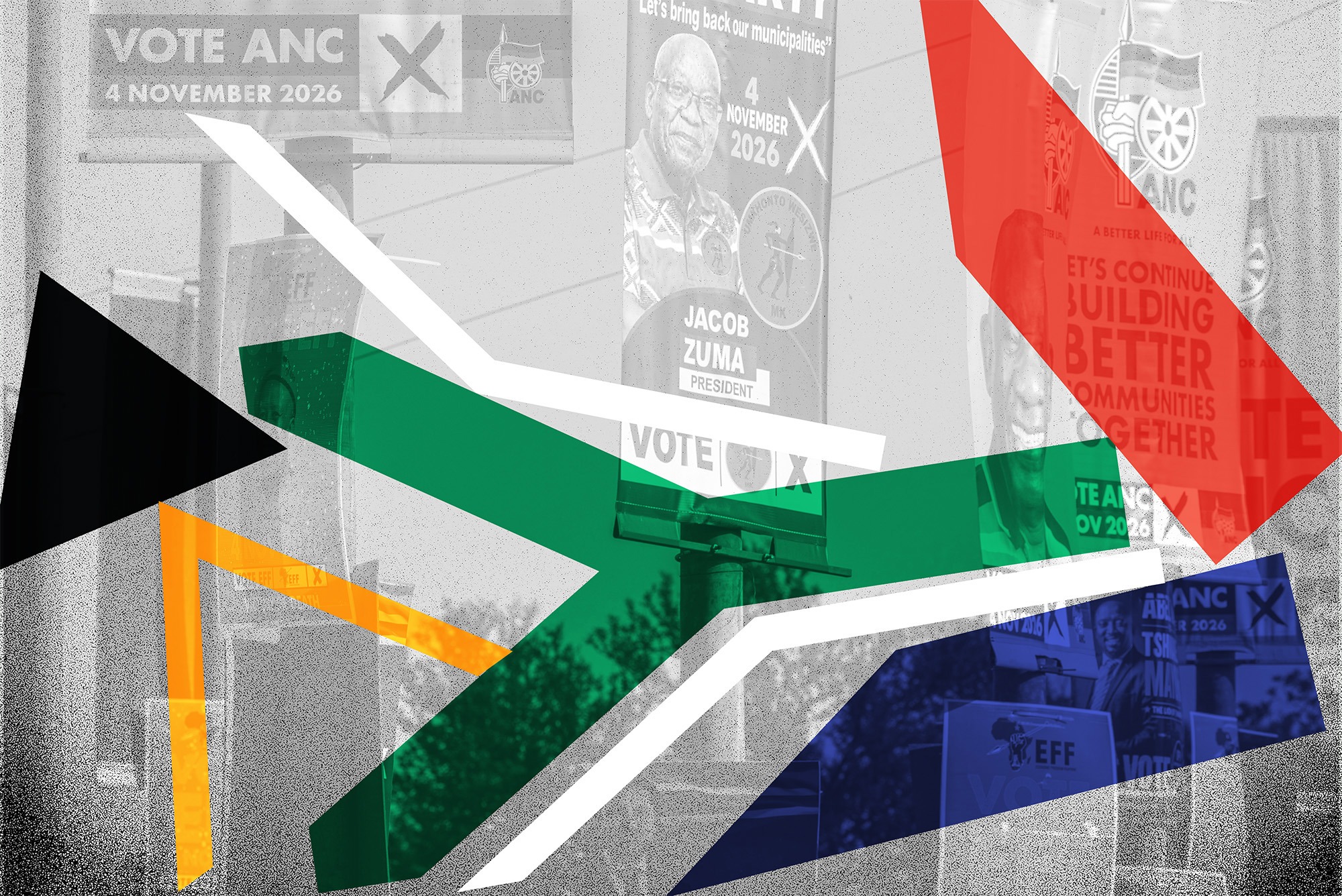
 Illustrative image: Election posters for different parties hang close to Freedom Park a on October 4, 2026 outside Tshwane, South Africa (Photo: Per-Anders Pettersson/Getty Images)
Thank you for all your election questions. This article was updated on 2 November with a new batch of answers, which appear first.
1. Can I vote abroad, by post or away from home on 4 November?
No. Unlike national and provincial elections, municipal elections do not permit voting outside South Africa or outside your registered voting district. Local ballots are strictly tied to specific ward candidates and local council proportional representation (PR) seats. Your only alternative is an IEC Special Vote cast at your designated voting station on the scheduled special voting days, provided you applied during the gazetted special vote registration window.
2. Can I vote from home if I’m elderly? I’m 70 and have difficulty getting around in a wheelchair.
Yes, through the IEC’s home visit special vote facility. Registered voters who cannot travel to their voting station due to advanced age, disability, severe illness or physical infirmity can apply to have IEC officials visit their private residence, care home, or hospital during the two designated special voting days. Applications must be lodged within the IEC’s gazetted special vote application window.
3. Will Cyril’s [Ramaphosa] face be on the election boards?
ANC President Cyril Ramaphosa’s face is the only one on his party’s election boards, which tells you a story. The ANC does not have a layer of local leaders it is either proud enough of, or confident enough of, to put on election boards.
4. When is Julius Malema going to tell the truth about his and Floyd’s [Shivambu] roles in the VBS money he received?
Probably never. The National Prosecuting Authority may compel him to tell the truth in court, but he has not been charged on VBS.
5. Will whichever party wins make youth unemployment one of its key mandates?
Employment, like growth, is a function of many things – mostly of national policies. This campaign has shown more than most that the local government context can be vital to investment, growth and jobs. You can look at our manifesto analysis of the largest nine parties to see which party has the best ideas for helping us work.
6. Who is the watchdog for these upcoming elections, to make sure everything is done fairly?
The Electoral Commission of South Africa (IEC). It does a great job. You can read more here. The site is not great but your patience will be rewarded with a mine of information.
7. Will Julius Malema still be president of the EFF by 4 November following his conviction? If not, who will lead the party?
Yes, he will be. EFF leader Julius Malema is appealing against his conviction on the illegal use of a firearm. It will take at least three years for his appeal to be heard, we reported here.
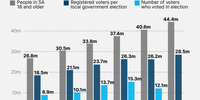
8. How many South African citizens are eligible to vote, whether registered or not?
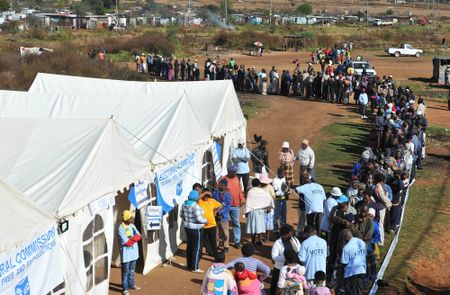
9. Does the UDM have a good reputation?
I analysed the UDM’s local government manifesto here. It has a very good reputation for being a whistle-blower party.
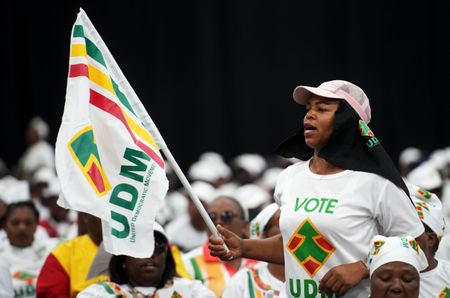
10. If a new party takes over, how will it deal with ANC officials already in office? How will it get things done if those officials obstruct change?
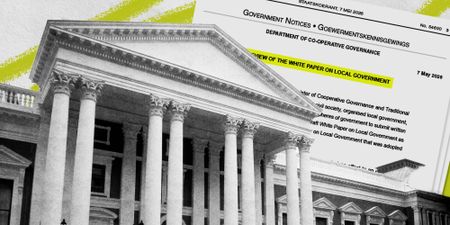
Because of decades of cadre deployment by parties in government, this is a real issue. The new White Paper on local government makes the most serious effort yet to depoliticise administrative appointments. It will take a long time for a new public administration ethos and culture to be implemented.
11. How can we avoid voting for one party, only for smaller parties to form a coalition and overturn who we thought had won the right to govern?
Unfortunately, the so-called Coalitions Bill, which could have set a threshold for participation in government to get rid of the entrepreneurial one-person parties who trade positions for power and wealth, has not been passed in time for this election. You can read more from Professor Susan Booysen here.
12. Can corrupt officials or politicians be prevented from standing for election or being appointed again?
Yes. Elected councillors convicted of an offence and sentenced to more than 12 months’ imprisonment without the option of a fine are disqualified (ending five years after sentence completion). For municipal officials, anyone dismissed for financial misconduct, fraud or corruption is barred from being re-employed in any municipal administration for up to 10 years.
13. What qualifications does a candidate need, what deposit is paid, and how much are councillors actually paid?
The Constitution sets no minimum educational qualifications; any registered voter can stand. Political parties pay a deposit (R2,000 to R3,500) and independent candidates pay R1,000. An ordinary full-time councillor earns between R550,000 and R650,000 annually, MMCs and speakers earn roughly R850,000 to R1.2-million, and executive mayors in major metros earn upwards of R1.5-million per year.
14. What powers does a city manager have to resist pressure from political principals and ensure the municipality is run according to the Constitution?
As the municipality’s accounting officer, a city manager has statutory duties to protect public funds. If given an instruction that contravenes procurement regulations or the Constitution, they are legally required to refuse it. If they comply with an unlawful instruction, they become personally and criminally liable for financial misconduct.
15. How can citizens engage with municipalities and councillors between elections, beyond voting?
Channels include ward committees, public participation meetings on integrated development plans and budgets, attending open municipal council and Municipal public accounts committee meetings, and submitting collective petitions to the Office of the Speaker.
16. If the DA wins a majority in the local elections, can it use that result to call a vote of no confidence in the national government and demand a general election?
No. Municipal government and the national government operate as distinct, constitutionally autonomous spheres. A vote of no confidence in the national government can only be introduced and voted on by sitting Members of Parliament in the National Assembly.
17. Will there be rules governing coalitions so we don’t have a revolving door of mayors and parties?
Unfortunately not. The Coalitions Bill, which sets out ways to make coalitions work better and with less instability, will not be passed in time for this election. All suggestions are that a large number, possibly a majority of councils, could be hung after the election on November 4.
18. Will Julius [Malema] be in jail by the time of the elections?
No. His appeal against his conviction could take up to three years to be heard.
19. Will the DA and other parties ‘prostitute themselves again to the highest bidder’, even if their voters don’t agree with the coalitions they form?
That’s heavy language. The DA’s coalition strategy in Johannesburg is outlined here by its Johannesburg mayoral candidate Helen Zille, while its election ambition is outlined here by its Federal Council chairperson and head of elections, Ashor Sarupen.
20. If a councillor’s response to a crisis, such as a 48-hour water outage or a collapsing road, is that they have ‘no power over officials’, why are taxpayers paying salaries that can exceed R500,000 to R1.6-million, depending on the municipality? Are we paying for leadership, or for someone to forward our WhatsApps to a call centre?
Great point. I have noticed our councillor has no more power or impact than ordinary citizens: they need to get in line with all of us checking on municipal decline. This is because of the system of local government governance that alienates peoples’ representatives from processes of government. The white paper on local government, passed by the Cabinet and about to be formally launched by President Cyril Ramaphosa, tries to bridge the gaps. We will write about this. In the meantime, here’s a good summary from the Centre for Development and Enterprises.
21. Are these elections for municipalities? How do we check that we’re on the correct voters’ roll? My partner was incorrectly placed on a Gauteng roll instead of Cape Town in the national elections and could cast only one vote.
It’s a municipal election. If your partner did not change their address, it is too late now.
22. What happened to Unite for Change? Last I heard, they failed to hold a joint conference. Does that mean the dream is dead?
Unite for Change was an attempt to unite smaller parties Rise Mzansi, Build One SA and Good party. It has failed.
23. How will the elected party prevent tender fraud and corruption in municipal procurement?
In many municipalities, with great difficulty. This research paper by Romi Sigsworth shows that many municipalities are subject to systems of what she calls organised crime.
24. Who do I vote for? The DA’s policies in Cape Town leave me with almost nothing for food after rent and utilities. Rent and utility costs have FAR outpaced my salary increases. I have three children, all disabled, placed with me through foster care, yet I am refused a grant or tax rebate for all but one. A third of my salary goes to SARS, almost half to rent, and medical aid takes 20%. I’m powerless. I know many South Africans have it worse: I have a home, a job and a salary. But at what point am I entitled to say this is not OK? Do I just not vote?
Our elections portal here has the manifestos of the largest parties and also all our coverage. This article by Ernst Calitz on affordable rentals in Cape Town will be helpful. We are sorry to hear about how difficult life is.
25. I want to know what those in power have DONE, not what they PROMISE. What is their actual record?
We track this record every day. Please become a Daily Maverick Insider to join our mission to keep you informed.
Our portal includes everything you need to. From manifesto analysis, which includes a look at the party’s history, to possible coalition formations.
26. Will Joburg get fixed? Will corruption continue? Will the poor be thought of? Will our municipalities be in the best hands?
One of the best things to come out of this campaign has been the focus on Johannesburg, which all stakeholders have agreed is now a national crisis with an impact on the national economy. Whether or not Johannesburg is put on a reform trajectory is really up to those of us who live here. The best election outcome is that a reformist coalition is formed to ensure that trajectory. I can share my personal strategy with you if that would be helpful. I hope you are going out to vote.
Politics is only going to take us some part of the road our city needs. My choice has been to be part of the Johannesburg Crisis Alliance, a broad umbrella organisation of all the best civil society and community-based organisations working for a better and thriving Johannesburg. I will write about their call for what should happen after the elections – it’s the best strategy for those of us who want to be activists for a better city. DM
Comments
Scroll down to load comments...