



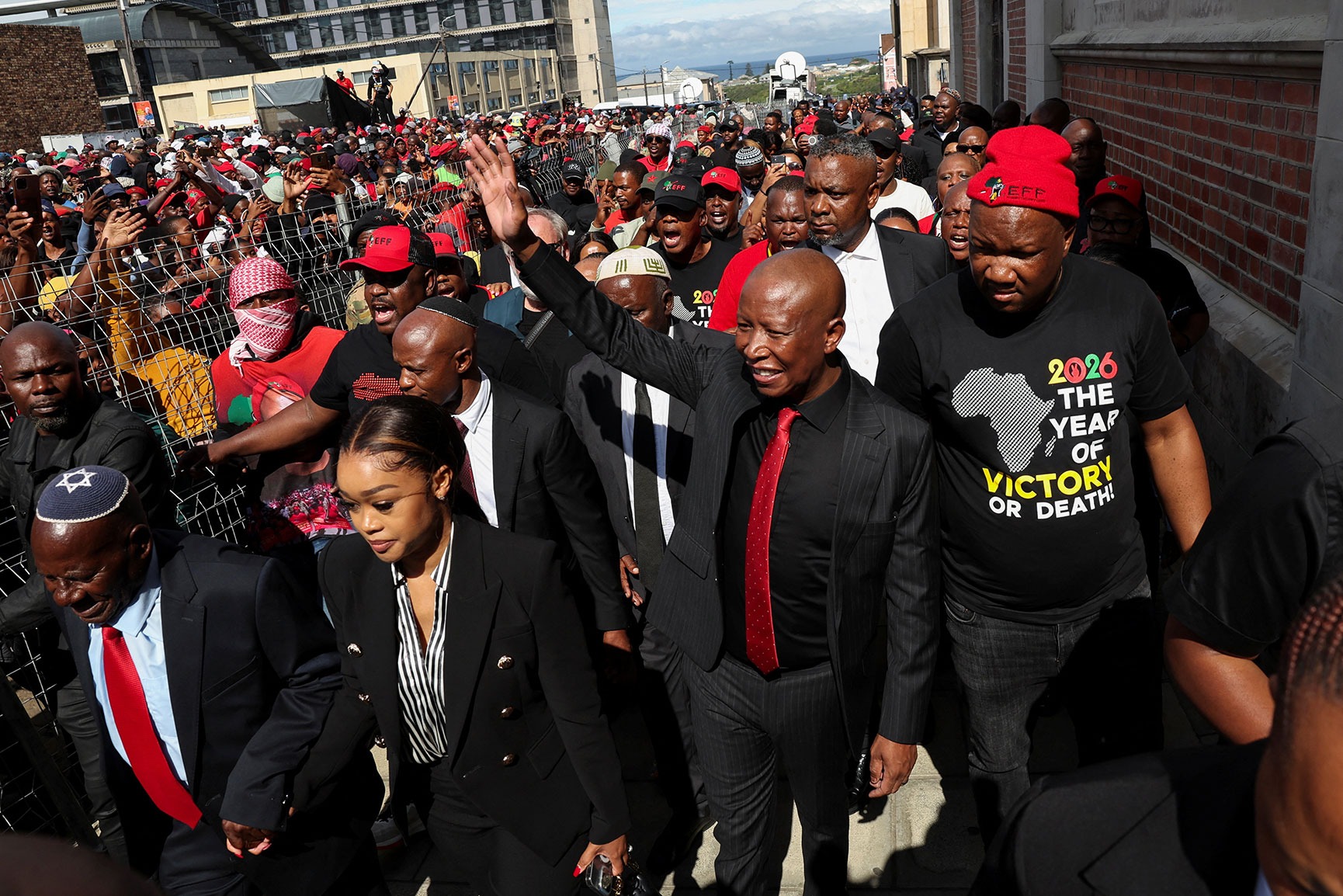
 Leader of the EFF Julius Malema waves to supporters after he was granted leave to appeal against a five-year prison sentence handed down in KuGompo Magistrates’ Court on 16 April, 2026. (Photo: Reuters / Esa Alexander)
Julius Malema was sentenced to five years’ direct imprisonment by Magistrate Twanet Olivier in the KuGompo Magistrates’ Court last week, after being convicted in October 2025 on five counts, including the unlawful possession of a semi-automatic firearm and discharging it in a public place during the EFF’s fifth anniversary celebrations in Mdantsane in 2018.
Malema was granted leave to appeal against his sentence, a process which could take years. In the meantime, he can still serve as a Member of Parliament (MP) and continues to serve on the Judicial Service Commission (JSC), which is responsible for appointing judges.
According to the Constitution, anyone sentenced to more than 12 months’ imprisonment without the option of a fine is not eligible to serve as an MP. However, it explicitly states that “no one may be regarded as having been sentenced until an appeal against the conviction or sentence has been determined”.
Prominent criminal defence attorney William Booth puts the realistic appeal timeline at a minimum of two years. The administrative process alone, including the typing up of court records and the submission of documents to the high court by the clerk of the court, is a significant source of delay before the appeal can even be heard, he told Daily Maverick.
Lawson Naidoo, executive secretary of the Council for the Advancement of the South African Constitution (Casac), said that predicting a final timeline for how long the process will last is near impossible.
“It could be a while,” he said, “at the least a few months, at the very least.”
Malema’s team must also separately petition the high court for leave to appeal against the conviction itself, if that is what they intend to do, after Olivier refused that application. However, according to Naidoo, Malema remains technically convicted and technically sentenced; the appeal only suspends the operation of the sentence.
/file/attachments/orphans/RC2BQKAXH7A6_403394.jpg "Leader of Economic Freedom Fighters Julius Malema in the KuGompo Magistrates’ Court on 16 April 2026 after he was granted leave to appeal against a five-year prison sentence. (Photo: Reuters / Esa Alexander)")
Speaking to supporters outside the court, Malema said his team had been prepared for any outcome.
“We had a chopper waiting at the airport for the legal team to fly immediately to Grahamstown,” he told the crowd.
He said that the EFF’s deputy president had been stationed in Makhanda, formerly Grahamstown, with papers ready to file an urgent bail application at the high court should Olivier have refused to release him.
Naidoo, however, said that such declarations did not reflect the reality of how the legal system operated.
“Papers have to be filed, matters have to be set down,” he said. “A lot of the statements made on Thursday were more about politics than about how the legal process actually works.”
JSC position under scrutiny
Beyond the sentence, Malema’s continued membership of the JSC is now drawing scrutiny from civil society organisations.
Judith February, executive officer at Freedom Under Law (FUL), one of the organisations that successfully challenged the JSC appointment of impeached former judge John Hlophe, said the case against Malema’s continued presence on the JSC was now overwhelming.
Citing his firearm conviction, an August 2025 Equality Court finding that his statements constituted hate speech, and a May 2025 high court ruling that he breached Parliament’s Code of Ethics during a JSC interview, February said that it was undeniable.
“It is clearer than ever before that Malema ought to step down as a member of the JSC,” said February. “Should he decline to do so, the National Assembly should take steps to remove him.”
/file/attachments/orphans/RC2AQKAY666J_386286.jpg "EFF supporters remonstrate with AfriForum members after EFF leader Julius Malema was granted leave to appeal against his sentence. (Photo: Reuters / Esa Alexander)")
Booth echoed the concern, pointing specifically to Malema’s conduct after sentencing. “The question is whether, in light of his comments, he is fit and proper to sit on that committee,” he said.
Malema’s comments came during an address to EFF supporters outside the court on 16 April, in which Malema accused Magistrate Olivier of being a racist and possibly a member of AfriForum. He went further, alleging she had not read the heads of argument placed before her and did not write her own judgment.
“We are dealing with someone who doesn’t apply the law,” he said.
“[Malema’s] conduct inside and outside of court, attacking the magistrate on the basis of race and her alleged affiliation with AfriForum, when he’s provided no such evidence of that, I think calls into question his fitness to serve as a member of the JSC, but that is a decision for Parliament to take,” said Naidoo.
“I would hope that is a matter the Speaker of the National Assembly takes up.”
/file/attachments/orphans/ED_507867_150271.jpg "Executive secretary of the Council for the Advancement of the South African Constitution Lawson Naidoo. (Photo: Gallo Images / Sydney Seshibedi)")
The fairness debate
Malema’s sentencing has divided public opinion. AfriForum, which originally laid the charges in 2018, called it a victory for accountability and a warning that politicians were not above the law.
The EFF described the sentence as “disproportionate and inconsistent”, adding that the NPA had demonstrated an “extraordinary and deeply suspicious appetite for imprisonment”.
Booth said that unlawful possession of a semi-automatic firearm carried a maximum sentence of 15 years, making Malema’s sentence considerably less severe than it could have been.
The court had to balance the seriousness of the crime, the interests of society and his personal factors, he said. Malema’s public profile is an aggravating factor, according to Booth.
“He plays a prominent role in Parliament,” he said. “He should set an example.”
Naidoo said he was surprised by the length of the sentence.
“My expectation was something more like two or three years,” he said. “But Malema did himself no favours with his demeanour in court and by attacking the magistrate rather than defending the charges against him.”
The charge itself is unusual in South African courts. Standalone firearm possession and discharge cases unlinked to murder, robbery or other violent offences are rarely prosecuted, according to 2020 research by Professor Pieter du Toit.
According to Naidoo, the magistrate’s sentencing approach was informed by a consciousness of the broader crisis of gun violence in South Africa.
Delivering her sentence, Olivier said, “Crime has reached astronomical proportions in this country, and if this goes unchecked, it will result in the perception that crime has no consequence in SA.” DM
Comments
Scroll down to load comments...