




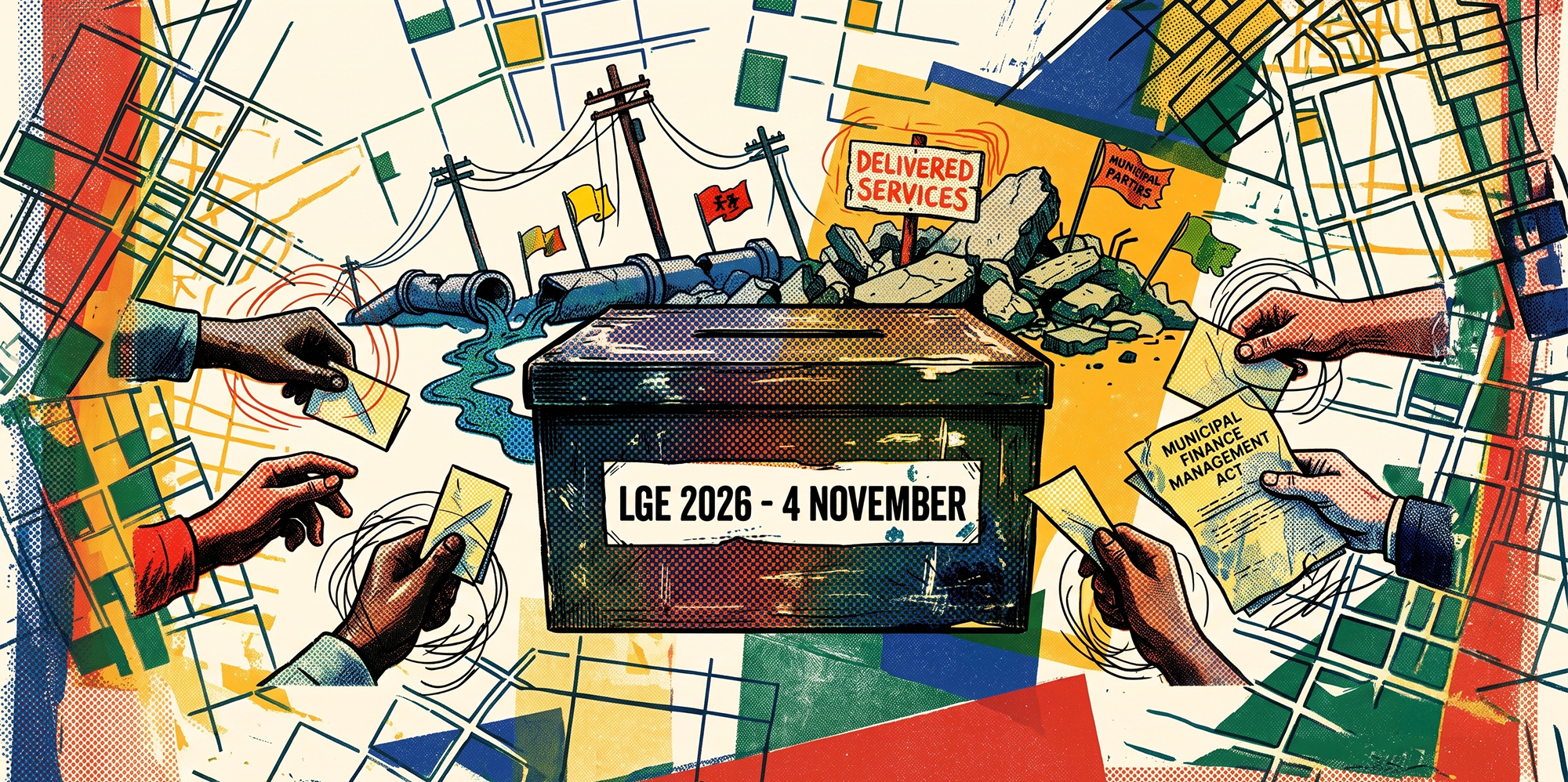
 The November 2026 local elections will leave accountability entirely up to the voter. (Graphic: Kevin Momberg)
/file/attachments/orphans/Election2026LogoInarticle_260133.jpg "LGE-2026-logo-signpost")
As ANC majorities decrease at national, provincial and local government levels, the likelihood of coalitions being formed to ensure governance increases. The coalition formed at national level, the Government of National Unity, exposes some of the problems of coalitions, which is why the Municipal Structures Amendment Bill, known as the Coalitions Bill, was introduced to regulate and stabilise coalition governments at local level.
Yet it seems almost impossible that the Bill, which the Cabinet approved in July and now sits in Parliament, will be passed and come into effect in time to have an impact on the formation of coalitions after the November 2026 local government elections. This means that voters will, in many cases, be voting blind.
What does the Coalitions Bill hope to achieve, and how can voters take action to prod parties into adhering to the principles of good governance it proposes?
The roads leading to Local Government Elections 2026 (LGE2026) suffer from the dead ends of delayed or abandoned reforms in coalition politics, detours that attempt to bypass a deficient local governance system and the roadblocks of national and provincial government trying to correct the dismal performance so prevalent in local government in South Africa.
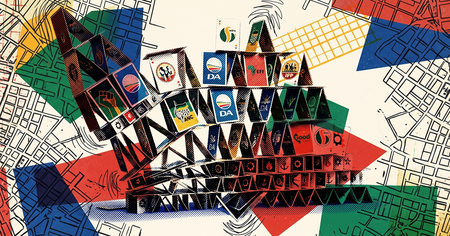
The 4 November 2026 ballot appears to offer voters a miraculous escape from an apparently dystopian local government future, but it will be up to voters to understand the conditions faced by local governments and to construct a roadmap to reclaim elections and their outcomes for the people.
Despite years of agitation for the reform and regulation of coalition formation, Parliament and the government generally have made only minimal progress towards bringing order to coalition arrangements.
The Coalitions Bill basically asks political parties to regulate themselves and how they put coalitions together, but the lack of progress in getting the Bill through Parliament shows that parties are not necessarily ready to self-regulate. Instead, they seem to see a coalition free-for-all as a way to gain or retain municipal power and potentially place them on the road to national power.
What does the Coalitions Bill propose?
Parties require a minimum 1% threshold of votes to qualify for a council seat;
Parties are required to formalise and publish coalition agreements;
No-confidence motions are restricted to once every two years and must be based on “serious grounds”;
Establish independent bodies to mediate coalition deadlocks; and
Extend the period in which coalition governments must be constituted from 14 to 30 days.
Delayed process
A tiny possibility remains that legislation to regulate local coalition governments will pass, but it would require that measures in the Bill be significantly diluted to achieve inter-party consensus.
The Coalitions Bill remains bogged down in its multi-year, constitutionally required legislative process. The Cooperative Governance and Traditional Affairs (Cogta) Portfolio Committee has deliberated, and many of the parties’ and other stakeholders’ concerns have been filtered into reformulations and tweaks.
The Cabinet has formally released the Bill for consideration by Parliament. As a Section 76 measure, the Bill is being processed for consideration by both the National Assembly and the National Council of Provinces. It is also potentially subject to constitutional challenges, which could further slow down its movement through the legislative process.
The relevant parliamentary proceedings involve both houses, and meaningful public hearings and consultations are required too. The mid-year parliamentary recess that has just ended, as well as the timing of the forthcoming local government campaigns, have conspired to slow down the progress of these measures to regulate coalitions.
In addition, the fusion of the private members’ and executive bills on coalitions has been time-consuming. It seems that all parties – big, medium, small and micro – are, in their different ways, resisting the attempt to provide some order to coalition formation. Smaller parties, in particular, have tasted the power of “kingmaking” when, even as one-seat parties, they become vote-deciding members of coalitions.
Small parties to win big
Hence, the finalisation of such legislation is all but impossible before the poll, and even enactment soon after the election is unlikely. Amid despair about the lack of efficient services, voters’ best hope for now is that a few incremental, stopgap changes and guidelines might cohere and start helping to build focused and effective local government, especially when coalitions must be formed.
Among such stopgap measures that could streamline the process, if they come into effect before or soon after the poll, is the proposed 1% threshold for municipal representation of political parties. These new rules, as proposed in the Coalitions Bill, could reduce the number of political parties represented in SA’s eight metros by more than half.
The threshold, whether set at 1% or another figure, would serve to limit the entrance into councils and/or coalition liaisons of small and frequently unaccountable parties, parties that excel at frequent, opportunistic realignment with potential coalition partners. Coalition-crossing, or the threat thereof, is the name of their game.
The result is a dysfunctional coalition system in which brigades of tiny parties attach themselves to a major party and get rewarded with positions and portfolios for as long as they stay onside. At present, the major parties collude in this, making attractive offers to the tiny parties to vote their way.
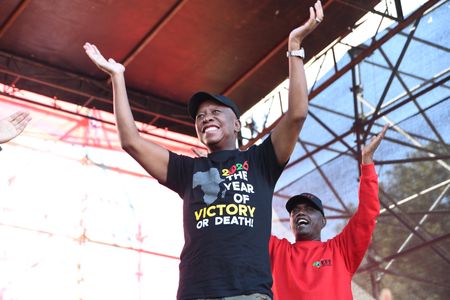
The threshold proposal interfaces with another proportionality element in earlier, now seemingly discarded, proposals in the Bill. Mayoral or municipal executive committees in councils without outright majorities would be structured according to the proportional representation of the parties in council. Such composition would limit the disproportionate “kingmaking” power of the small parties, given that executive committees generally comprise six to 10 members.
A counter-argument to those proposals was that the denial of municipal council representation, if parties fall below the threshold, would transgress the constitutional right of representation and the assurance that “every vote counts”.
In any case, if these provisions are not enacted by November, the small, community and micro-parties will again have a field day, reaping low-hanging coalition fruit in the aftermath of LGE2026.
South Africa will only have clarity on the scope of their participation, and how many new small parties have made it to that stage, when nominations are formalised and ballots are cast and counted. Many new and small parties went extinct in previous electoral combats, but new or refreshed small entrants are emerging to challenge incumbents.
Besides the proportionate composition of municipal executives, another key measure that could smooth the process of coalition formation and encourage better governance is the extension of the period in which coalition governments must be constituted, from 14 to 30 days.
This and the proposal that coalition agreements be legally binding on participants would help make coalitions more stable because they have been comprehensively negotiated before they come into effect, and the parties are then formally committed to them. It seems, however, that these provisions will not meet with approval and could be dumped.
There is perhaps a greater chance of success for provisions such as those governing the way parties may enter into public coalition agreements; the containment of the number of permitted motions of no-confidence (which have become a means for opposition parties to stymie legislative progress); the institution of conflict-resolution mechanisms; and Speaker discretion on whether a vote will be secret or not.
Broad reform
The slow progress towards coalition-regulation measures is not the only obstacle on the road to workable outcomes after LGE2026. South African voters will be asked to select party-political incumbents to proceed into a limping system of local government. The parties will ask for mandates to deliver what most municipalities are incapable of: effective governance, functional services and credible budgeting.
Despite pockets of excellence, municipal government in South Africa is generally broken. This was demonstrated by the National Treasury’s recent interventions, when it suspended equitable share transfers to 69 municipalities unable to comply with the Municipal Finance Management Act (MFMA) and its supporting regulations.
It was, however, a weak measure, which had to be rescinded by the end of July 2026. Nonetheless, it has raised voter consciousness of municipal disdain for the rules of accountable governance.
Instead, Section 139 and 154 constitutional interventions had more potential to correct municipal government. By mid-2026, about 45 local and a few district municipalities were under administration – and many more should rightfully have been placed under administration. The interventions by provincial governments in terms of Section 139 ranged from mild (for example, council advisories) to severe (financial recovery plans).
Several municipalities have also been placed under national government administration, and the numbers are rising. These interventions bring occasional improvements or increase stability, but they are not long-lasting corrections.
Such longer-term corrections and countermeasures to dysfunction are proposed in the White Paper on Local Government Review, which in April 2025 acknowledged that “local government performance has regressed due to a variety of administrative, governance, service delivery, infrastructure, financial, structural and systemic challenges. Deficient performance has become evident in key areas of leadership, management and administration, exacerbated by uncoordinated and ineffective national and provincial regulatory and oversight responsibilities.”
In May 2026, the Cabinet approved the gazetting of the draft White Paper on Local Government for public consultation. The launch of the White Paper is expected in September, but even if it takes place then, it will not have much effect on LGE2026 itself or the coalition arrangements that will be necessary in many areas thereafter.

The White Paper and the Coalitions Bill are among several proposed reforms, oversight tools and support programmes introduced by the National Treasury and Cogta to improve local governance. There are mooted reforms of the MFMA to enforce funded and credible budgets and to strengthen expenditure controls and consequence management; there are proposed actions to deal with irregular expenditure and to tighten the Treasury’s and provinces’ powers to monitor and intervene.
There are also proposed measures to monitor compliance through financial reporting systems; funding reform with emphasis on conditional grants and incentives to ensure that available funds convert into services; capacity support by means of the Municipal Finance Improvement Programme and technical advisers – besides the Sections 139 and 154 intervention tools already mentioned.
Accountability or decline
Municipal management thus intersects with the evolving coalition frameworks, raising questions about electoral contest, voting and accountability. Accountability in particular is confused: which party in what coalition for what period can be held responsible for municipal neglect and other misdeeds?
The Coalitions Bill’s proposal that parties enter binding and public coalition agreements could be very helpful, if they are constructed in good faith, with accountability built in. Formal, public agreements could help limit arbitrary party-political behaviour.
They could help contain not only the power demands of micro-parties, but also the bigger parties’ inappropriate use of micro-votes to improvise majorities. Public coalition agreements would enhance public accountability, one of the constitutional expectations of local government.
Both the 1% cut-off for municipal representation and limitations on inflated small-party representation might have contributed to improved municipal governance. In the absence of parliamentary consensus so far, however, and if no guidelines are introduced, much of the responsibility for pushing parties to improve governance switches to the South African voter.
Voters will have to demand that their political parties be publicly accountable when forming coalitions. After the election, winning parties must account continuously and publicly on the details of their coalition deals and governance operations, or local government will continue to stumble and decline. DM
Susan Booysen is a Wits University emeritus professor, research consultant, and author-analyst. Her continuous research project is the evolution of coalition politics and governance in South Africa. She is working toward the publication of her next research report following the local government elections in November 2026.
Comments
Scroll down to load comments...