




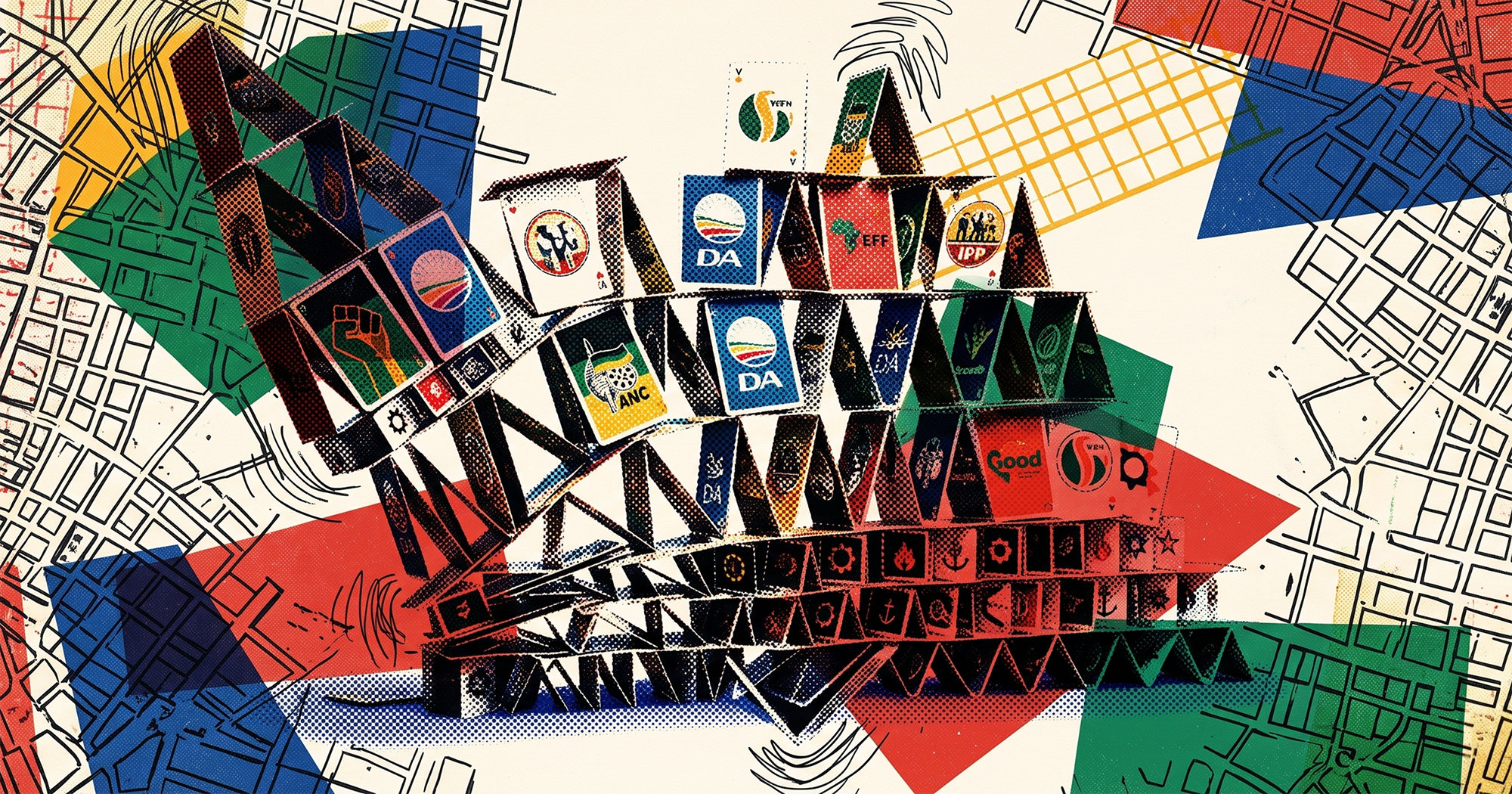
 Coalitions are expected to become more entrenched after the 2026 Local Government Elections. (Graphic: Kevin Momberg)
/file/attachments/orphans/Election2026LogoInarticle_260133.jpg "LGE-2026-logo-signpost")
Saturated with experiences of lapses in local government and volatility in governing coalitions, South Africa is lurching towards the 2026 local government elections (LGE2026). A deluge of further coalition governments awaits as participating political parties adapt and outsmart one another. Coalition cultures evolve while governance and delivery trail. New legislation remains a mirage.
All parts are moving. And the election is looming.
Three intersecting tracks of activities are on our radar screens as we approach 4 November:
The political parties and their campaigns (at this stage either formally launched or unfolding through positioning);
The efforts to regulate coalition government (still under-determined); and
The plans to reform and improve local government (unfolding but embryonic).
Some instruments might bring order. The Coalitions Bill is before Parliament and attempts to redesign local government to bring in workable municipal institutions are in a White Paper Review stage — but both are destined to fall foul of the timelines that come with LGE2026.
South Africa’s evolving coalition culture with its largely unrestrained party-political practices is at the heart of it all. The culture may still be contained by a few regulations and guidelines, but only minimally so. The broader project of Parliament legislating a new coalition order has become diluted and is hardly likely to create a new coalition order. Hence, the prevailing coalition culture is our guides to the future of post-election local government.
To help fathom the LGE2026 aftermath, this analysis takes stock of the prevalence and practices of current local government coalition politics, the expanded prospects for coalition governments following the elections, and the likely impact on governance. It reflects on the coalition cultures and associated formats that flourish in contemporary South Africa, driven by the fates and fortunes of the political parties.
The field of local coalition governments could be stretched well beyond the 70 out of 257 local and metropolitan municipalities under coalition government following LGE2021. Subsequent by-elections have added and subtracted a few coalition councils, bringing the current total to 76.
The municipalities of Beaufort West, iKheis, Hantam and Mthonjaneni are no longer under coalition governance. New coalition governments often go virtually unnoticed, being configured as simple confidence-and-supply arrangements between big and small parties in council.
ANC losses and the opening of the coalitions field
LGE2026 marks a decade since voters — especially in the populous Gauteng metros — diversified their votes away from endorsing electoral behemoth the ANC. LGE2016 marked the tangible onset of new coalition politics in South Africa, beyond the foundational post-1994 arrangements.
In the four sets of local elections from 2000 to 2016 the number of coalition governments per election had hovered around 30. Come 2016, the new coalition wave started gathering force.
The 2021 local election results affirmed the swing away from ANC hegemony, and subsequent by-election results continued the trend away from outright municipal council majorities (these had been almost without exception under ANC command).
In 2026 it remains largely the ANC’s continuous decline that propels South Africa into rising coalition politics: at the time of writing, about 105 out of South Africa’s 205 local municipalities remain under outright ANC majorities. The DA follows with 11 and the IFP with nine. Many of these majorities are held by the slimmest of margins and are candidates for future coalitions.
/file/dailymaverick/wp-content/uploads/2024/05/2024-05-29T073912Z_953767982_RC2708A6AJML_RTRMADP_3_SAFRICA-ELECTION.jpg "A cardboard cutout of ANC president Cyril Ramaphosa waves next to a campaign tent at Mahlanhle Primary School in Ga Mahlanhle, Limpopo. (Photo: Reuters / Alet Pretorius)")
Central to the argument about continuous ANC decline and the growth of coalitions is that it is a gradual process — the ANC is not collapsing, even if it is in ongoing decline and is ceding significant chunks of support to multiple contenders.
Local election results in South Africa have been sound indicators of both party-political decay and growth in the subsequent national and provincial elections. On a jagged curve, the overall ANC trend has been relentlessly downward.
The ANC’s 17-percentage-point national decline from 2019 to 2024 (15 percentage points in Gauteng) in combination with by-election markers since June 2024, is revealing. In the by-elections from 2024 to 2026, the ANC has ceded wards but has also retained many majorities.
The incremental yielding of ANC support is confirmed in public opinion surveys. Such decline sets the scene for the anticipated increase in coalition municipalities and illuminates the likely configuration of coalition governments. More parties emerge with solid blocs of votes while no single opposition party, to date, garners sufficient support generally to displace the ANC entirely.
All that has arisen in this space are a few medium or small split-offs that maintain modest ceilings. For example, it remains uncertain whether the MKP’s 47% KZN base will convert into matching local power.
Further, a few small parties are consolidating, and new micro-parties — almost inevitably with kingmaker ambitions — are in the wings. Independents will emerge, unperturbed by past evidence of poor prospects.
Kingmaking is the name of the medium, small and micro parties’ game. In lieu of the lack of regulation they still aspire to leapfrog into power, to become the kings despite not carrying enough ballot support to govern in their own right. The micro-kings often morph into the voting slaves of the big parties or party alliances that need top-ups into majorities, while medium-size kingmakers call the shots and act like they have won majority power.
Ineffectual municipal governance
Many of the accumulating insights on party support, by-election results, local governance capacity and party-political coalition culture indicate few restraints on post-LGE2026 coalition practice.
In SA coalition culture style, parties will construct coalitions unperturbed by (often overstated) policy differences, Struggle histories and governance records. It will be about the power of the magical number that delivers a majority of council seats, whether it is four or 136, proportionate to council size. Governance will be a secondary thought as parties wheel and deal to construct a majority out of whichever line-up of the willing and greedy presents itself.
Effects of arbitrary partner choices and erratic coalition government have been disconcerting — but dysfunctional government proliferates in coalition and majoritarian municipal councils alike.
Collapsed council meetings, time spent in courts and in strategy meetings for new coalition configurations instead of in the trenches, delivering services, have been haunting local coalition governments specifically. However, factional contests and large-scale cookie jar warfare have delivered similar fallout in majoritarian councils.
Both coalition and majoritarian municipalities bear aborted, failed service delivery projects, tender fraud, sustained adverse audit findings, unfunded municipal mandates, inability to pay staff, appropriation of staff pension payments, under-qualified and/or corrupt appointments, and many other ills. The councils have also demonstrated that “instability” (or change in coalition governments’ party configuration) may sometimes also help build effective governance.
Regulation in the wings, but take-off stalled
Meanwhile, legislation to forestall the instability and distraction caused by political wheeling and dealing associated with coalitions is hovering in Parliament. It remains in limbo, unlikely to be enacted in time for the start of the new term (see the next in this three-part series).
Informed sources point to the requirements of the legislative process and confirm that time has run out. At best, a select few of the long-vaunted reforms may follow in the months and years after the election. In the event of inter-party consensus, there could, at best, be a few guidelines as the tool to contain the councils’ coalition practice.
Such guidelines may bring in the (suggested; it is probably just a guideline) requirement of more time for post-election negotiation of coalitions, publicly available coalition agreements, or limitations on the use of motions of no confidence. The proposal to make proportionate composition of mayoral executive committees compulsory when no outright council majority emerges appears to have bitten the dust.
In the interim, South Africa’s helter-skelter coalition game amid faltering government appears set to continue in the aftermath of LGE2026. The game will be driven by de facto coalition rules, such as:
Kingmakers paired with their big party patrons;
Rewards of high municipal positions and lucrative portfolios;
Local alliances unsynchronised with national and provincial variants; and
Court action among coalition partners.
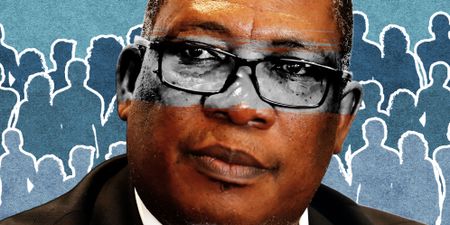
Evidence of likely coalition players
Much of the power pursuits and use of coalition tactics (such as renegotiating coalitions after coalition-crossing by a kingmaker) have been mapped. A residual uncertainty is who the exact party-political players will be. My analysis of by-election results since the May 2024 national elections helps anticipate this part of the future.
By-elections are solid indicators though not exact predictors of the trends that follow. In by-elections since mid-2024 the ANC has continued to shed support, losing seats to the DA, MKP, IFP, PA — but retained many. The DA also lost a few. The PA has gained, and the IFP has had a few successes in KwaZulu-Natal. The MKP showed that it is putting down roots, also beyond KZN.
/file/attachments/2989/ED_503352_560514.jpg)
Micro and community parties often fade or abstain from by-election contests, and by-election results may therefore be skewed towards the bigger participants. By-election turnout also tends to be low, and lower than in general elections.
Irrespective, by-election trends promise that the November poll results will bring a refreshed midfield of growing parties. The ANC will hover, still bigger than most others and often with outright majorities, for example, in the Eastern Cape and Limpopo. But it is unlikely to retain a compelling spread across provinces.
Support-bleeding will favour the MKP in KZN. The DA will grow but also suffer the fragmentation hazard; outright majorities may elude it in many municipalities. The MKP and PA may emerge with substantial presences over a broad front, and the IFP and EFF with a few substantial regional presences. These parties are likely to be mid-size kings (or kingmakers), thus crucial coalition building blocks at many sites.
The pull of coalition kingmaking by minor parties, through small-party top-ups into majorities, is likely to remain despite the growth of this midfield. Bigger parties will combine with ambitious micro-predators and barter (often) unspoken benefits for minimal seat numbers toward council majorities.
Political blood bonds and struggle histories may matter little; and governance sensibilities and policy rationalities are bound to be optional.
SA’s formulae for coalition government
SA political parties bring in mind-boggling inventiveness when they configure alliances to deliver majorities, as my research for the Coalitions Barometer (2021-2023 and 2023-2025) and my personal coalitions research, 2025-2026, have shown.
Two intersecting rules apply. First, national coalition tendencies will be predisposed to determine local coalitions, yet the national will not be guaranteed to prevail locally. Second, specificities at the local coalface will often override national directives … and “a thousand” coalition options will bloom.
Following LGE2021 there were variations on a few prototypes to configure coalition majorities in councils. South Africa is likely to again encounter these mutations in post-election negotiations, legislation and regulations permitting.
Configurations are constrained moderately by political parties’ (negotiable) principled and historical coalition partner preferences. Previous natural affinities are frequently overridden by new opportunities; for example, those arising from the merry-go-rounds of the Government of National Unity, governments of provincial unity and governments of local unity.
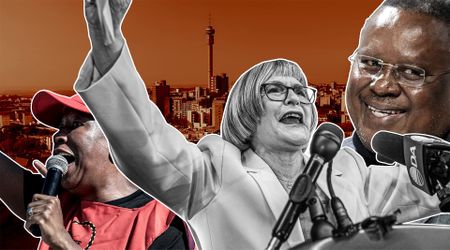
In addition, pragmatic-opportunistic interpretations of conditions on the ground — including corruption, personal scandals and council mismanagement — have in the past occasionally superseded all other rules.
As a first post-LGE2021 prototype, there was a coalition variant of simple, de facto coalitions of the biggest (plural majority) party being in charge, and other parties in council allowing this. This is minority government, stable and operating on the coalition principle of confidence-and-supply. Opposition parties recognise their own inability to build a numerically matching coalition. This formula currently finds widespread application in ANC-EFF cooperation.
Second, there are simple, formal coalition governments of two parties, mostly one big party in combination with one or two small top-up coalition partners; the second one a convenient coalition spare wheel. These coalitions are also generally stable, although some small partners have executed coalition-crossing and caused government change (after by-elections). Prince Albert local municipality is a case in point. A more complex variation is when the kingmaker is a medium-sized party, or in where several non-majority parties form a governing block (mostly in larger and diverse councils).
Third, and the most prevalent of SA local coalition formations, is the complex coalitions constituted through big parties in combination with diverse small-party support blocs. Variants have flourished across metros and larger towns. Several smaller parties form an alliance with the biggest party (eg, ANC or DA) to construct a voting majority, and all are essential parts of the outright majority (confidence-and-supply arrangements with a single party or alliance of parties may also sustain this coalition).
Alternatively, two relatively big parties unite into a seemingly simple outright — possibly also an oversized — majority; eg, DA-IFP, IFP-EFF, ANC-EFF which, however, becomes more complex due to being joined by a bloc of micro-parties. A small party might also be supported by the bigger parties (jointly holding a majority) to “lead” as proxy when the two leading parties (such as the ANC and EFF) settle not to be led by each other.
Another variant is when small parties join forces with the main opposition (second-biggest party) to keep the biggest party out of power; or, in small councils, equal opposition parties unite against the biggest party (which lacks an outright majority). Such alliances can be ideologically diverse — eg, the DA and EFF — with the contingents of micro parties present in metros.
Complex coalitions also prevail in the case of grand coalitions, where ideologically diverse, incongruent parties cooperate, anchored in unique local dynamics.

SA parties have also hatched reciprocal coalitions where two parties agree to give control over one municipality to the one party as the quid pro quo for the second party’s control over another municipality. Hantam and Karoo Hoogland illustrate this model. It was a relatively stable arrangement between the ANC and PA.
This cacophony of coalition configurations points to the likely proliferation of coalition invention, as preferences of parties and type of practices evolve — and legislation to contain or structure formulae emerge in diminished forms.
An inconvenient coalition future
The often discordant party behaviours around coalitions may be South Africa’s inconvenient coalition future, and not a temporary aberration. Recent polling, by-election trends, and quiet regulatory moves in Parliament all point toward a permanently fragmented political landscape.
Come November 2026, more councils will become candidates for coalition government while parties like the MKP, PA and EFF contend for places in municipal executives. Small parties like ActionSA and Rise Mzansi may intermittently join the ranks of local governments. Community parties will continue to rise, even assuming spaces of now-distrusted major parties.
The three plates of South African municipal elections and governance circa 2026 — coalition culture and practice, party strengths and agendas, and efforts to regulate and renew the system of local government — therefore are operating, unsynchronised and without imminent prospects for coordination. DM
Susan Booysen is a Wits University emeritus professor, research consultant, and author-analyst. Her continuous research project is the evolution of coalition politics and governance in South Africa. She is working toward the publication of her next research report following the local government elections in November 2026.
Comments
Scroll down to load comments...