



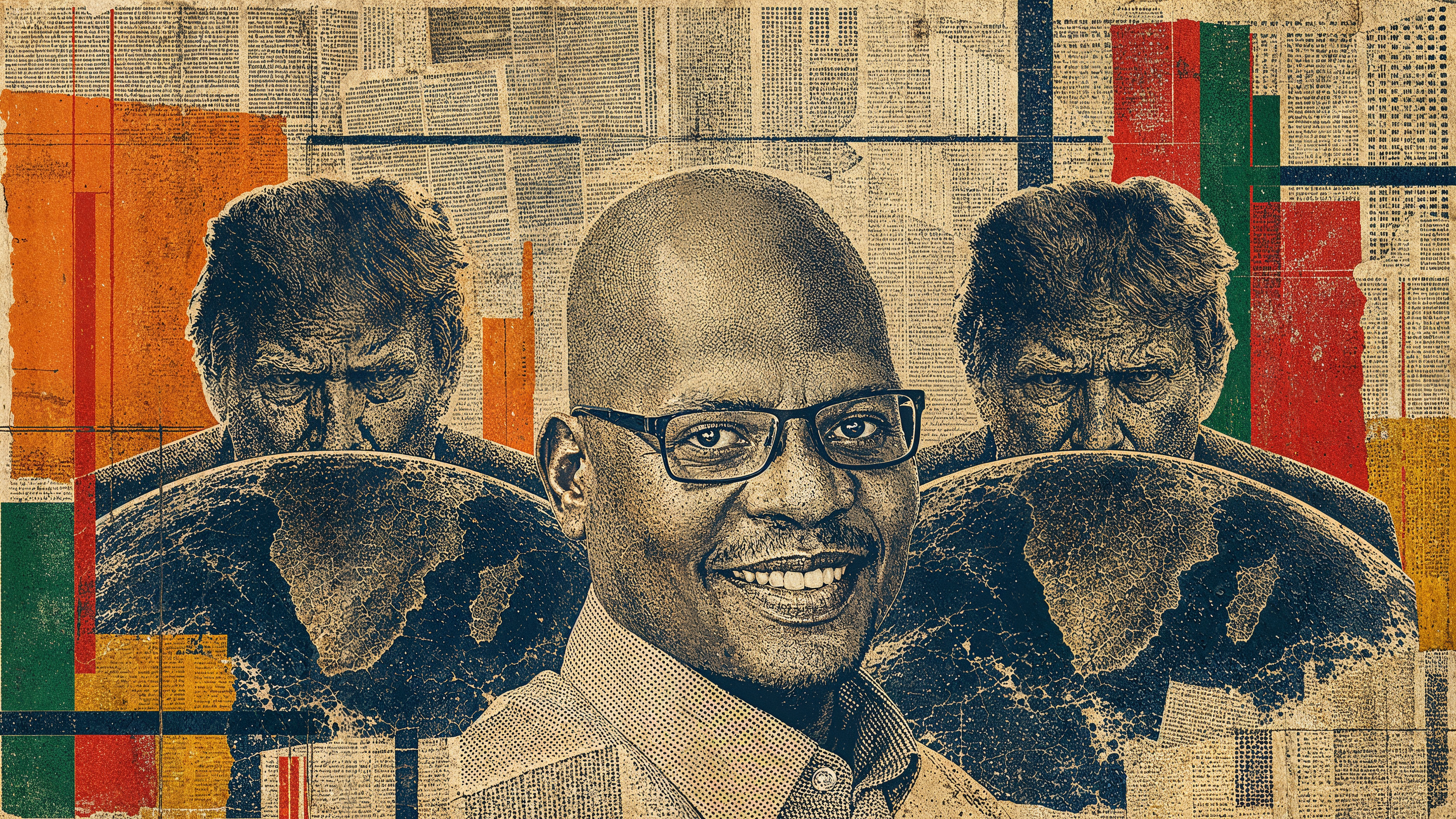
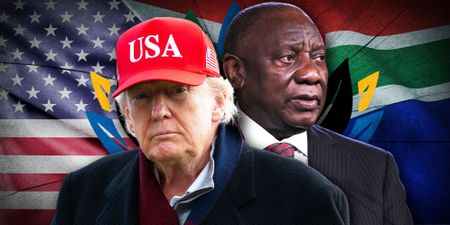
 Mondli Makhanya, US President Donald J. Trump (Illustrative image: Bernard Kotze using Figma | ChatGPTimage2)
Spare a thought for diplomats, government officials and political leaders from around the world who have to reckon with the bedlam that is American foreign policy.
Wrestling with an opponent or ally who is protecting their country’s national interest is always hard work. That’s because everyone, friend and foe, want to get as much out for their country as they can. It’s obviously harder when it is a foe, but friends are definitely not a cruise. This is just the nature of the game.
But spare a special thought for South Africa’s leaders and officials who have had to go through this torture over the past 20 months of US President Donald Trump’s second term. Trump’s first term in office was not particularly great for South Africa because he largely ignored us. Aside from insults and swear words here and there, we were not a priority for him.
So much so that it took him nearly two years to nominate an ambassador to South Africa, usually one of the priority appointments for US heads of state. Once the nomination was made it was another slog to get the nominee confirmed by the senate. She eventually arrived in November 2019, with barely a year of Trump’s term to go.
The calibre of the individual was telling. Lana Marks was a luxury handbag entrepreneur and a member of Trump’s Mar-a-Lago Club who just happened to have been born in the Eastern Cape and spoke some isiXhosa. Quite a qualification for a senior diplomatic post if ever there was one.
Priority list
When Trump returned to office in 2025, there was both an expectation and concern that South Africa and the continent would again be way down on his priority list.
Under President Joe Biden’s administration, there had been much more engagement and the hope that, if victorious in the November 2024 election, Kamala Harris would continue to give us the attention we deserved. Good attention, that is. Well, she and the Democrats ran a terrible campaign and handed the keys to power in Washington back to the orange guy.
Upon his return to the White House, the Russia-Ukraine war was nearing its third year, Israel was devastating Gaza, and China had become an even more enormous rival to US economic and political power. The country was also making ominous murmurs about its military intentions in the Pacific, including acting on Taiwan. So it made sense that we would think that way.
Now this country is not just on Trump’s radar. South Africa has become one of his great obsessions alongside blonde women, golf, McDonald’s and Diet Coke. In this second term he has imposed, reversed and re-imposed tariffs on the world, threatened to invade Greenland, wrecked relations with neighbour and closest ally Canada, thrown Nato into turmoil, moved to turn his country into an authoritarian dictatorship, revived America’s imperialistic project in Latin America, cut life-saving aid to hundreds of millions of people around the globe and begun yet another unwinnable war in the Middle East.
Onslaught after onslaught after onslaught
Yet, in the midst of all of that, there was always South Africa. It has been onslaught after onslaught after onslaught on a country that poses no threat whatsoever to the US, except just to exist.
The latest onslaught is against as-yet-unnamed senior figures in South Africa’s political establishment, whom the US accuses of inciting violence against minorities, enabling racial discrimination and effecting land confiscation. It is all fictional stuff, but in the demented Trump administration it is real.
“The United States will not allow such behaviour to go unchecked. These actions directly undermine peace, economic stability, and the rule of law, and they are incompatible with the pillars of America’s foreign policy… Those responsible for these injustices have no place in the United States,” US Secretary of State Marco Rubio said in his announcement.
This was followed by a media roadshow by US ambassador Leo Bozell, who hammered home the assertion that South Africa’s leaders were errant children who did not listen to instructions from the world’s parent. In a paternalistic and undiplomatic tone, he chided the president of his host country for not implementing the “asks” that Trump had given him, including overturning laws that were passed by Parliament and can only be overturned by the courts.
As veteran diplomat and international relations expert Kingsley Makhubela put it, the US is expecting President Cyril Ramaphosa to violate his oath of office. The relentless onslaught persists despite South Africa doing its best to be the respectable partner that is expected of sovereign nations. Facts have been placed on record. Detailed proposals have been put on the table. Front channels and back channels have been used to communicate reality. Ramaphosa’s humiliation with a smile during that infamous Oval Office meeting. All to no avail.
Cold comfort
The cold comfort is that in as much as we are an obsession, we are not alone in being victims of the erratic decision-making in Washington. Close allies, such as Canada and European nations, have been in the crosshairs too. They also initially tried to play nice and after a while realised that it was futile and have been staging their own versions of fightback.
The difference is that most of them have more power and leverage than we do. When the European Union speaks as a unit (with the United Kingdom joining in), it is powerful, and when Canada retaliates against Washington’s irrational behaviour, it hurts US businesses.
South Africa is in a much weaker position. Our fragile economy, rickety state and amoebic leadership make us vulnerable. It also does not help that there is no united African front, or even a semblance thereof. Whereas the EU operates as a collective in the face of Trump’s aggression (with a few notable exceptions), the African Union is a glorified stokvel. Some key African leaders are even happy to be Trump’s rent boys.
Our approach of accepting our weaker position in the face of a superpower has been tried. It failed dismally because it was premised on us dealing with a level of honesty on the other side.
The concessions we have made – trade deals, policy tinkering, offerings on critical minerals and duty easing – are not what Washington is seeking. Besides the big prize of South Africa being nice with the genocidal regime, the Trump administration is pursuing a project that wants to see South Africa as a vassal state. They will stop at nothing in pursuance of that objective.
End of an era
Rolling over was never the solution and, thankfully, that era is over. International Relations Minister Ronald Lamola’s more combative language in a speech in Washington DC this week was a sign that South Africa has given up on being a whipping boy.
As was Ramaphosa’s statement that this country “will not be bowing its head” to the US. They were probably also emboldened by indications that the Republicans are likely to lose at least one chamber of Congress in the November mid-term elections, meaning that Trump would no longer have unfettered power between now and the end of his term.
Of course, we cannot be foolish and wage an unsolicited diplomatic war with the US. We need them more than they need us. But, like most of the world, we have at last come round to realising that the best way to deal with a bully is to push right back, instead of being a wimp. DM
Comments
Scroll down to load comments...