



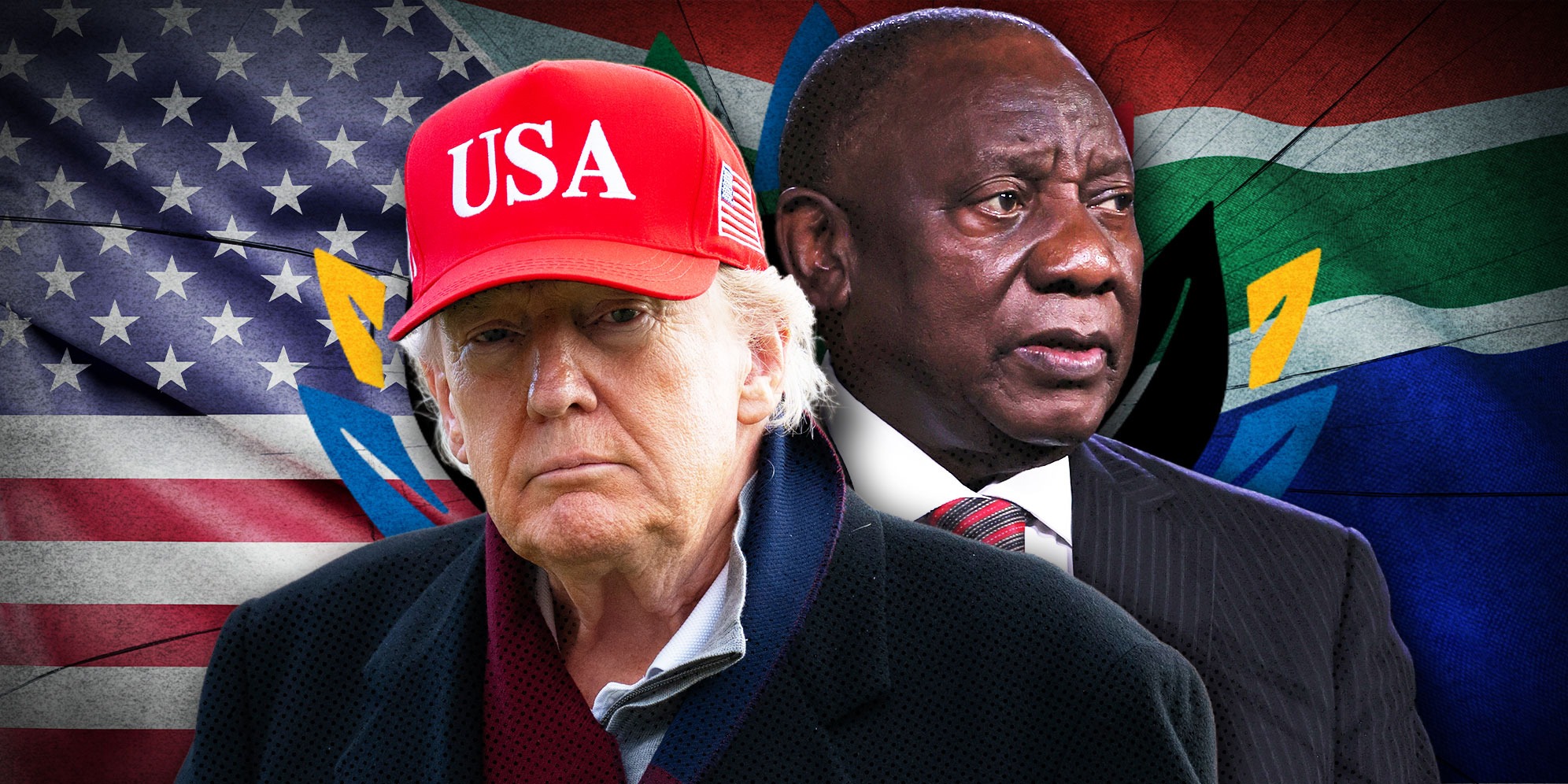
 Illustrative Image: US President Donald Tump (Photo: John McDonnell / Getty Images) | SA President Cyril Ramaphosa (Photo: Jemal Countess / Gallo Images) | G20 Logo (Image: G20 Website) | USA Flag (Image: Freepik) | SA Flag (Photo: Freepik)
 The South African government has responded to the US imposition of targeted travel sanctions by insisting that South Africa has the “sovereign right to put in place laws that address the nation’s concern over centuries of racial injustice”.
International Relations and Cooperation Minister Ronald Lamola urged the US to respect South Africa’s democracy and sovereignty over its choice of policies to correct the wrongs of the past, and said the US should continue talking to Pretoria about its issues rather than taking “unilateral action”.
He was responding to an announcement by US Secretary of State Marco Rubio that visa restrictions – travel sanctions – would be imposed on South Africans responsible for, or complicit in “the enactment or implementation of laws or policies that enable uncompensated land seizures, race-based discrimination, and/or the incitement of imminent violence against members of minority ethnic or racial groups in South Africa”.
Rubio referred to US President Donald Trump’s executive order of February 2025 in which he condemned “government-sponsored discrimination occurring against the Afrikaners and other minority populations in South Africa”.

The Trump administration has made clear it wants South Africa to address black economic empowerment (BEE), expropriation without compensation, the “Kill the Boer” Struggle chant and farm murders.
Kallie Kriel, the CEO of AfriForum, welcomed the fact that the US travel sanctions “will not harm ordinary South Africans or the country itself, but [are] specifically directed at politicians and others guilty of gross human rights violations against minorities and Afrikaners”.
/file/attachments/orphans/Peter-USsanctions2_514118.jpg "Kallie Kriel, CEO of Afriforum. (Photo: Gallo Images/Beeld/Deaan Vivier)")
But the organisation Afrikaners vir Suid-Afrika (AfSA) rejected the US action, which it said had escalated the dispute between the two countries from criticism and aid cuts to targeting individuals.
It also criticised the US ambassador to South Africa, Leo Brent Bozell, for issuing (on X) “the needlessly belligerent warning that the new directive is ‘the first step in a series of escalatory measures’. This amounts to pressure to change South Africa's laws, court outcomes and foreign policy.”
The United States remains gravely concerned about racially motivated crime and government-sponsored discrimination occurring against the Afrikaners and other minority populations in South Africa, including race-based discriminatory legislation, threats of land expropriation without compensation, and incitement of racial violence through dehumanizing chants and slogans. https://t.co/HdadCjCjq4
— U.S. Mission SA (@USEmbassySA) September 16, 2026
“Some Afrikaner organisations have applauded the directive,” AfSA said, referring to statements like the one made by AfriForum. “But they don’t speak for all Afrikaners – and on social media their stance has fuelled hostility toward the whole Afrikaner community. The actions of a few should not stigmatise an entire group.
“Our courts decide – not foreign governments,” AfSA said, noting that the Constitutional Court had upheld the “Kill the Boer” chant – which has offended the US – as protected political expression rather than incitement.
It also noted that the expropriation without compensation law was now being challenged in court. It said that BEE’s effectiveness and vulnerability to abuse and elite enrichment needed to be debated, but this was a debate for South Africans.
‘Unsupported narrative’
It noted that farm violence was part of a national crisis that affected all groups, and the pain of its victims “shouldn’t be exploited to push an unsupported narrative of state-sponsored racial persecution”.
Analysts said that it seemed that Washington had made a deliberate decision to escalate the crisis in US-SA relations, as the announcement of the travel sanctions came when President Cyril Ramaphosa was still considering his response to a message from Trump reiterating his demands. Bozell met Ramaphosa on 26 August to convey Trump’s message.
Coincidentally, the sanctions announcement came shortly after the rightwing Afrikaner group Lex Libertas said it intended to place 3,000 crosses on the National Mall in Washington, DC. Each of these crosses, the group said, would carry the names of farmers murdered in South Africa.
In an unusual and significant move, Lamola responded to Rubio’s announcement of the sanctions measure in both Afrikaans and English. “Dit is ons soewereine reg om wetgewing in werking te stel wat die gevolge van eeue se rasse-onreg aanspreek,” he noted. (“It is our sovereign right to put in place laws that address the nation’s concern over centuries of racial injustice.”)
In a clear reference to the likes of AfriForum, he blamed “fringe groups who wrongly portray themselves as representatives of “minorities” and “Afrikaners in general” for the “mischaracterisation of South Africa’s domestic policies”.
/file/attachments/orphans/Peter-USsanctions3_477127.jpg "Minister Ronald Lamola. (Photo: Gallo Images/Luba Lesolle)")
Lamola said healing the divisions of the past was a “constitutional imperative …intended to improve the plight of the people who had been excluded for centuries”.
He added that the South African government “remains seized with the challenges of crime in South Africa which affects everyone and not targeting anyone based on their race, colour, or social origin”.
He said challenges in relations with the US “can only be resolved by constructive engagement through state actors on both sides of the diplomatic channel, not unilateral acts”.
Turning up the heat
Bob Wekesa, the director of the African Centre for the Study of the United States at Wits University, said it seemed the US had decided to escalate the standoff with South Africa.
He noted that Rubio’s announcement had come when it seemed Ramaphosa was considering his response to Trump’s message of 26 August. Instead of waiting for the response, it seemed that the US had decided “to turn up the heat on South Africa to see if they buckle.
“This suggests the US feels it has nothing to lose and it will bend the will of South Africa to hearken to the demands they have made. It’s like, ‘Bring it on.’ I don’t see South Africa bending to that at this point. For one, I don’t see the ANC budging on BBBEE policy,” he said.
So it looked like an inevitable clash “between an irresistible force and an immovable object. Nothing happens. It’s a stalemate. Going forward, I see these sanctions, travel bans, being the first steps. There might be a few other actions from the US side. I think the US still has a few buttons to press. They might be economic. There might be sanctions on certain South African products.
“Just when diplomatic relations seemed to be improving, they suddenly collapsed,” he noted.
Wekesa also conjectured that the timing of Rubio’s announcement might be related to the weekend summit of the BRICS bloc in New Delhi as well as SA’s local government elections and the US midterm elections, both in November.
He noted that the BRICS summit, which Ramaphosa attended – and which was also attended by Iranian President Masoud Pezeshkian and other leaders – had come out strong and invigorated.
“One of the demands from the US has been that South Africa remains non-aligned and its involvement in the BRICS is seen from Washington as a form of alignment against US interests.”
/file/attachments/orphans/Tamsin-Ramaphosa-BRICS_798653.jpg "His Excellency President Cyril Ramaphosa delivers country statement during a session of BRICS and Invited Leaders during the 18th BRICS Leaders' Summit held at Bharat Mandapam in New Delhi, Republic of India. (Photo: Siyabulela Duda / GCIS)")
Wekesa also speculated that with the ANC predicted to lose ground in the local government elections, Washington was “perhaps calculating to hit South Africa at its point of weakness”.
He thought it possible that the Trump administration might also wish to demonstrate to its right-wing base in the midterm elections that it cares for white people.
Anthoni van Nieuwkerk, head of international relations at the Thabo Mbeki School of Public and International Affairs, said he thought the ultimate aim of the Trump administration was to effect regime change in South Africa, replacing the ANC-led government with a more friendly one that the US could do business with.
/file/attachments/orphans/Peter-USsanctions7_863201.jpg "Anthoni van Nieuwkerk head of the Thabo Mbeki School of International Relations. (Photo: TM Foundantion)")
He said the travel sanctions were one of a series of moves by the US to put pressure on the SA government to move away from its current trajectory – politically and ideologically. The end game was to remove the ANC and other like-minded elements “so that you’re left with pliant clients in the GNU [Government of National Unity] with whom you can make business.
“Because, what the Americans want is not to get rid of South Africa, but to hold South Africa under a friendly government, because we are valuable. We’ve got critical minerals and a geostrategic position.” DM
Comments
Scroll down to load comments...