




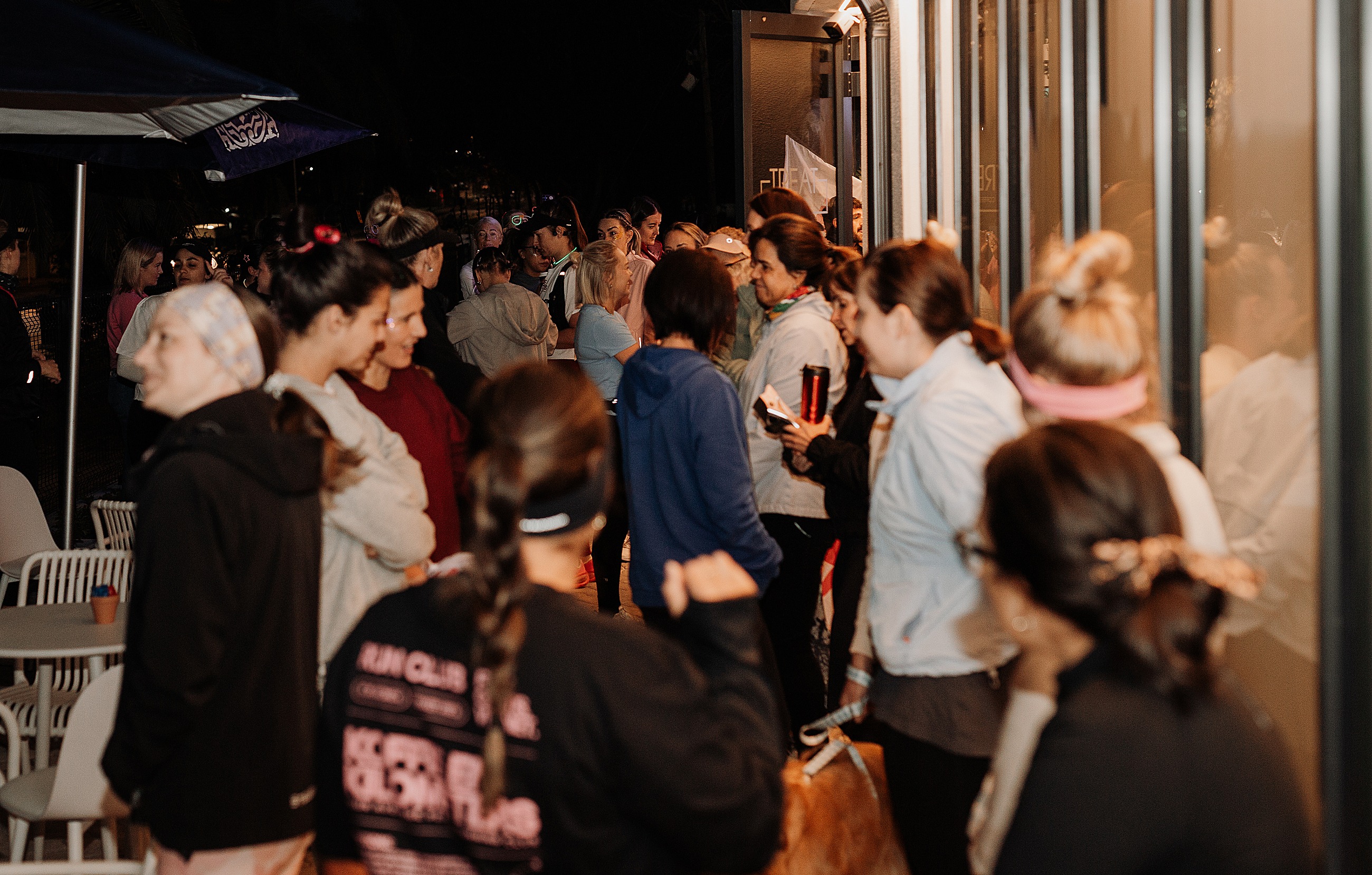
 Running crews are new social clubs for post-pandemic human connection, but they are also tools for women to seek safety in numbers. (Photo: Supplied / Koffie & Kilometres Crew)
When Adidas surveyed 9,000 people – split neatly down the middle concerning gender identification – between 17 December 2022 and 6 January 2023, South Africa was not among the nine countries selected.
But there is no doubt that finding 92% of the women respondents affirmed a concern for their safety when they go for a run is a universally applicable fear.

“My biggest fear is very simple: that I won’t make it home,” aspirant 3h30 marathon runner and community activist Marisa Calvert tells Daily Maverick when asked about her biggest fear.
Calvert has long been vocal on South African social media about women’s safety. She details the constant, exhausting mental calculations female runners endure before and during every run:
“What time am I leaving? Is it light enough? Which route is busiest? Has somebody seen me leave? Is my live location on? Is Garmin LiveTrack on? Does my partner know roughly when I should be back?”
During runs, she constantly evaluates threats – deciding whether to cross the street near transit hubs or navigating the dilemma of whether responding to a man’s greeting will invite harassment or trigger aggression.
No way to run
Calvert acknowledges brand involvement from companies such as Puma, Asics, Sorbet, Clicks, BRU, Kula and Gilnokie. However, she points out that brand support is overwhelmingly concentrated in August (Women’s Month).
She explicitly calls on brands to move beyond temporary marketing:
“Women’s safety cannot be a Women’s Month campaign. There is so much brands could support practically, whether that is safer group runs, access to secure training spaces, transport to and from runs, safety tools or simply using their platforms to keep the conversation going throughout the year.”
When you cross-reference consultant agency data, the broader South African apparel market is projected to reach $7.9-billion by 2030, with women’s apparel generating $4.18-billion in revenue. Naturally, key economic hubs such as Johannesburg (35%) and Cape Town (30%) lead regional spending.
South Africa’s athletic footwear sector alone is valued at $901.4-million in 2025. Running shoes hold the largest single piece of the pie at 36.8% ($331.7-million).
Demand is anchored by grassroots movements like Parkrun (over 228 weekly national events), where runners replace primary training shoes every 600-800km (a six-to-nine-month purchase cycle).
The incentive to support women is clear because women currently account for 35.6% of athletic footwear end-user demand (more than $320-million in 2025). This share is projected to narrow the gap with the men’s segment (42.3%), reaching 38-39% by 2034 as female fitness participation rises.
Positive pavement pounding
Having spent around eight years running early mornings and late evenings, public relations specialist Lee-Ann Caboz acknowledges how easy it is to develop a false sense of security on familiar routes.
Having experienced frightening incidents on the road herself, her biggest fear is that familiarity masks real danger:
“My biggest fear now is probably that sense of false security that comes with knowing an area well or having run the same route a hundred times. Experience doesn’t necessarily make you immune to what can happen around you.”
As a result, her safety routine is strict: she no longer runs alone, choosing to run with her crew, a partner, or with a family member following in a vehicle.
She says that “being independent and being safe are not mutually exclusive”.
“Sometimes the smartest thing you can do is simply make sure somebody knows where you are... and you are not out there entirely on your own.”
Caboz joined Koffie & Kilometers (an all-female run crew in the northern burbs of Cape Town) seeking accountability, connection, and physical safety away from isolated areas.
Her primary motivation is cultivating spaces where women can run free of fear, performance pressure, or social cliques. A central moment for her occurred on a misty morning run when she slipped out of sight around a corner for barely a minute, and her fellow captains sped back at a 3:45 pace to ensure she was safe. That moment demonstrated to her that true community is having people who actively look out for you.
Drawing on her background in sports brand marketing, Caboz explained to Daily Maverick that brands historically prioritise event health and safety or elite/influencer appearances, ignoring the daily safety realities of everyday women.
She argues that commercial partnerships should offer tangible value – such as access to emergency response technology (read: panic button platforms like Aura or Namola), recovery resources and safety education – rather than simple logo placements.
Allies on the long run
There are positive examples of brands being allies and partners in fitness, not just there for the sign-ups and swag. Puma’s support of the annual HER initiative (a nine-week night-running programme in Cape Town preparing women for a 10km race) and grassroots campaigns like Run(HER) supported by crews such as CRRC, Must Love Hills, adidas Runners, Slow and Steady, Forge, and Rabbit Run Club.
Internationally, global studies (Read: that earlier Adidas finding that 92% of women worry about their safety while running) have prompted campaigns like With Women We Run and The Ridiculous Run, that stresses male allyship and safety integration into running apps.
But the commercial side of sport leaves much to be desired. Globally, female athletes receive only 4% of sports media coverage despite comprising 40% of professional athletes. This creates a self-perpetuating cycle: low media visibility leads sponsors to assume lower return on investment (ROI), justifying reduced funding.
And when it trickles down to grassroots impact, brand sponsorships remain concentrated on elite professionals or macro-influencers, leaving everyday women and grassroots movements without structural backing.
NPOs and community initiatives fighting gender-based violence face severe financial instability. In 2020, the all-women organisation Catch Me If You Can (CMIYC) had to indefinitely postpone major fundraising events due to a lack of corporate sponsor backing, while simultaneously facing institutional challenges such as having their club status questioned under claims of gender discrimination.
To Caboz’s earlier point, female consumers hold significant household purchasing power and actively favour brands that support social causes and female athletics.
Beyond that, athleisure and activewear (leggings, sports bras, joggers) dominate daily wardrobes post-Covid – just count how many iterations of lululemon-style apparel brands popped up.
When safety concerns cause 46% of women to lose interest in running or limit their training hours, brands lose recurring gear replacement revenue. Investing in women’s safety directly protects and expands this target market.
/file/attachments/orphans/BMrunningsafety_299886.jpg "(Photo: Supplied / Koffie & Kilometres Crew)")
Always watching
But what should also be addressed is the exact safety features that Calvert relies on to let her loved ones track her route and also help her track her progress.
Fitness tracking technologies like Strava occupy a complex position in the lives of female athletes.
In a local study, 69.4% of surveyed app users use Strava for running. It offers virtual peer support, route mapping, workout accountability and social status through sharing race achievements.
Features like Privacy Zones (which hide start and end points near home or office locations) and Beacon (which sends live-tracking links to trusted contacts) provide runners and their families with peace of mind.
But publicly tagged activities broadcast exact routes, training schedules, and start/finish locations. This data can be exploited by strangers to track runners’ movements, leading to fears of targeted physical harassment, stalking, or home burglaries.

A major flaw is the app’s complex, opt-out privacy design. Enabling “Enhanced Privacy” does not automatically hide a runner from public view.
And it’s this unintended public exposure that leads to digital harassment, such as strangers sending unsolicited “kudos” or following users based on nearby runs. This exposes a broader issue in consumer tech: putting the burden on female users to navigate complex settings to keep themselves safe.
There are no easy answers to keeping women safe on our roads while they’re running, but a solution is definitely in community and working together to make the sport accessible to all and well supported, down to grassroots level. DM
Comments
Scroll down to load comments...