




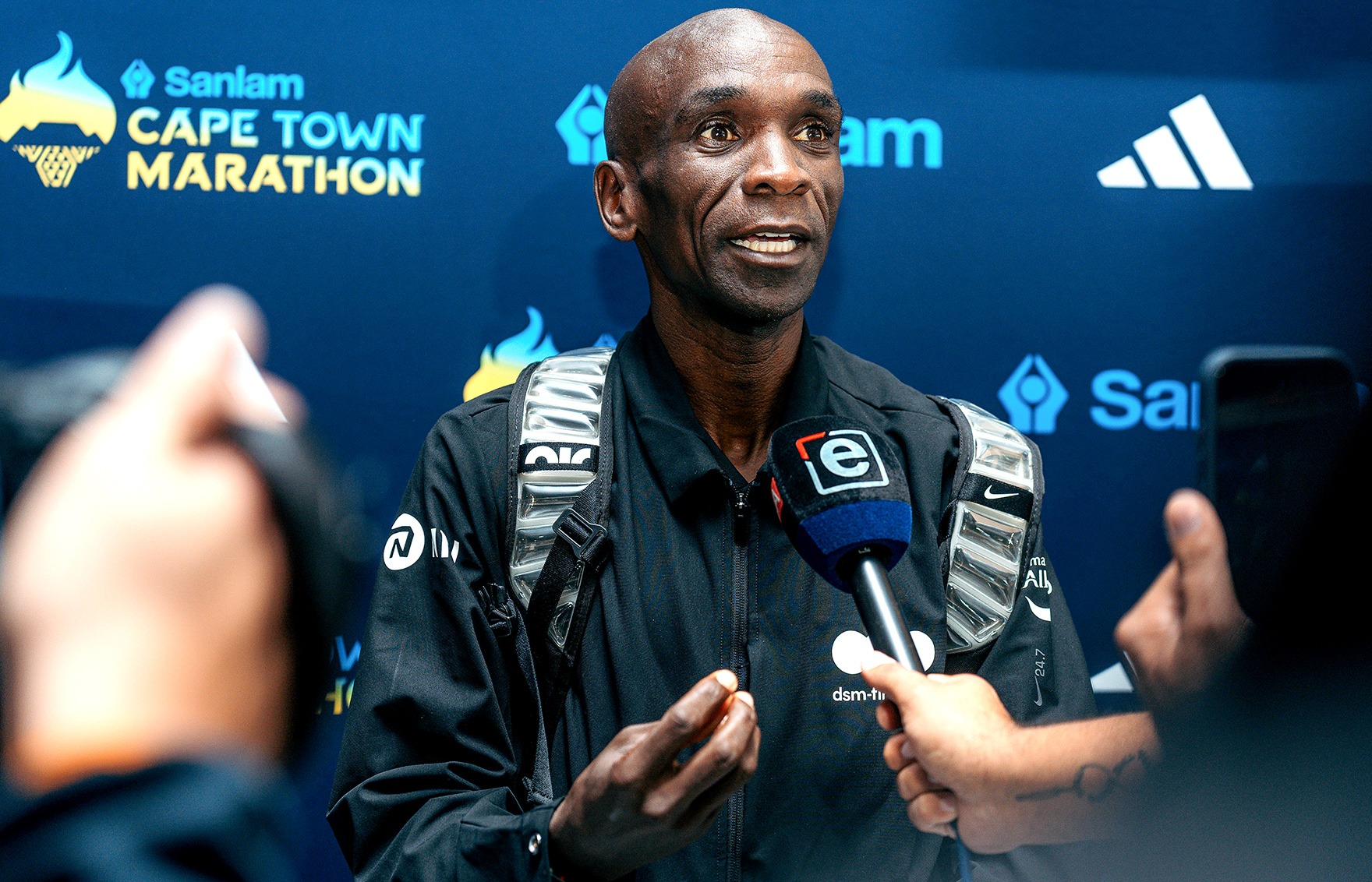
 World-renowned marathoner Eliud Kipchoge arrived in Cape Town on Tuesday, 19 May, to run the 2026 Sanlam Cape Town Marathon as part of his Eliud’s Running World tour. (Photo: Supplied / Cape Town Marathon)
Eliud Kipchoge never broke the two-hour marathon barrier in official race conditions. It took 16 years to shave three minutes off the marathon world record of 2:06:05 when Dennis Kimetto set his official world record of 2:02:57 at the 2014 Berlin Marathon in a pair of Adidas Adizero Adios.
Nike put its running technology eggs in the Kipchoge basket in 2017, with a specific goal of slashing another three minutes off that record. It almost paid off immediately with his 2018 Berlin Marathon of 2:01:39, wearing Nike Zoom Vaporfly 4% Flyknit. The swoosh took top honours again in 2023 when Kelvin Kiptum strode his Nike Air Zoom Alphaflys to a Chicago Marathon victory in 2:00:35.
/file/dailymaverick/wp-content/uploads/2021/08/11gh_57107248.jpeg "Eliud Kipchoge of Kenya reacts while crossing the finish line first to win the Gold medal in the Men's Marathon during the athletics events of the Tokyo 2020 Olympic Games at the Odori Park in Sapporo, Japan, 08 August 2021. EPA-EFE/KIMIMASA MAYAMA")
But in April this year, the elusive performance happened when Sebastian Sawe massacred those expectations with his historic 1:59:30 at the 2026 London Marathon. He wore the brand new Adidas Adizero Adios Pro Evo 3, a sub-100g racer that was the culmination of three years of research and iterative development.

When Daily Maverick asked Kipchoge about the incredible marathon times we’re seeing this year, as someone who has dedicated most of his time trying to push humanity beneath the two-hour limit, he was incredibly optimistic.
“There has been huge, huge progress as a result of habits … small habits that become big. The next five seconds will fall easily because the belief is there that they [the current crop of elite athletes] can run fast.”
Running economy
It’s difficult to calculate how much Adidas spent on developing the barrier-smashing Evo 3, but those in the know reckon Nike ploughed $36-million into the Breaking2 project. Of that, it paid Kipchoge a $1-million base fee to miss out the major marathons and stick to its specific plan.
With regard to the business of running fast, the leading performance brands (Adidas, Nike and Asics) sank and estimated $1.4-billion into sports science and R&D over 2024 and 2025.
And to the victors go incredible spoils. Adidas 2025 net sales of €24.811-billion were an all-time high for the company. Almost three out of every five euros came from footwear sales, which totalled €14.232-billion.
The running category grew over 35% in Q4, a step up over the 30% sequential swelling in the brand category over the rest of the year.
Runners clearly saw the writing on the performance charts, and it was underlined with three stripes.
The German performance apparel outfit is riding a wave right now, but the maths puts the bill for the next five-second improvement on the limits of human achievement at around $70-million of targeted investment for research and development.
Kipchoge has since shifted his focus from footwear to technology, partnering with Chinese tech giant Huawei to bring his training methods and data tracking to more potential champions.
“Technology can come with a lot of advantages… for now it gives us time to train more. It gives our minds time to relax because you know [your] recovery, you know [your] nutrition. Everything guided by the data… you know your fitness [because] it is guided by the data.”
The elements of success
Elite runners leverage dedicated data analysts and wearable technology to monitor muscle fatigue, sleep and recovery to prevent overtraining. But the base of developing athletes with the physical conditioning to sustain 21.1km/h over 42.2km is still nutrition.
“Running, you know, is degenerative,” Jake Axelrod, founder of local supplement company Metalabs. He is referring to running involving sustained mechanical stress and repetitive friction on skeletal muscles, which can lead to various physical injuries.
He was also making a counterpoint to Daily Maverick’s framing of branch-chain amino acid (BCAA) supplements as useless cash grabs. BCAAs do help trigger protein synthesis, which can accelerate recovery.
Read more: Ozempic, Wegovy and the R33bn bill that is SA’s obesity time bomb
He does, however, advocate for a food-first approach – a counterintuitive position for a protein powder merchant – and pitches his product as a convenient way to make the necessary nutritional requirements for elite performance, as well as a pantry staple to incorporate into a healthy lifestyle.
But there’s a catch, though. The explosive popularity of GLP-1 drugs (such as Ozempic) has fundamentally changed consumer dietary habits. Because rapid weight loss from these drugs can result in severe muscle wasting (up to 80% muscle loss versus 20% fat loss if not managed properly), doctors are instructing patients to prioritise protein intake.
This medical guidance has created a massive new market of protein consumers. Axelrod says that “there’s never been a time in history where more people are looking for more high- [quality] protein”.
This demand is not limited to powders; protein is being added to everyday snacks and cereals (even Doritos) globally.
Axelrod explains the direct market impact: “There’s even been crazy, crazy supply constraints on whey protein production because the demand for protein, especially in the US, because that’s the biggest user of these GLP1s at the moment, has skyrocketed.”
Diminishing returns
Those protein prices will begin to hit the consumer this year as the weight-loss industrial complex churns for an ever-growing legion of injectors.
On the performance running shoe side, the cost of all that investment in slicing seconds off marathon times will also hit the recreational weekend warriors. Since Nike kicked off its now failed crusade to break the two-hour barrier, we’ve seen a 15%-30% upward creep in prices.
Now, with the conflict in the Middle East choking global oil supply, the input production costs of making those high-performance polyether block amide foams – which are made from the prehistoric plankton juice – are also facing upward pressure.
The improvement margins are getting slimmer as we approach the upper limits of human performance, but Kipchoge is impressively optimistic.
He was in Cape Town to participate in the Cape Town Marathon, for the first stop on his world tour, which has the grand ambition of seven marathons on seven continents over a two-year period. His goal, however, is just to inspire people to get out and run.
“I believe the beautiful life is the life where you can push yourself… it’s the lifestyle of making sure we fulfil it, forget about that [goal] or set another and, you know, we enjoy life together.”
He never broke the two-hour barrier in race conditions, but the impact he made by inspiring the belief that it was possible was enough. It’s just the economics that can help take us further. DM
Comments
Scroll down to load comments...