




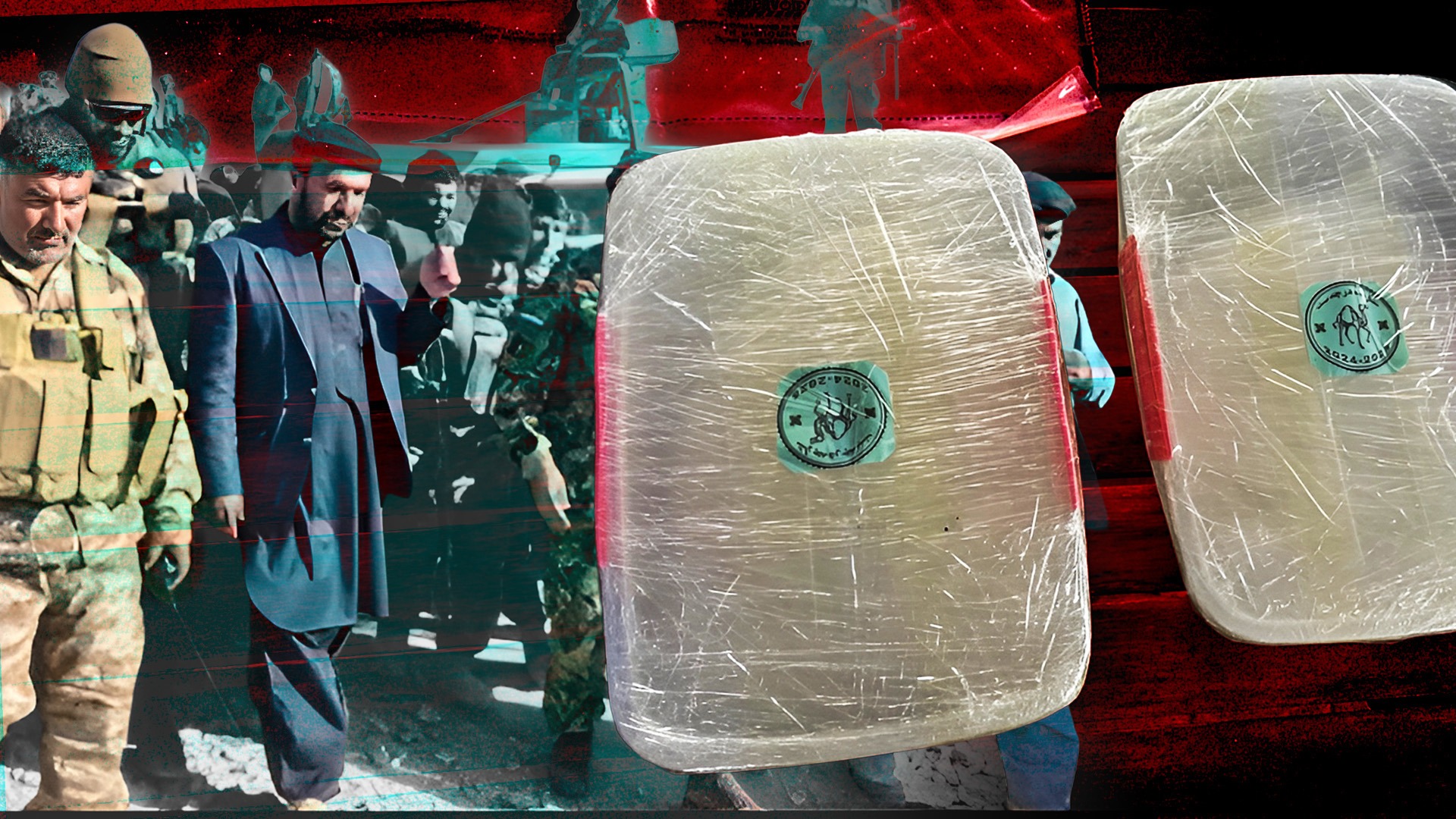
 Abdul Zahir Qadeer (in blue) walks with armed guards. He allegedly organised 2kg of methamphetamine to be sent to Johannesburg, where a source, secretly working with US authorities, picked it up in a parking lot. (Photos: US Department of Justice)
On 10 December 2024, someone opened the back door of a vehicle in a parking lot near a Johannesburg restaurant. Inside the vehicle was a black bag concealing two plastic containers, each marked with a green stamp depicting a camel, and divided between the containers was a 2kg stash of methamphetamine (known as “tik” in South Africa).
A person who had paid $14,000 (around R226,000) to someone in Afghanistan for this consignment picked it up.
What the seller probably did not know was that this seemingly basic drug deal was anything but straightforward.
Ex-Afghan politician, weapons and drugs
United States authorities have alleged that the buyer was secretly working on its behalf, and that the drug consignment was from a former Afghan politician, Abdul Zahir Qadeer, also known as Haji Abdul Zahir.
He was once a general in Afghanistan’s Border Force and is a former member of Afghanistan’s National Assembly, the legislature there until the Taliban regained control in 2021.
𝗗𝗖𝗜 𝗘𝗫𝗧𝗥𝗔𝗗𝗜𝗧𝗘𝗦 𝗔𝗙𝗚𝗛𝗔𝗡 𝗡𝗔𝗧𝗜𝗢𝗡𝗔𝗟 𝗧𝗢 𝗨.𝗦. 𝗧𝗢 𝗙𝗔𝗖𝗘 𝗡𝗔𝗥𝗖𝗢𝗧𝗜𝗖𝗦 𝗧𝗥𝗔𝗙𝗙𝗜𝗖𝗞𝗜𝗡𝗚 𝗖𝗛𝗔𝗥𝗚𝗘𝗦
— DCI KENYA (@DCI_Kenya) July 11, 2026
The Directorate of Criminal Investigations (DCI), through its Anti-Narcotics Unit (ANU), has successfully extradited Afghan national Abdul… pic.twitter.com/O2bOyfUIOi
Qadeer was arrested in Nairobi, Kenya, in April 2025, where he denied the charges that the US brought against him, countering that the case was politically motivated.
But a few months ago, in July, he was extradited to the US, where he is now formally accused of conspiring to traffic drugs and weapons there (and internationally).
This case does not appear to have been reported on in South Africa until now, coinciding with the resumption of the Madlanga Commission of Inquiry.
The commission is investigating whether a cartel with ties to drug traffickers has infiltrated the state, politics and private sector.
Trafficking in focus at the Madlanga Commission
The Madlanga Commission is investigating whether a cartel, known as the Big Five, has infiltrated South Africa’s criminal justice system, political arena and private sector. Accusations about this, and the cartel’s ties to drug trafficking linked to South America, first surfaced in July 2025. The Big Five, meanwhile, is a label that has for decades been used in South Africa’s law enforcement spheres to identify top criminal suspects linked to drugs.
One focus of the commission has been on drug trafficking between South Africa and Brazil.
Meanwhile, there have also been local crackdowns on drug production facilities that suggest Mexican cartels are active in South Africa.
And while it has long been known that drug dealings in Afghanistan and Pakistan are connected to this country – with methamphetamine and heroin being brought in – names of suspects and granular allegations are rarely publicised.
‘Large-scale international trafficker’
The accusations emanating from the Qadeer case change this and now directly connect South Africa, especially Johannesburg, to alleged drug happenings in locations ranging from poppy fields in Afghanistan to buildings in New York.
The Qadeer case also points to how individuals secretly passing on information to the US, as well as foot soldiers for suspected global crime kingpins, are active in South Africa.
Qadeer allegedly had ties to the Taliban, as well as government officials in Afghanistan connected to narco dealings.
A criminal complaint against Qadeer details how the US built up its case against him.
In it, Nicholas DiFrancesco, a US Drug Enforcement Administration (DEA) special agent, described Qadeer as “a large-scale international narcotics and weapons trafficker” and said an investigation commenced in November 2024.
That month, a confidential source working for the DEA, identified as CS-1, began communicating with Qadeer via encrypted voice and electronic messaging platforms.
‘Operating in Africa’
They had focused on “their potential partnership in trafficking hundreds of kilograms of heroin and methamphetamine for importation into and sale in the United States for a purported drug trafficking organisation”.
DiFrancesco said that CS-1 had pretended to work for that organisation.
On 9 November 2024, CS-1 told Qadeer in a call that they were “laundering millions of dollars in drug proceeds for the [drug trafficking organisation], operating in Africa”.
DiFrancesco explained that CS-1 had also told Qadeer that the organisation was buying 400 to 600 kilograms of drugs at a time but was unhappy with the quality from its supplier, so was looking for a better supplier.
The complaint against Qadeer said that he had stated he could help supply CS-1 and the drug trafficking organisation.
It added: “[He] explained that he was a ‘teacher,’ and the ‘people who are doing these things’ (the drug suppliers) in Afghanistan were his ‘students.’
“In addition, Qadeer told CS-1, ‘I’m ready to play any kind of game which is making money,’ and Qadeer explained that this type of transaction would be ‘easy’ for Qadeer.”
Armed guards and ‘Taliban cooperation’
According to DiFrancesco’s complaint, later that same day, 9 November 2024, Qadeer sent CS-1 photographs of himself surrounded by armed guards.
A message accompanied Qadeer’s photographs: “[T]ell them this is my friend.”
The next day, CS-1 indicated to Qadeer that the drug trafficking organisation was interested in working with him, and Qadeer allegedly wanted information on the kinds of drugs they were keen to obtain.
“Qadeer discussed growing ‘poppy’ in Afghanistan, and he confirmed that he could provide the [traffickers] with ‘product’ (i.e., narcotics) anywhere in the world,” the complaint said.
/file/attachments/orphans/qadeer-joburg-caryn2_770703.jpg "How South Africa fits into global heroin trafficking routes. (Source: European Union Drugs Agency)")
Over the following days, Qadeer and CS-1 had discussed drugs in calls and messages.
Around 13 November 2024, CS-1 told Qadeer that his drug trafficking organisation wanted to buy a sample of four to six kilograms of heroin.
The traffickers wanted a drug received in Africa, and it would then be sent to the US and other locations for testing.
Heroin and the Southern Route
South Africa fits into what is known as the Southern Route of heroin trafficking. A Global Initiative Against Transnational Organized Crime report from July 2026, Heroin Trafficking Along the Northern and Southern Routes, by Paddy Gin and Daniel Husain, refers to South Africa several times. It explains: “Today, the southern route forms a flexible trafficking architecture that links the major poppy-producing provinces of southern Afghanistan to maritime gateways in Pakistan and Iran, and from there to Europe, the Middle East, and east and southern Africa.”
“Qadeer responded that he would find a sample of heroin that CS-1 would ‘love,’” DiFrancesco’s complaint said.
“Qadeer also explained to CS-1 that the Taliban controlled Afghanistan, causing the price of ‘kilos’ (i.e., kilograms of drugs) there to fluctuate, but that if Qadeer had money and a strong team, the Taliban would cooperate with him.”
(In 2022, the Taliban banned the cultivation of opium poppies, used to make heroin – this saw traffickers adapt.)
‘Contact government officials’
After that conversation, Qadeer wanted to speak to CS-1 using a different encrypted communication platform.
During another phone call, CS-1 explained to Qadeer that after the heroin sample purchase, his trafficking organisation planned to buy between 700kg and a tonne of the drug from Qadeer.
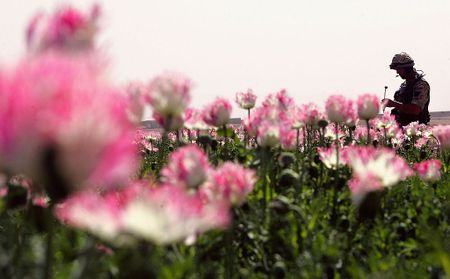
The complaint alleged: “Qadeer responded that he would contact government officials in Afghanistan involved in narcotics trafficking, who were purchasing ‘poppy’ land (i.e., land used for the production of heroin), and ask those officials to be on Qadeer’s ‘team.’”
During a phone call more than a week later, around 23 November 2024, Qadeer allegedly agreed to give CS-1 and the drug trafficking organisation 2kg of another drug, methamphetamine, to be delivered in Africa.
CS-1 had explained that half of the stash would be sent to New York to test its quality before any bigger order was made.
‘Lucky’ and the Joburg car park
“During subsequent telephone calls between on or about November 27 and December 5, 2024, Qadeer agreed to deliver the two-kilogram sample to CS-1 and the [drug trafficking organisation] in Johannesburg, South Africa on December 10, 2024, for subsequent testing and distribution,” DiFrancesco’s complaint said.
Around 7 December 2024, Qadeer allegedly agreed to a $14,000 payment for the sample.
Two days later, another confidential source secretly working for the DEA, CS-2, ensured this was paid via a hawala service (an informal fund transfer system) to Qadeer’s nephew in Afghanistan.
/file/attachments/orphans/qadeer-joburg-caryn3_313059.jpg "Two kilograms of methamphetamine that was delivered, allegedly by a footsodlier of Abdul Zahir Qadeer, to a secret US witness, in Johannesburg in December 2024. (Photo US Departme)")
Qadeer then let CS-1 know that one of his associates would contact CS-2 about the promised methamphetamine sample.
“Later that same day, on or about December 10, 2024, CS-2 was contacted via an encrypted messaging application by an individual who identified himself as ‘Lucky’ and instructed CS-2 to meet him at a restaurant in Johannesburg,” DiFrancesco’s complaint against Qadeer stated.
“CS-2 met ‘Lucky’ at the agreed-upon restaurant later that day, and, after a brief conversation, ‘Lucky’ directed CS-2 to follow him to a nearby parking lot.
“Once in the parking lot, ‘Lucky’ opened the rear door of his vehicle for CS-2. CS-2 retrieved a black bag… from the vehicle, and ‘Lucky’ said that the drugs contained in the bag were of good quality.”
According to DiFrancesco’s complaint, CS-2 left the location and took the bag as evidence to South African law enforcement.
On Monday, 14 September, the Hawks referred a Daily Maverick query about this to the South African Police Service; however, no response had been received from the police by the time of publication.
Machine guns, rocket-propelled grenades
In January last year, CS-1 and Qadeer allegedly turned their focus to weapons.
“During two telephone calls, CS-1 asked Qadeer if Qadeer could provide machine guns, rifles, and other weapons. Qadeer explained that his contacts (the ‘Suppliers’) could provide rifles, but only in ‘huge’ quantities such as 200 or 300 rifles per order,” DiFrancesco’s complaint said.
/file/attachments/orphans/qadeer-joburg-caryn_117952.jpg "A list of weapons that a secret US witness puported to want from Abdul Zahir Qadeer, sent to him in January 2025. (Photo: US Department of Justice)")
It added that Qadeer allegedly told CS-1: “Listen… I know what we need, I’m a fighter. I told [the Suppliers] I need Kalashnikov, I need PK [machine guns], I need RPGs [rocket-propelled grenades], I need DShK [a heavy Soviet machine gun].”
CS-1 had pretended that the weapons were needed for his drug trafficking organisation to safeguard narco consignments on ships.
‘Against US interference in Afghanistan’
Based on the complaint against Qadeer, the methamphetamine delivered to CS-2 in the Johannesburg parking lot has played a pivotal role in his arrest.
Qadeer, while still in Kenya ahead of his extradition to the US a few months ago, had tried to fight off being sent to the US.
Kenyan court documents relating to this show that he denied involvement in drug trafficking and firearms activities.
“[Qadeer] claimed that the request for his extradition arose from his alleged opposition to the USA’s interference in Afghanistan during his alleged tenure as a member of the Afghanistan National Assembly,” according to the documents.
As the case against him progresses in the US, more details about South Africa’s role in this global saga may emerge.
More local drug busts and narco manufacturing facility crackdowns will expose which other international cartels are using South Africa as a trafficking hub. DM
Comments
Scroll down to load comments...