




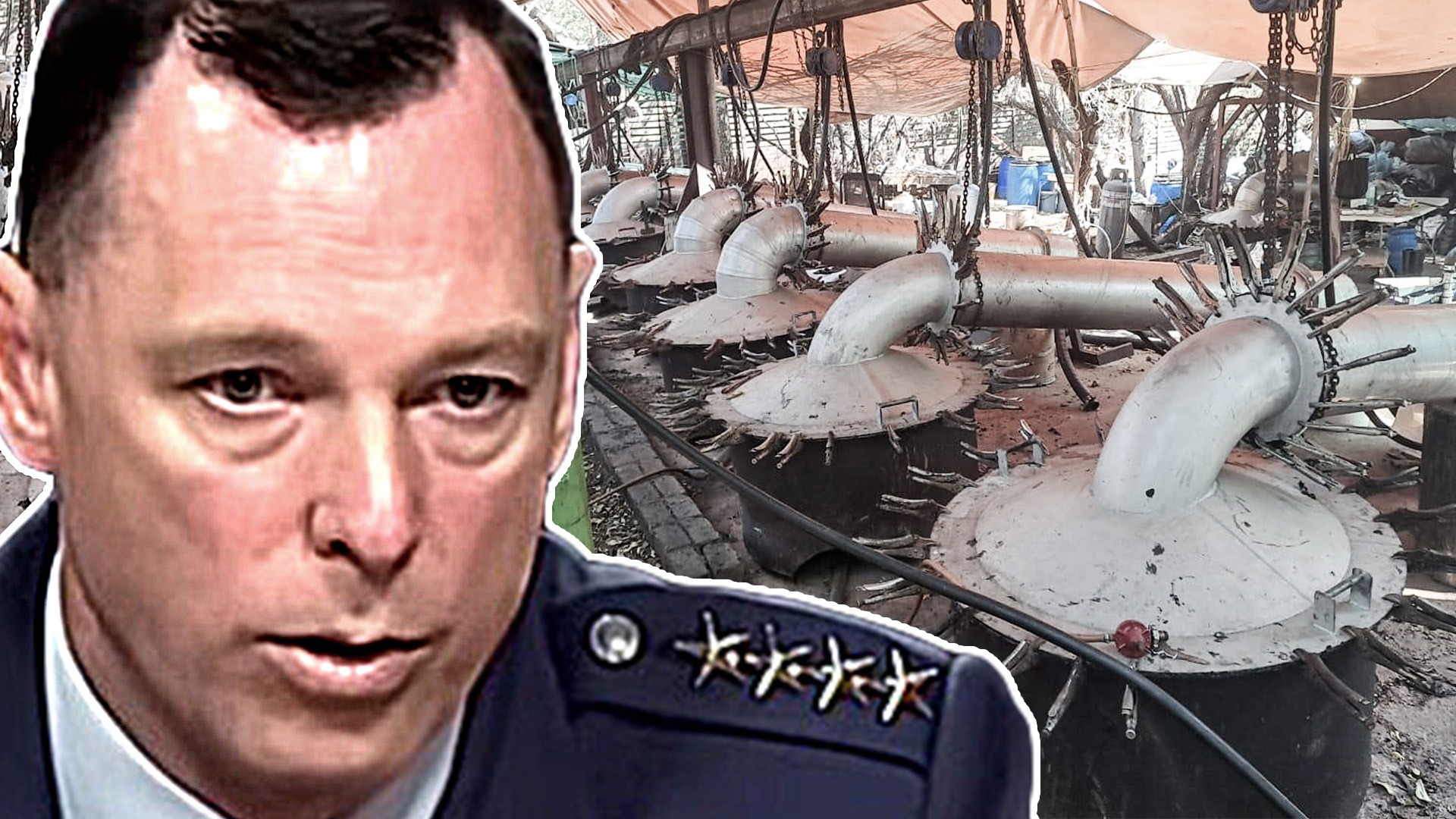
 US Africa Command head General Dagvin Anderson testifies before the US Senate Armed Services Committee on 14 May 2026. (Photo: Screengrab from US Africa Command / YouTube) | Drug factory equipment after police raided a farm in Groblersdal, Limpopo, in 2024. Suspects from Mexico were among those arrested. (Photo: X / SAPS)
The extent of international cartel activity on this continent, including in South Africa, is becoming clearer, and the emerging picture is alarming.
General Dagvin Anderson, who heads the US’s Africa Command, a combat command responsible for military operations to protect America, recently warned about a combination of cartel and terrorist activity in Africa.
He has said that it needs different authorities to work together to tackle it, or it risks “a rupture”.
“We are watching this develop, and it’s of concern as this fuels both the terrorists and the cartels,” Anderson said recently before the US Senate Armed Services Committee.
Over several months, various sources with ties to policing in South Africa have told Daily Maverick that drug production, especially linked to Mexico, is becoming a serious problem here.
Anderson’s stance adds weight to these concerns.
Daily Maverick first reported in 2024 that it appeared that Mexico’s Sinaloa Cartel was active in South Africa – a narcotics production plant pointed to this – and that the synthetic drug fentanyl, driving an overdose crisis in the US, was moving through this country.
Since then, up until about a fortnight ago, three more drug manufacturing facilities have been discovered in cases in which Mexican suspects have been arrested.
The South African Police Service (SAPS) recently acknowledged that there were four cases with alleged Mexican links.
Disrupted drug production
Daily Maverick has established that, according to information the SAPS has previously released, these relate to:
- July 2024 – A drug laboratory worth about R2-billion was uncovered at a farm in Limpopo. Three men from Mexico, along with two local suspects, were detained. Lieutenant General Godfrey Lebeya, who headed the Hawks at the time, had said the Mexican suspects may be Sinaloa Cartel members.
- November 2024 – A Mexican suspect was arrested after a drug-making facility, worth around R100-million, was discovered in Rietfontein, Tshwane.
- September 2025 – Five Mexican suspects, along with a South African, were arrested after a clandestine drug production facility was discovered outside Volksrust in Mpumalanga. It was suspected that crystal methamphetamine was made there.
- May 2026 – It was announced on 13 May that a drug manufacturing facility, worth about R1-billion, was discovered in Swartruggens in North West. Those arrested were Fabian Astorga, Jesus Alonso, Medina Astorga, Luis Alberto Ramirez Rios, Jose Andres Medina and Jacquelin Lopez Madrid of Mexico; Ismael Afiado Massingue and Lourenco Constantino Cumbane of Mozambique; Tobias Soyani of Zimbabwe; and Tyron John Schutte, Kyle Schutte and Vusi Amos Mkambi of South Africa.
This trend now forms part of the situation that is sparking concerns locally and in the US.
‘Sinaloa on site in SA’
Earlier this month, on 14 May, Anderson expressed some worries to lawmakers in the US about cartel activity in Africa. (A recording of this meeting was posted to YouTube last week.)
Responding to questions about South and Central American cartels and connections to terrorists, he said: “That’s an area that is emerging that is causing us great concern.”
Anderson said that over 18 to 24 months, the US tipped off partner countries to drug activities and laboratories.
In that time, 11 of 12 drug laboratories had “Mexican cartel members on site.”
/file/attachments/orphans/GS7Y83zXwAAuXtC_927777.jpeg "In July 2024, police discovered a clandestine drug production facility worth more than R2bn in Groblersdal in Limpopo. Among those arrested were suspects from Mexico. (Photo: SAPS)")
“[This included] the largest drug lab that had ever been disrupted in South Africa [...] there were Sinaloa Cartel members on site,” Anderson said.
It appears that “the largest drug lab” he referred to was the R2-billion drug facility discovery in Limpopo in July 2024.
“They [Sinaloa Cartel members] are actually doing production now in Africa as well as the transit of that across the continent,” Anderson said.
The drugs manufactured in Africa were destined for the Middle East, Europe and the US.
Traffickers and terrorists
Anderson said the US had intelligence about a shipment of about 35 tonnes of cocaine, with a street value of roughly $1-billion, that Spanish authorities had intercepted.
This, he said, appeared to be the largest cocaine “interdiction” in history.
According to a press statement by Spain’s Civil Guard, the interception, publicised earlier this month, was linked to an investigation into the Mocro Mafia – the Moroccan Mafia.
/file/attachments/orphans/SeveralsuspectsincludingfromMexicowerearrestedinMay2026whenpoliceuncoveredadrugmanufacturingfacilityinSwartruggensasmallNorthWesttownPhotoSAgovernm_489396.jpg "Several suspects, including from Mexico, were arrested in May 2026 when police uncovered a drug manufacturing facility in Swartruggens, a small North West town. (Photo: SA government)")
Anderson said the cocaine had come from South America, moved along the west coast of Africa towards another location that he did not publicly divulge.
Speaking more broadly, he said that terrorist organisations were being paid for helping to move drugs.
“There’s a symbiotic relationship that money then comes back to our hemisphere to those drug cartels, but also helps provide fuel for those terrorists.”
This suggests that cartel activities in and around South Africa may be connected to terrorist groups.
‘Preventing rupture’
A statement by Anderson from earlier this month, posted on the US Senate Committee on Armed Services website, also said: “Since 2024, we have seen an increased flow of drugs emanating from the Americas through Africa into Europe, with a nearly sixfold increase of cocaine flowing across the Atlantic Ocean.”
That year, 2024, coincides with when Daily Maverick first reported on Mexican cartel activity in South Africa.
#sapsHAWKS [SWARTRUGGENS DRUG LAB UPDATE] Forensic experts are still processing the crime scene; however, approximately 481 kilograms of methamphetamine with an estimated street value amounting to millions of rands has thus far been confiscated. It is anticipated that the… pic.twitter.com/20HC4OHHv2
— SA Police Service 🇿🇦 (@SAPoliceService) May 15, 2026
Anderson’s statement added that Mexican, Venezuelan and Caribbean cartels were seeking to export expertise in drug production to Africa.
“Mexican cartel members were arrested during raids in several African countries at some of the largest labs ever discovered,” it said.
“This convergence turns a fragile security landscape into a pressure cooker, demanding interagency focus and coordination to prevent a rupture.”
Threats to Mozambique and Nigeria
Aside from the drug production facilities uncovered in South Africa, there have been incidents in other countries on the continent, pointing to cartel activities.
Last month, police in Mozambique announced the arrests of three suspects, including two from Mexico.
According to a Mozambican news report, the two were “identified as members of the Sinaloa Cartel in Mexico and intended to establish themselves in the national territory, specifically in Matutuine district, Maputo province”.
Recently, on 20 May, police in Nigeria also announced that they had cracked down on a crystal methamphetamine manufacturing facility in a remote forest.
Among the nine suspects arrested were three from Mexico.
“Through a clinical, simultaneous operation executed by the elite operatives of our Special Operations Unit SOU, we have successfully dismantled a sophisticated, transnational methamphetamine production syndicate run jointly by a Nigerian drug cartel and their Mexican counterparts,” a statement from Nigeria’s National Law Enforcement Agency said.
“This network did not just traffic drugs; they were actively manufacturing industrial-scale quantities of highly lethal illicit substances right on our soil, threatening the national security and public health of Nigeria.”
Corruption
The recent crackdowns on drug manufacturing facilities have occurred while South Africa grapples with an unprecedented law enforcement crisis.
Central to the crisis are accusations, first made in July last year by KwaZulu-Natal police head Nhlanhla Mkhwanazi, that a drug cartel known as the Big Five had infiltrated the country’s criminal justice system, politics and private security.
The scandal has led to the arrests and suspensions of several senior police officers.
/file/attachments/orphans/WhatsAppImage2026-03-18at114749_546971.jpeg "KwaZulu-Natal Police Commissioner Nhlanhla Mkhwanazi, who has alleged that cartels have infiltrated South Africa’s criminal justice system. (Photo: Zwelethemba Kostile/Parliament RSA)")
The Madlanga Commission of Inquiry, set up to investigate the accusations, recently heard from police officers who testified on how certain colleagues bungled global drug trafficking cases.
The inquiry heard about two consignments of cocaine that arrived in South Africa from Brazil.
Daily Maverick reported that one of those consignments contained cocaine bricks showing the Jaguar brand, an image used by a now-jailed Sinaloa Cartel member. However, it was not proven that the cocaine was tied to the cartel.
The Madlanga Commission, meanwhile, heard that nearly R300-million worth of cocaine from the two consignments was stolen from state storage.
This is especially concerning, considering how international cartels are viewed.
US Attorney Jay Clayton, referring to a related case in the US a few weeks ago, said: “The Sinaloa Cartel, and other drug trafficking organisations like it, would not operate as freely or successfully without corrupt politicians and law enforcement officials on their payroll.” DM
Comments
Scroll down to load comments...