




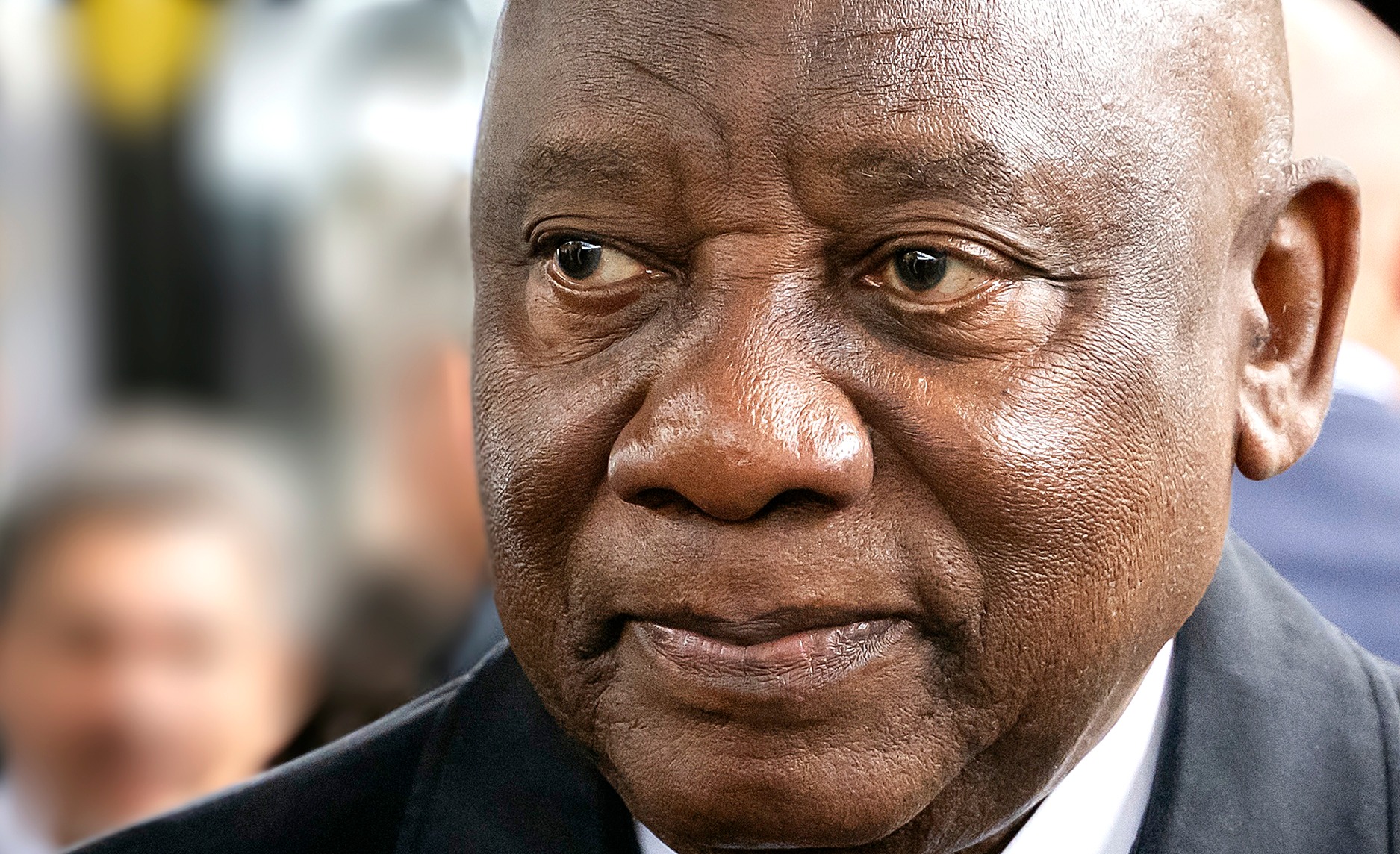
 President Cyril Ramaphosa has objected to MPs’ selection of the impeachment committee evidence leader. (Photo: EPA / Gian Ehrenzeller)
The likelihood of Parliament’s presidential impeachment process facing litigation at every turn set in on Wednesday when, in a second intervention, President Cyril Ramaphosa objected to MPs’ selection of an evidence leader over claimed conflicts of interest.
The threat of ongoing litigation was acknowledged across party political lines, but the question that was put to a vote was what to do about it in connection with the presidential objections to the impeachment committee’s choice of evidence leader, advocate Thandazani Madonsela.
Ramaphosa, in a letter on the eve of Wednesday’s impeachment committee meeting, said “there is a reasonable apprehension that adv Madonsela SC may harbour a sense of grievance towards me and that he may act upon it” because he had removed the advocate as his representative on the Judicial Service Commission in March 2022.
/file/attachments/orphans/pic_117641.jpg "Advocate Thandazani Madonsela.
<br>(Photo: newslive_sa / Instagram)")
This had not previously been raised in public. Ramaphosa’s other claimed conflict of interest – that Madonsela had provided legal advice to the ANC on impeachment processes – has been on public record for about two weeks. It was formally disclosed to MPs that Madonsela supervised a junior in a legal opinion, but that his brief ended in early July.
Daily Maverick reported that ANC MPs abstained from the vote on evidence leader so as not to be accused of double standards at this 5 August impeachment committee meeting.
Legal advice
The so-called progressive caucus, including the MK party, the EFF and the African Transformation Movement (ATM), proposed proceeding after dismissing Ramaphosa’s objection as “second-guessing” the impeachment committee’s democratic processes to delay it.
In contrast, the group coalescing around the Government of National Unity (GNU), including ActionSA and the African Christian Democratic Party (ACDP), raised concerns about getting all the legal ducks in a row to avoid future reviews.
Wednesday’s vote on what to do about the presidential objections overwhelmingly went in favour of getting legal advice on options, allowing the impeachment committee chairperson, Rise Mzansi MP Makashule Gana, the relief that his proposed compromise was accepted.
“We need to take a step back from the politics of the matter and look at the legalities of the matter,” he told MPs before the vote. “It was to be expected every step of the way would be challenged.”
/file/attachments/orphans/WhatsAppImage2026-06-01at1451192_265898.jpeg "Makashule Gana of the Rise Mzansi has been elected as the chairperson of the Impeachment Committee on Section 89 Enquiry. The committee consists of 31 members from different political parties. (Photo: Phando Jikelo / RSA Parliament)")
Presidential spokesperson Vincent Magwenya dismissed opposition criticisms of delaying tactics and second-guessing.
“The impeachment process is a political process in its design. Of course, opposition parties will criticise everything that the President does in protecting his rights within due process,” he told Daily Maverick.
“Some of their leaders have been using appeals avoiding trials, and others are avoiding prison sentences through due process. But the sky is falling when the President chooses to exercise his rights for procedural fairness.”
Legal risk
No date was set for the legal opinion on options concerning the President’s objection to the evidence leader over the claimed conflict of interest. However, the impeachment committee meets again on the eve of the court hearings from 2 September on Ramaphosa’s review of the Section 89 independent panel report, which found he had a case to answer over the forex theft from sofa cushions at his private Phala Phala game farm.
All procurement paperwork for the evidence leader had been signed. However, the decision to obtain legal advice regarding the evidence leader selection effectively delays the impeachment committee’s background work that could have continued had the evidence leader’s appointment been finalised.
Public impeachment hearings are interdicted after Ramaphosa successfully approached the courts for an injunction against public impeachment hearings until the court review is finalised.
This interdict stands as the Constitutional Court has dismissed an application for direct access to appeal from the EFF, the ATM and the impeachment committee.
Earlier during Wednesday’s committee proceedings, ACDP MP Steve Swart pointed out that if the committee simply proceeded, a later review could succeed.
“Every step of this process is subject to litigation and review… I tend to think we should allow our legal team to advise us what the implications are. But I say this reluctantly.”
Afterwards, DA parliamentary leader George Michalakis told Daily Maverick of concerns that this matter could “open the door for the President to take another decision of the committee on review. It cannot become a never-ending battle that prevents Parliament from getting on with its job.”
Approached for comment, Gana declined, saying: “It is my approach not to give commentary at this stage. I do give the resolutions of the meeting.”
Coalition complications
The confluence of politics and parliamentary proceedings and litigation is an uncomfortable one. Parliamentary politics have become more complicated than a straightforward government-opposition divide since the ANC lost its parliamentary majority in the May 2024 elections.
The resulting GNU coalition partners are anchored on the ANC and the DA, as well as the IFP, the Patriotic Alliance, the Freedom Front Plus and one- and two-seat parties like Al Jama-ah, and usually dominate. But the lack of a firm partnership agreement means associations are fluid and the ANC can no longer count on getting its way.
This starkly emerged, for example, in the DA litigation against the proposed 2025 value-added tax hike proposals, which were dropped in an out-of-court settlement.
It is against this backdrop that the presidential impeachment proceedings are playing out.
The original motion was brought by ATM MP Vuyolwethu Zungula shortly after the news of the $580,000 theft from the Phala Phala game farm sofa cushions emerged in public when former spy boss Arthur Fraser laid a criminal complaint in June 2022, more than two years after the theft.
In December 2022, the ANC’s then parliamentary majority used its numbers to vote down the Section 89 independent panel report, effectively nixing any agreement.
When Ramaphosa’s request for direct access to the Constitutional Court to review the S89 panel report was dismissed, he did not return to the lower high court to start proceedings there. The matter was deemed closed.
However, a successful EFF-ATM court challenge against that December 2022 parliamentary vote meant that in May 2026 the Constitutional Court set aside the vote as invalid and referred the Section 89 panel report back to Parliament’s impeachment committee.
Ultimately, MPs – and Parliament – are left on the front lines of a process where political stakes and legal battles are enmeshed with their constitutional oversight responsibilities to hold executive conduct to account. DM
Comments
Scroll down to load comments...