




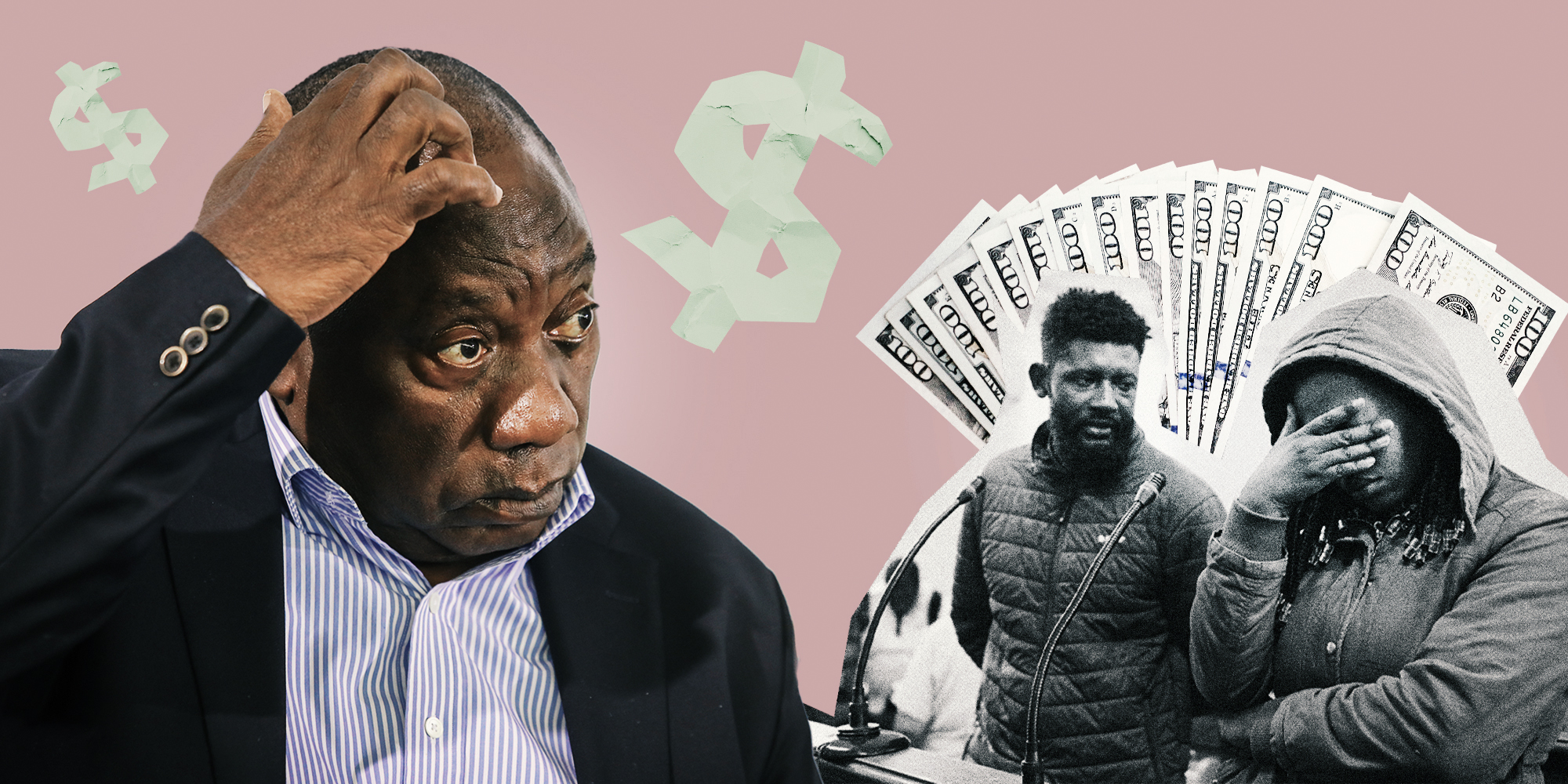
 Illustrative image: Sources: President Cyril Ramaphosa. (Photo: Jaco Marais / Gallo Images) | US dollars. (Photo: iStock) | Theft accused Imanuwela David and Froliana Joseph appear at the Bela-Bela Magistrates’ Court in connection with the R9m burglary at President Cyril Ramaphosa’s Phala Phala farm. (Photo: Gallo Images / Beeld / Deaan Vivier)
The two-year delay in reporting the theft of $580,000 from President Cyril Ramaphosa’s Phala Phala game farm, along with claims that parts of the crime scene were tampered with before police began their investigation, has left the State relying heavily on circumstantial evidence.
That has been evident since the trial began, but it became even clearer on Wednesday, 5 August 2026, as the Modimolle Magistrates’ Court heard closing arguments in the case.
The case now comes down to one question: whether that evidence can prove beyond reasonable doubt that the three accused conspired to carry out the February 2020 burglary.
/file/attachments/orphans/ED_477844_614988.jpg "Imanuwela David (39) and Froliana Joseph (30) appear at Bela-Bela's Magistrate's Court in connection with the dollar heist at President Cyril Ramaphosa's Phala Phala lodge in 2020 on November 07, 2023 in Bela-Bela, South Africa. The pair have been charged with theft, housebreaking with intent to steal, conspiracy to commit robbery, conspiracy to commit housebreaking with intent to steal. (Photo: Gallo Images / Beeld / Deaan Vivier)")
Imanuwela David, the first accused whose life is said to have changed dramatically after the robbery, is alleged to have masterminded the burglary alongside the second accused, Floriana Joseph, who worked as a cleaner at the farm. The State alleges Joseph saw the money, estimated now to be more than R9-million, hidden inside a couch and alerted her brother, Ndilinasho Joseph, the third accused.
Much of the proceedings on Wednesday were around the defence arguing that the State had failed to establish the facts necessary for the court to infer guilt beyond reasonable doubt. This was while the State maintained that the cumulative effect of the evidence pointed squarely to the accused.
‘State’s case built on assumption’
Representing David, attorney Koena Matlala argued that the prosecution’s case rested on assumptions rather than proven facts.
“If we were to rely on circumstantial evidence alone, the State has not proved its case. There are no proven facts. The State is relying on evidence that is far-fetched,” Matlala told the court.
The State alleges David conspired with the second accused, Floriana Joseph, and others to steal hundreds of thousands of US dollars allegedly hidden inside furniture at the farm.
‘Dramatic’ lifestyle changes
Another key pillar of the State’s case is what the State says was David’s dramatic change in lifestyle after the burglary.
State evidence has shown that David travelled twice to the vicinity of Phala Phala before the February 2020 break-in. The State argued that his financial circumstances changed significantly after the theft.
During the trial, the court heard that David spent more than R5-million on a fleet of luxury vehicles, including one he allegedly bought for the mother of his child.
Evidence also showed that he spent R250,000 on custom-made dental grills, R70,000 on adding diamonds to his Rolex watch and R1-million on a property in Rustenburg, North West.
Matlala, however, sought to dismantle that evidence, arguing that the purchases could not automatically be linked to money stolen from Phala Phala.
He told the court that David had been receiving substantial sums of money long before the burglary.
According to the defence, some of those funds came through David’s uncle’s construction company, where David said he “helped” with the business.
Cellphone evidence under attack
Part of the State’s case is cellphone communication between David and the second accused before, during and after the burglary. Two months ago, Daily Maverick reported that investigators had identified more than 80 calls and message exchanges involving the accused.

The State argues the calls show the pair were coordinating the break-in.
According to the State’s version, the group first broke into neighbouring Stokiesdraai Farm (they damaged only cushions) before making their way to Phala Phala after allegedly receiving directions from the second accused.
Matlala argued that the State’s theory was riddled with inconsistencies.
“The evidence says calls were made before and after. But if indeed they were communicating and accused two was giving directions, why would they get lost? If indeed they were given directions to Phala Phala Farm, why would they go to the wrong place?”
He argued that the same facts were equally consistent with the group having simply become lost.
Matlala also challenged the State’s reliance on cellphone tower evidence.
“On count three, the reliance on cellphone data is questionable in that it places people in the vicinity, but not at the scene of the crime,” Matlala said.
He reminded the court that State witness Mr Nkosi conceded during cross-examination that the cellphone evidence could not place the accused at the exact location of the burglary.
“That, Your Worship, does not assist the court in drawing an inference.”
Presiding Magistrate Peter Manthate quickly intervened, saying the court would assess the evidence as a whole rather than in isolation.
“But the court will make an inference on the totality of the evidence, not only certain aspects,” Manthate said.
The exchange offered a glimpse into what is likely to be the key issue in the judgment: whether the cumulative weight of the circumstantial evidence excludes every reasonable innocent explanation.
No knowledge, no conspiracy
Relleng Masipa, representing the second and third accused, Floriana Joseph and her brother Ndilinasho Joseph respectively, argued that the State had failed to prove the foundation of the alleged conspiracy that the two knew large sums of foreign currency were being kept at Phala Phala.
While one of the two had worked as a cleaner at the farm and was familiar with the property, Masipa argued there was no evidence that she knew money was hidden inside the farmhouse or had passed that information to the other accused.
This, he said, was significant because the court had previously heard there were four other cleaners employed at the farm.
“The State wants the court to assume she knew there was money because she worked there. But there is no evidence to support that conclusion,” Masipa argued.
Without proving that knowledge, Masipa submitted, the allegation of conspiracy could not stand.
Throughout the trial, the State presented no evidence that the siblings had benefited financially from the burglary or that their lives had changed. Masipa, who had previously applied for their discharge, argued on Wednesday that this was one of the reasons they should be acquitted.
“What would she conspire about if she did not know there was money at the farm?” he asked.
Masipa also challenged the prosecution’s reliance on cellphone records.
Although the records showed communication between accused one and accused two before and after the burglary, he argued they revealed nothing about the content of those conversations.
“The court is being asked to infer that every call was about the theft, but there is no evidence of the content of those conversations,” argued Masipa.
He said there were no text messages, recordings or other evidence demonstrating a “meeting of minds” between the accused.
Masipa further questioned the cellphone analysis, saying accused two had been linked to two different cellphone numbers, creating uncertainty about her movements.
He submitted that one phone appeared to move while another remained connected to towers near Mabula Lodge, making it impossible to determine which phone was actually in her possession at the relevant times.
He also argued that cellphone tower evidence in rural areas could not pinpoint a person's exact location because towers serviced large geographical areas.
“The fact that two phones connected to the same tower does not mean the people were together,” Masipa said.
Masipa further highlighted contradictions in witness statements about transport arrangements before the burglary, arguing that the conflicting versions weakened the State’s case rather than strengthened it.
Judge probes investigation
The court turned its attention to the police investigation of the initial break-in, before Phala Phala, with the magistrate questioning aspects of how the first burglary, at the neighbouring Stokiesdraai Farm, had been handled.
Among the issues raised was why the burglary had not been reported immediately and whether investigators had thoroughly pursued all available leads before charging the accused.
The questions emerged as the magistrate tested both the State’s and the defence’s submissions, signalling that the quality of the investigation itself could feature in the court’s assessment of the evidence.
Separately, Matlala disputed the State’s financial evidence, arguing that prosecutors had failed to establish that David’s luxury purchases had been funded with money stolen from Phala Phala.
“The witnesses told the court there were dollars. I am not sure it was dollars,” he submitted.
Circumstantial evidence sufficient, says State
Responding to the defence’s submissions, State prosecutor advocate Nkhetheni Munyai acknowledged that the prosecution’s case was built largely on circumstantial and hearsay evidence.
“It is common cause that this case has relied on circumstantial evidence and hearsay evidence,” Munyai told the court.
He argued, however, that this did not weaken the State’s case.
Instead, Munyai submitted that the court should consider the evidence in its totality rather than assessing each piece in isolation.
According to the State, the cellphone records, the movements of the accused before and after the burglary, two of the accused’s employment at Phala Phala, David’s dramatic change in lifestyle after the burglary and the financial evidence collectively establish that the accused acted together to commit the crime.
He argued that while no single piece of evidence proved the case on its own, the combined effect of the evidence justified the inferences the State was asking the court to draw.
Judgment has been reserved for 2 October, 2026. Magistrate Manthate must now decide whether the State has proved its case beyond reasonable doubt. DM
Comments
Scroll down to load comments...