




 President Cyril Ramaphosa (Illustration: Daily Maverick)
The Constitutional Court has put another brake on the battle over President Cyril Ramaphosa’s Phala Phala impeachment inquiry, refusing the African Transformation Movement (ATM) and other applicants direct access to challenge the interim order that stopped Parliament from proceeding with its public hearings.
The decision leaves the interim interdict granted by the Western Cape high court in place while Ramaphosa challenges the Section 89 panel report that forms the basis of the impeachment process.
/file/attachments/orphans/ED_607672_161524.jpg "ConCourt refuses ATM appeal over Ramaphosa’s Phala Phala impeachment inquiry. (Photo: Gallo Images / Sharon Seretlo)")
In an order handed down on Wednesday, 12 August 2026, the Constitutional Court said it would not hear the matter at this stage because Ramaphosa’s review application was due to be determined by the Western Cape high court. The outcome of that review could render the interim interdict moot.
“The Constitutional Court has considered the application to appeal directly to it and the application to file a replying affidavit by the fifth (uMkhonto Wesizwe party) and sixth (United Africans Transformation) respondents. It has concluded that no case has been made out for leave to file a replying affidavit...”
The court said it had also considered whether to hear the appeal at this stage and whether doing so would be in the interests of justice.
“It has also concluded that it is not in the interests of justice to hear the matter at this stage, given the imminent determination of the review in the Western Cape Division of the High Court, the outcome of which will render the interim interdict moot,” the order reads.
“Consequently, leave to file a replying affidavit and leave to appeal must be refused.”
Public inquiry remains on hold
The Constitutional Court decision follows a Western Cape high court ruling granting Ramaphosa an interim interdict on 24 July, stopping Parliament’s Section 89 impeachment committee from proceeding with its public inquiry while his review application is pending.
In his court papers, Ramaphosa argued that the committee should not begin its work before the courts had ruled on his application to review and set aside the report of the Section 89 panel, chaired by former chief justice Sandile Ngcobo.
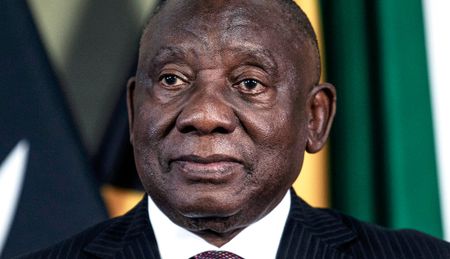
“If there is a serious and substantive challenge to the validity of such a determination in the report, as there is in my case, it should be determined before the enquiry commences,” he said in his affidavit.
Ramaphosa argued that allowing the impeachment process to proceed before his review was decided could undermine the purpose of his court challenge.
He said it could also leave the courts unable to provide effective relief if they ultimately ruled in his favour.
The President further argued that he would suffer irreparable harm if the inquiry proceeded before the review application was determined.
/file/attachments/orphans/ED_615768_810537.jpg "Judge Matthew Francis, Judge André le Grange and Judge Diane Margaret Davis at the urgent interdict hearing on Phala Phala in the Western Cape high court in Cape Town on 15 July 2026. (Photo: Gallo Images / ER Lombard)")
Western Cape high court Judge André le Grange said when handing down the judgment that the court had carefully considered the “weighty arguments” advanced by the parties, given the urgency of the matter.
Ramaphosa had approached the high court after Parliament moved to establish the committee to consider the findings of the Section 89 independent panel chaired by former chief justice Sandile Ngcobo.
The panel found that Ramaphosa had a case to answer over the theft of $580,000 from his Phala Phala game farm.
Ramaphosa has denied wrongdoing and is challenging the panel’s findings.
The ATM, Economic Freedom Fighters, uMkhonto Wesizwe party and United African Transformation opposed Ramaphosa’s application for the interdict. Parliament’s Section 89 committee, chaired by Makashule Gana, also opposed it.
/file/dailymaverick/wp-content/uploads/2024/04/ED_496697_49fffd.jpg "ATM's Vuyolwethu Zungula. ( Photo: Gallo Images/Fani Mahuntsi)")
The ATM and other parties then sought direct access to the Constitutional Court to challenge the high court order and have the public impeachment inquiry revived. That bid has now been refused.
Committee will keep working
While the public hearings may be on hold, the committee is not sitting idle.
Gana said its preparatory work would continue in line with the Western Cape high court’s decision.
“We are going to continue with our preparatory work in line with the decision that was made by the Western Cape high court,” Gana said.
The committee is expected to meet next week to move closer to finalising its terms of reference and to receive an update on the appointment of an evidence leader.
“We are moving to finalise the terms of reference, we are going to meet next week to move closer to finalising the terms of reference, but also to get an update on the appointment of evidence leader,” Gana said.
“So the preparatory work of the committee has not been interdicted and will continue.”
A fight that’s been running since 2022
The latest legal battle is another chapter in the long-running Phala Phala saga.
The matter began after the theft of foreign currency from Ramaphosa’s Limpopo farm became public and the ATM pushed for Parliament to investigate.
The subsequent Section 89 panel, chaired by Ngcobo, found that there was prima facie evidence that Ramaphosa had a case to answer over the burglary and his handling of the money.
The National Assembly initially voted in December 2022 against establishing an impeachment committee.
In May this year, the Constitutional Court ordered Parliament to refer the Section 89 report to an impeachment committee, clearing the way for the process to resume.
Ramaphosa then launched his review application in the Western Cape high court, challenging the panel’s report.
That review is expected to be heard in early September. DM
Comments
Scroll down to load comments...