




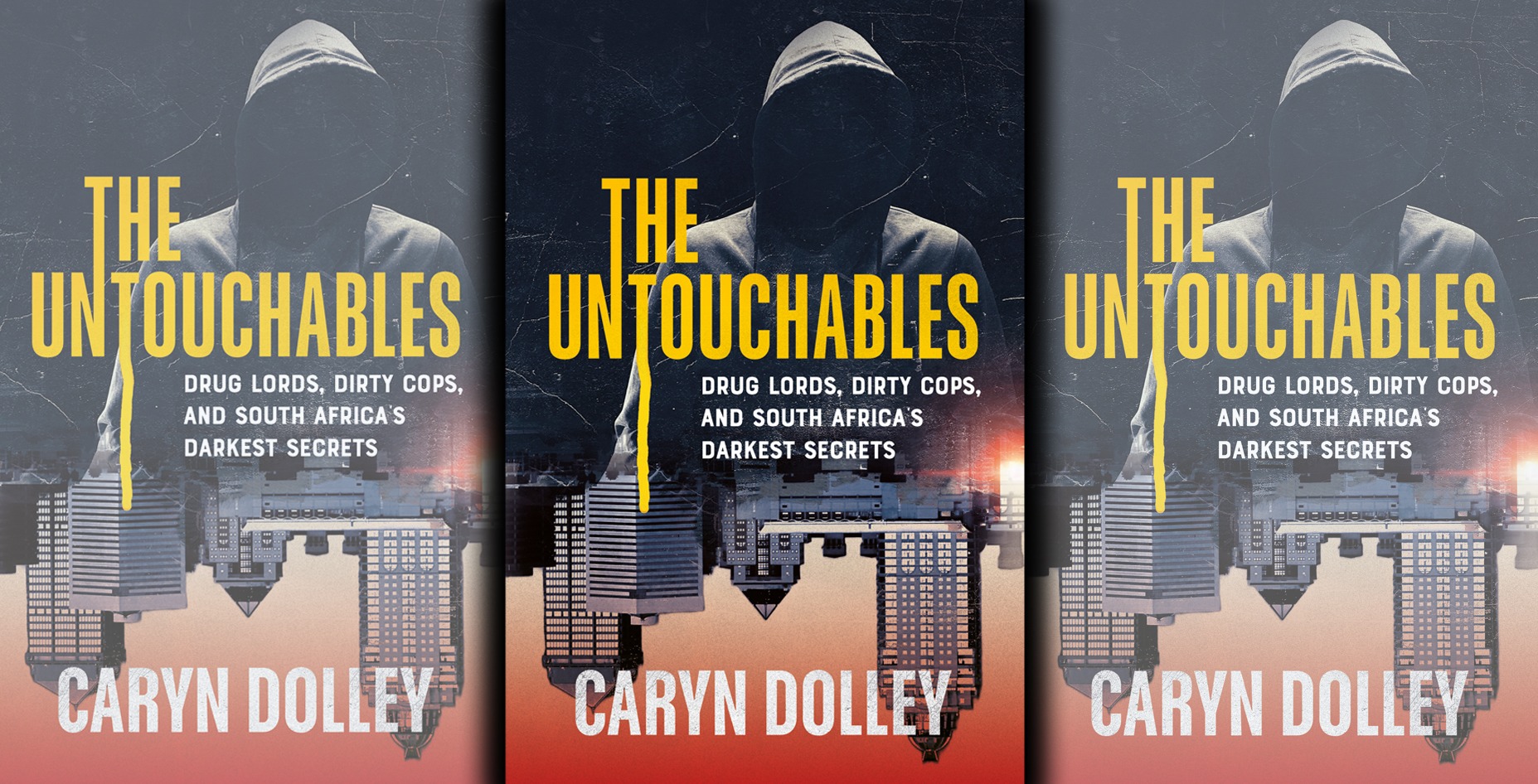
 The Untouchables by Caryn Dolley. (Photo: Maverick 451)
In her new book, Caryn Dolley recounts the moment in July 2025 when Nhlanhla Mkhwanazi set fire to South African law enforcement, with explosive allegations of criminal conduct, political collusion, and multi-national organised crime running through it all. Here is an excerpt.
***
He is flanked by police officers clutching high-calibre weapons, their faces masked. Wearing Special Task Force camouflage, he looks into the cameras. His eye contact is unwavering, his voice solid. Some watching from home recoil at this steely display. They feel that this brash intimidation is aimed directly at them; they worry that a coup d’état is about to end South Africa’s (SA’s) Government of National Unity. Others watch with something closer to hope. They feel that someone is finally taking a stand – putting their security first. As the words leave his lips, friction sparks between the country’s policing and political worlds. Suspicions smoulder. An epic scandal ignites. On Sunday 6 July 2025, when most South Africans are trying to avoid direct eye contact with the impending work week, KwaZulu-Natal’s police commissioner, Nhlanhla Mkhwanazi, holds a press conference and calmly detonates the biggest law enforcement scandal democratic SA has ever seen – alleging that a drug-trafficking cartel has infiltrated the country’s criminal justice system, its politics and its private sector, security included.
“The war that we’re facing, it’s so serious that it deals with high-level senior officers within the criminal justice system. Therefore, it is important for us to go into a combat mode. It is important for me to make sure that I take on the enemy directly.” Mkhwanazi doesn’t just tell. He shows – a presentation, which states, in part: ‘This investigation has unmasked the syndicate which involves politicians, law enforcement (SAPS, Metro Police & Correctional Services), prosecutors, judiciary and controlled by [a] drug cartel as well as business people.’ This is a country still recovering from rampant State Capture that ravaged it during Jacob Zuma’s presidency between 2009 and 2018. During that time, policing was decimated, the taxman’s organs were ripped out, and crime-fighting structures were intentionally imploded – critical investigations buried with them. Now, Mkhwanazi’s accusations start torching reputations, incinerating careers, melting artificial cordiality among cops, and provoking runaway allegations that burn uncontrollably in all directions. Some come back to him.
SA’s law enforcement landscape was up in flames. Crooks were either running for their lives or making sure their disguises were still holding. Once the biggest parts of the blaze were doused, the country would have to pick its way through blistering coals and ash to rebuild the SAPS; surrounding institutions would need to be checked for a pulse. Mkhwanazi’s words, while untested, were potent. There were multiple repercussions. Like many other journalists across SA, my already full workload instantly became heftier thanks to his statements. I steeled myself. What was coming – democratic SA’s law enforcement scandal laid bare – was not going to be easy to witness, let alone document. I knew that the veracity of what Mkhwanazi said was yet to be confirmed as fact – or fabrication. But at the same time, I felt the strangest sense of something akin to vindication. For years, I’d been writing about drug trafficking in SA and beating the drum that some police officers, and sometimes politicians, were probably involved.
Take the case of Vito Palazzolo. In the 1990s suspicions were that he was in collusion with corrupt cops, a minister and government officials. Nothing really came of this, except the implosion of an investigative unit. Hard Livings honcho Rashied Staggie spoke about how police officers were supporting his gang, getting it guns and drugs. Then we’ve got Vicky Goswami’s admissions that he and his henchmen violently tried to rule SA’s drug scene. Around all this there’ve been major drug interceptions. And criminal cases in other countries were pointing to the international narco heavyweights operating here. As far as I was concerned, something had to give. Either the murders would persist until an exceptionally high-profile state official or business figure was killed, thereby forcing focus onto the crisis, or something else would have to blast the rotting situation high up for all to see. It often felt, though, that I was isolated in these thoughts. I also felt alone in understanding that the trafficking I was writing about was a catastrophic forewarning, because my news articles, and even my book Clash of the Cartels, simply became archival. Now, though, something was happening. Finally! National focus was on the illicit drug trade plus allegedly corrupt police and politics. The absolute trafficking trifecta.
I also had a disorienting sense of déjà vu. Like an old record that glitches, I’d repeatedly been told that this trafficking trifecta has long dominated the country’s drug trade. In fact, as far back as June 1996 there was a South African police information note on drug-trafficking suspects, including some tied to Big Five investigations, the soccer fraternity, and the Goswami crowd. A key section said: “Due to the sensitive nature of the information contained within this report and the involvement of certain police officials with this syndicate, no distribution of this report is necessary.” That’s police speak for – “Don’t leak this report because some cops are culprits and we don’t want them to know that we know.” That was 1996, about three decades before Nhlanhla Mkhwanazi made his startlingly symmetrical accusations that shoved SA to the edge of a precipice.
The country’s leaders couldn’t escape the scandal. No matter which way they turned, there it was in full, sordid view. In a move that must’ve sent shockwaves of panic through the corrupt, President Cyril Ramaphosa ordered the creation of a commission of inquiry to investigate Mkhwanazi’s vast allegations. This became known as the Madlanga Commission of Inquiry. A parallel Parliamentary hearing was also set up to probe the scandal. Both proceedings were to be broadcast live – unless witnesses’ safety required otherwise – meaning the nation would finally get a look at the skeletons stuffed into the state’s dingiest closets. To avoid jumping back and forth, I’m going to draw together details from Mkhwanazi’s July 2025 press conference, the two parallel state hearings, and other connected developments – treating them as a single unfolding story, which is what they are.
After Mkhwanazi’s press conference, one name emerged from the wreckage of his allegations – the name of the cartel that had allegedly infiltrated SA’s criminal justice system, its politics, its private security.
The Big Five. DM
We’re launching Caryn Dolley’s new book in style. Join us in Cape Town with Marianne Thamm (19 August), Nelson Mandela Bay with Angela Daniels (20 August), and Joburg with Ferial Haffajee (25 August). Book now.
The Untouchables is available to purchase on the DM Shop for a retail price of R340.
/file/attachments/2996/Social_wide_341107.jpg "The Untouchables: We're launching Caryn Dolley's new book in style. Join us in Cape Town with Marianne Thamm (19 August), Nelson Mandela Bay with Angela Daniels (20 August), and Ferial Haffajee on 25 August. Book now.")
Comments
Scroll down to load comments...