



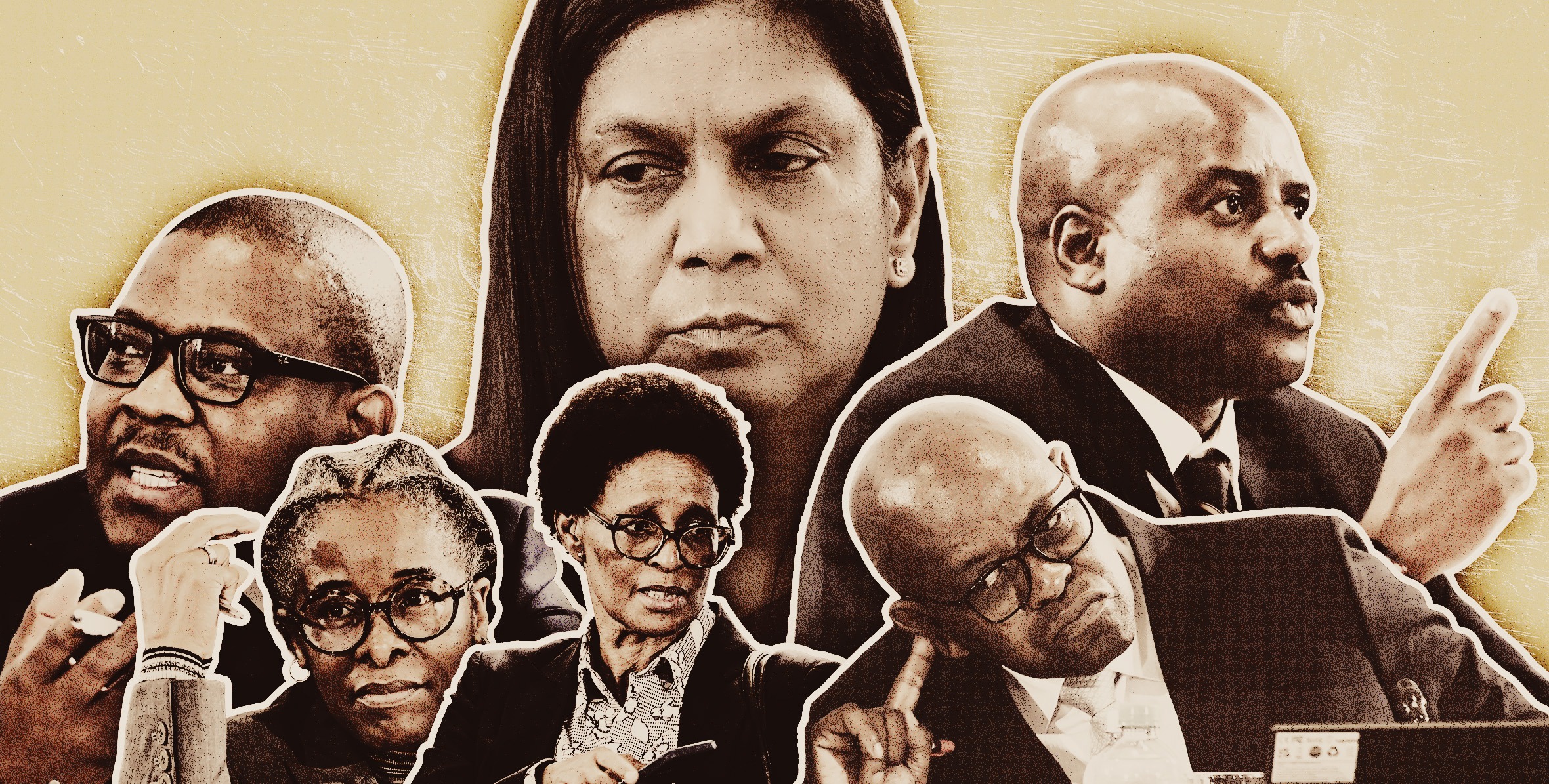
 Illustrative image: Sandile Khumalo SC. (Photo: Frennie Shivambu / Gallo Images) | Sesi Baloyi SC. (Photo: Frennie Shivambu / Gallo Images) | Mahlape Sello SC. (Photo: Lefty Shivambu / Gallo Images) | Andrea Johnson. (Photo: Frennie Shivambu / Gallo Images) | Mbuyiseli Madlanga. (Photo: Frennie Shivambu / Gallo Images) | Julius Mkhwanazi. (Photo: Frennie Shivambu / Gallo Images)
For a year now, since Lieutenant General Nhlanhla Mkhwanazi’s game-changing press conference in July 2025, one topic has enthralled citizens across South Africa: who will survive a grilling by Madlanga Commission evidence leaders?
A more in-depth, entertaining and, at times, frightening excavation of facts at this, the most effective commission the country has ever witnessed, has been a lesson in civic duty and how the law, accountability and governance should work.
In an atomised media world offering a multitude of distractions, the Madlanga Commission has brought the country together and collectively schooled us.
Nuts and bolts of governance
What has been revealed to the public are the nuts and bolts of the law, the checks and balances of regulations, and standard operating procedures — matters into which we normally would not have any insight.
We have learned what a Section 204 witness is; we know now that it was a politician, National Coloured Congress MP Fadiel Adams, who made a “Section 27” referral (to the Investigating Directorate Against Corruption — Idac) about the Crime Intelligence boss, Dumisani Khumalo, and National Police Commissioner Fannie Masemola. He got the ball rolling, so to speak.
/file/attachments/orphans/ED_607193_662956.jpg "Leader of the National Coloured Congress (NCC), Fadiel Adams briefs the media at Cape Town Parliament on May 03, 2026 in Cape Town, South Africa. This follows after members of the the PKTT conducted an unlawful operation at his former home. (Photo: Gallo Images / Brenton Geach)")
Other politicians who have stepped into the spotlight include:
The suspended minister of police, Senzo Mchunu (who met with Idac head Andrea Johnson to investigate his own chief of staff, Cedrick Nkabinde);
EFF leader Julius Malema (who is named in WhatsApp messages between Crime Intelligence officer Feroz Khan and alleged tobacco smuggler Mo Sayed);
The DA’s Ian Cameron, who was accused of supporting “an Idac narrative” against Khumalo and Masemola; and
ActionSA MP Dereleen James, who was meant to meet with Idac investigators but didn’t make it.
/file/dailymaverick/wp-content/uploads/2025/11/ED_582658-1.jpg "Police Minister Senzo Mchunu at the Parliamentary Ad Hoc Committee inquiry into alleged corruption and political interference in the criminal justice system at Good Hope Chambers on October 17, 2025. (Photo: Gallo Images / Brenton Geach)")
While Parliament’s multiparty ad hoc committee — also set up after Mkhwanazi’s press conference — was more a platform for political theatrics where many shot off their mouths, the Madlanga Commission is the real deal.
Here, evidence has been downloaded from the devices of those implicated in an ever-expanding web of criminality reaching the highest echelons of government.

Johnson soon regretted her rushed appearance before the ad hoc committee. At the Madlanga Commission, her tenuous grasp on her mandate was painfully laid bare, alongside her previously undisclosed relationship with Khan, a central figure in the puzzle. Following these revelations, she resigned from Idac.
Avoidance tactics
The swiftness of arrests and suspensions of senior officials, and the lengths to which some witnesses have gone to avoid appearing before the commission have kept the conversation at the collective water cooler going.
Avoidance tactics included:
Allegedly staging his own assassination (ANC-linked “businessman” Brown Mogotsi);
Developing a life-threatening condition (ANC-linked “businessman”, Suliman Carrim, a friend of alleged cartel boss Cat Matlala;
Surviving a close shave with a bullet (Crime Intelligence’s Feroz Khan); and
The sudden onset of a debilitating panic attack requiring sedation (Johnson).
Fearless cohort
Gone are the Gupta years of obfuscation, legal sleight-of-hand, compliant investigators and prosecutors weaponising law enforcement and the courts to protect criminals.
Led by advocate Mathew “Chakalaka” Chaskalson, the team of advocates Mahlape Sello, Adila Hassim, Lee Segeels-Ncube, Ofentse Motlhasedi, Thabang Pooe, Mpilo Sikhakhane and Teboho Mosikili operate with surgical precision.
When witnesses take the stand before Judge Mbuyiseli Madlanga and advocates Sisi Baloyi and Sandile Khumalo, they are left squirming — none more so than suspended Ekurhuleni police chief Julius Mkhwanazi, who was subjected to relentless questioning
In addition, a fearless cohort of civil servants, like Idac’s state advocate Drushantha Ramsamy, its legal adviser, advocate Peter Serunye, and its investigator Mantsha Rapeshu, has emerged at this commission.
/file/attachments/orphans/ED_616947_514428.jpg "Adv Drushantha Ramsamy (State Advocate with the Investigative Directorate Against Corruption (IDAC) testifies at the Madlanga Commission of Inquiry at Brigette Mabandla Judicial College on July 30, 2026 in Pretoria, South Africa. President Cyril Ramaphosa established the commission to investigate and report on the veracity, scope, and extent of the allegations made on 6 July 2025 by KwaZulu-Natal (KZN) Police Commissioner Lieutenant-General Nhlanhla Mkhwanazi that South Africa’s criminal justice system was compromised. (Photo: Gallo Images / Frennie Shivambu)")
Ramsamy, during her evidence on Thursday, 30 July, told the commission that Johnson was in charge of “Project Diversion”, an investigation directed at building cases against Masemola and Khumalo.
These younger civil servants, who refused to kowtow or be bullied by their bosses at Idac, provided game-changing testimony to this commission this week. Their actions and courage in standing their ground and doing what is right are a great example for younger South Africans who have been forced to live with the consequences of endemic crime and corruption, aided and abetted by those charged with protecting society. DM
Comments
Scroll down to load comments...