




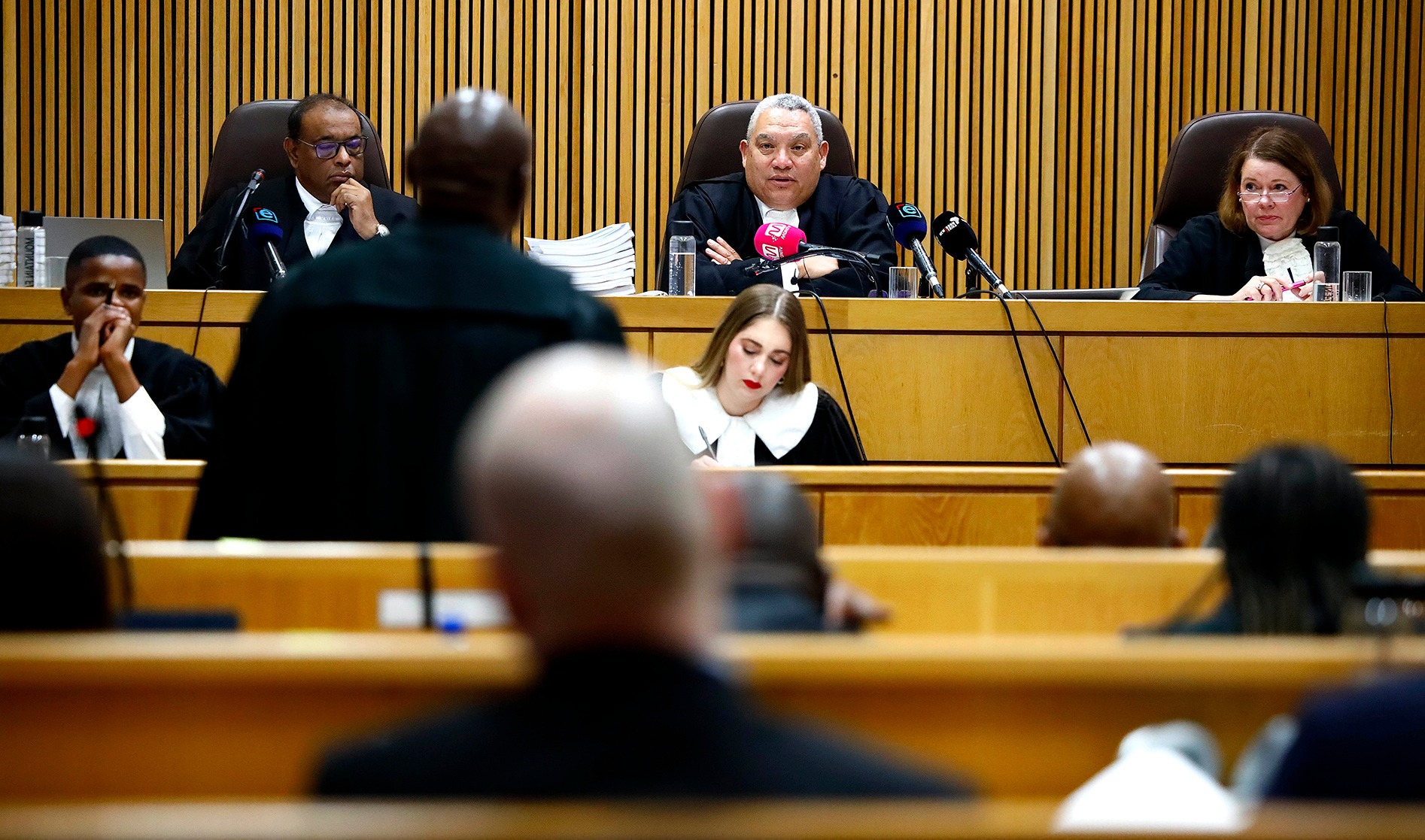
 Judges Matthew Francis, Andre Le Grange and Diane Davis at the urgent interdict hearing on Phala Phala at the Western Cape Division of the High Court on 15 July 2026 in Cape Town, South Africa. (Photo: Gallo Images / ER Lombard)
 Opposition parties have argued that the Western Cape High Court would be “crossing” into Parliament’s lane should it grant President Cyril Ramaphosa an urgent interdict to prevent the impeachment committee from starting proceedings against him, pending his review of the Section 89 panel report.
“If you stay in your lane you wouldn’t grant the interdict,” advocate Anton Katz SC, representing the African Transformation Movement (ATM), told the court on Wednesday, 15 July. “But if you grant the interdict, you’d be cutting into the lane of Parliament,” he continued.
The court on Wednesday heard Ramaphosa’s urgent bid to stop Parliament’s impeachment committee from starting its probe into his conduct in the Phala Phala saga.
The ATM, Economic Freedom Fighters (EFF), uMkhonto Wesizwe (MK) and United Africans Transformation (UAT) parties are opposing his application. The impeachment committee, chaired by Rise Mzansi’s Makashule Gana, also resolved to oppose the interdict on legal grounds.
Judges Andre Le Grange, Matthew Francis and Diane Davis presided over the matter.
/file/attachments/orphans/ED_615713_442832.jpg "Paperwork at the urgent interdict hearing on Phala Phala at the Western Cape Division of the High Court on 15 July 2026 in Cape Town, South Africa. It is reported that President Cyril Ramaphosa wants Parliament’s Section 89 impeachment process suspended while independent panel report is reviewed. (Photo: Gallo Images / ER Lombard)")
Ramaphosa launched a review of the report of the Section 89 panel led by former Chief Justice Sandile Ngcobo last month, after the Constitutional Court ruled in May that the report be sent back to Parliament, paving the way for impeachment processes against Ramaphosa to begin. The Ngcobo report found that Ramaphosa had a case to answer over the theft of $580,000 in cash hidden in a sofa at his Phala Phala farm.
In his review application, Ramaphosa warned MPs that he would be “compelled” to seek an interdict should impeachment proceedings go ahead before his review has been heard. His review application hearing is set for 2-4 September.
He then applied for an urgent interdict on 12 June, claiming that he would suffer “irreparable harm” to his reputation if the committee proceeded with public hearings on the matter.
Reputational harm
On Wednesday morning, advocate Wim Trengove SC, representing Ramaphosa, said that the scope of the interdict is limited to the commencement of public impeachment hearings, which would be “humiliating” for the President.
He argued that if the Section 89 panel’s report is flawed and invalid, its invalidity causes harm to the President.
“Very significant harm will be done to the President if the hearing goes ahead and it is ultimately found that the report is invalid,” said Trengove. “It is humiliating to put the President on trial.”
/file/attachments/orphans/ED_615726_497560.jpg "Advocate Wim Trengove presents his case on behalf of Cyril Ramaphosa at the urgent interdict hearing in the Western Cape Division of the High Court on 15 July. (Photo: ER Lombard / Gallo Images)")
Trengove further argued that the Rules of the National Assembly were designed not only to facilitate an impeachment process, but also to “protect” the President against the “punitive effect” of a “momentous” public inquiry, which he said is without proper foundation.
“We submit, with respect, that the purpose of the scheme of the rules and the purpose with which they have been designed is, in the first place, to hold the President to account where there is a complaint against him worthy of investigation, but at the same time, to protect the President against the humility; against the punitive impact of a public inquiry when there is no justification for it,” he said.
His arguments concerning Ramaphosa’s right to protection drew scrutiny from the judges.
“I mean, for heaven’s sake, yes he [Ramaphosa] needs protection against frivolous accusations. But, as the respondents indicated, it could be the committee could say these are all unfounded allegations… They can exonerate him,” said Judge Le Grange.
Advocate William Mokhare SC, representing the impeachment committee, argued that the committee would protect Ramaphosa’s rights — as it would any citizen who appeared before it.
In a meeting of the 31-member impeachment committee on 18 June, the committee resolved to continue with its processes “until a court of law tells [it] otherwise”.
/file/attachments/orphans/ED_615721_967999.jpg "Advocate William Mokhare presents his case on behalf of the impeachment committee at the urgent interdict hearing on 15 July. (Photo: ER Lombard / Gallo Images)")
“The chairperson [Gana] has stated to this court under oath that he understands his responsibility to be one that must ensure that the proceedings before the impeachment committee are fair and transparent, and to protect the witnesses who may appear before it … including the President, not to be abused before it.
“So the humiliation that the President is saying that he apprehends will be taken care of by the chairperson to ensure that nobody abuses the committee to advance personal [agendas],” said Mokhare.
Judge Le Grange queried how Gana would protect Ramaphosa should the report be found to be unlawful. Mokhare responded that the protection refers to the process’s integrity — “it doesn’t extend to what happens if the review is successful or not”.
Separation of powers
Advocate Katz, as well as advocate Mfesane Ka-Siboto, for the EFF, and advocate Dali Mpofu, for MK and UAT, argued that Ramaphosa’s application for an urgent interdict dealt with, at its core, a separation of powers issue.
They argued that the President would not suffer irreparable harm as a result of the impeachment hearing proceeding, but rather the harm would be inflicted on the public if the court were to grant an interdict in this case.
“The very idea that this court is being asked to intervene in the operations of Parliament — that in itself is [harmful],” said Ka-Siboto.
Katz argued that Ramaphosa had failed to make a case for irreparable harm, and failed to show that extraordinary circumstances warranted his urgent application.
“What the President is trying to do is to ask this court to traverse the land or another organ of state or another branch of government, which this court will not do unless special, extraordinary circumstances call for it,” he said.
“If you grant the interdict there’s a suggestion that there’s no harm to us. But there’s huge harm to the separation of powers.”
It was a Section 89 motion brought by ATM leader Vuyolwethu Zungula in 2022 that prompted Phala Phala impeachment processes against Ramaphosa.
/file/attachments/orphans/ED_615717_129555.jpg "Advocates Wim Trengove and Dali Mpofu exchange pleasantries at the urgent interdict hearing on 15 July. (Photo: ER Lombard / Gallo Images)")
Mpofu also petitioned the court to return with a decision indicating that it chooses to “stay in [its] lane”.
“On what basis can this court intrude into the exclusive terrain of the legislature?” he asked.
“Not only does it [this case] want to interfere with the judgment of the Constitutional Court, it also wants to interfere with the functioning of the legislature. There is simply no basis upon which this court can cross into the other lane,” said Mpofu.
He further raised an issue of the harm that would be caused to the people of South Africa, should an interdict be granted to halt impeachment proceedings.
“The people of South Africa can only hold the President accountable through their elected representatives, which is Parliament. That’s the only tool in the hands of the people of this country to get answers to what happened in Phala Phala… Who’s going to talk about the damage to them?” he asked.
/file/attachments/orphans/ED_615707_586139.jpg "Members of the MK party protest outside the Western Cape High Court during the urgent interdict hearing on 15 July. (Photo: ER Lombard / Gallo Images)")
Some 40 MK members picketed outside the High Court on Wednesday morning, holding placards reading “Ramaphosa must fall” and “I vote MK party 4 November 2026”.
Speaking to the media on the court steps, MK parliamentary leader John Hlophe said that the “obvious thing” for Ramaphosa to do would be to step down as President.
He added that the party hoped the President’s request for an interdict would be “dismissed with the contempt it deserves”.
The court will resume at 10am on Thursday for Ramaphosa’s replying arguments. DM