




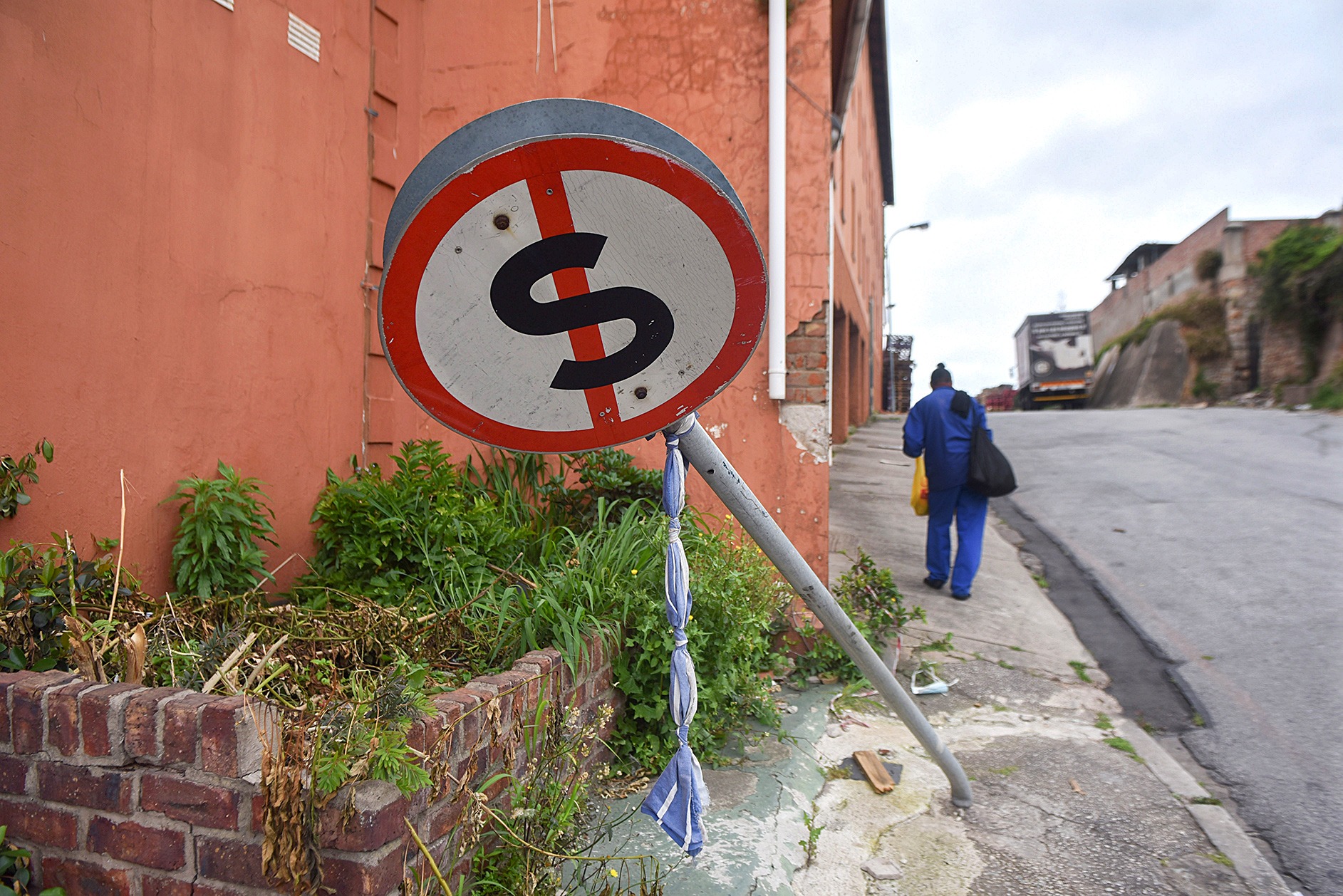
 The state of Military Road in Nelson Mandela Bay — just a stone’s throw away from the seat of the local government — is a reflection of the municipal dysfunction in the metro. (Photo: Deon Ferreira)
The National Treasury said last week it was confident that ratepayers’ contributions would ensure service delivery is not affected in municipalities whose equitable share payments have been withheld — but Nelson Mandela Bay, with its low collection rate and high unauthorised, irregular, fruitless and wasteful expenditure, fears serious problems lie ahead.
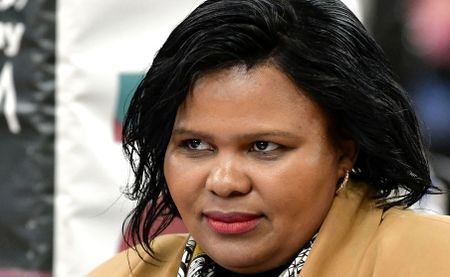
The political head for municipal finances in the metro, the EFF’s Khanya Ngqisha, said the National Treasury’s decision to withhold the metro’s July equitable share transfer would result in “unintended consequences”.
He said the municipality had expected to receive R1.7-billion in equitable share, most of which would be used to fund free basic services to assist indigent households and to support services in informal settlements.
The Treasury pays the municipal equitable share in three tranches (July, December and March). The first tranche, which is now due, totals around R600-million.
“Closing the funding arrangement that is used to finance such critical services means that some services to the needy may reduce or stop, as every expenditure incurred must be fully funded with cash,” said Ngqisha.
The metro had already scaled back free basic services to indigent communities to ensure that the budget is funded. Free basic water has been cut from eight to six kilolitres per household per month, while free basic electricity has been reduced from 75kWh to 50kWh.
“Also, Treasury’s decision may impact payment of salaries and wages as well as councillors’ emoluments, as the little reserve [left in the city’s bank account] will continue to shrink,” said Ngqisha.
Arrears escalate
He noted that the metro’s municipal rates collection was faltering as arrears continued to climb. While the city had initially expected R3.6-billion from ratepayers this financial year, a low collection rate has slashed projections to R3-billion (roughly R257-million a month).
Compounding the crisis, these rates must also plug a water revenue shortfall of more than R1-billion, and cover Eskom bulk electricity payments, due to the electricity department’s severe underperformance.
Ngqisha was unconvinced that the metro’s reserves of about R548-million would be able to cover the shortfall if the equitable share were held for an extended time. He said ratepayers must gear themselves for “unintended consequences in terms of interruption to service delivery”.
/file/attachments/orphans/Khanya1_552794.jpg "Khanya Ngqisha, Nelson Mandela Bay's budget and treasury political head. (Photo: Supplied / Nelson Mandela Bay metro)")
Ngqisha said he believed there was room for a political solution.
“We must understand that the reason for this stance by the National Treasury relates to a historical accumulated unauthorised, irregular, fruitless and wasteful expenditure, which, at 30 June 2025, was around R30-billion.
“Out of this amount, there are already amounts written off in the financial year 2025/26, which were disclosed to the National Treasury. There is room for further political engagements,” he said.
Treasury’s strategy
Speaking at a National Treasury press conference last week, Ogalaletseng Gaarekwe, the deputy director-general for intergovernmental relations, outlined three reasons why municipal equitable share payments were being withheld:
- Creditor defaulters: Municipalities failing to pay Eskom, water boards, or other creditors must submit a payment plan to release an initial third of their share, followed by proof of payment to unlock the rest.
- Unfunded budgets: Councils that passed unfunded budgets must rectify their financial planning before their funds are released.
- High wasteful expenditure: Municipalities must present clear plans to curb unauthorised, irregular, fruitless and wasteful expenditure (UIFWE).
Nelson Mandela Bay falls squarely into this third group. With a staggering R30-billion in UIFWE, the metro has the highest rate of wasteful spending in the country.
/file/attachments/orphans/OgalaletsengGaarekwedeputydgintergovernmentalrelations_274948.jpg "Ogalaletseng Gaarekwe, the Treasury's deputy director-general for intergovernmental relations. (Photo: Ntswe Mokoena / GCIS)")
Gaarekwe said they usually receive a fast response from municipalities once the equitable share is withheld. In 2025, she said, the Treasury withheld the July equitable share for 75 municipalities, all of which did enough to have their money released in early August.
Call for accountability
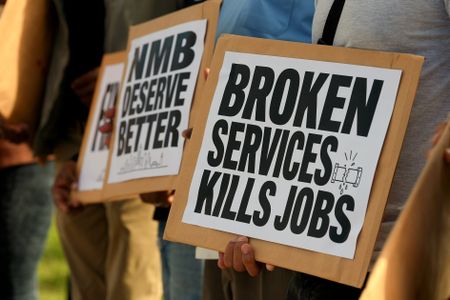
Monga Peter, the spokesperson for the the Nelson Mandela Bay Civil Society Coalition, said public funds cannot be disbursed without accountability, and municipalities that are synonymous with corruption, financial mismanagement, unfunded budgets and reckless governance cannot simply expect business as usual.
“However,” he continued, “while the intention of strengthening fiscal discipline is understandable, we are deeply concerned about the devastating consequences this decision will have for ordinary residents, who are already paying the price for years of governance failure.
“In Nelson Mandela Bay, households and businesses continue to endure deteriorating service delivery, unreliable infrastructure, water and sanitation failures, electricity challenges, pothole-ridden roads and declining municipal performance. The people of this metro have become victims of systemic governance failures that were never of their making.
“The withholding of equitable share funding risks further undermining the municipality’s ability to deliver basic services, ultimately punishing communities rather than those responsible for creating the crisis.
“The consequences will not be borne by politicians, municipal managers or senior officials. They will be borne by pensioners, unemployed residents, working families and businesses already struggling under mounting economic pressure.
“The metro did not arrive at this point overnight. It has deteriorated under the watch of institutions specifically mandated to prevent municipal collapse.
“If the Treasury is prepared to exercise its constitutional authority by withholding funds, then the same determination must be shown in holding individuals personally accountable for the financial and administrative collapse of municipalities.”
Premier calls a meeting
Eastern Cape Premier Oscar Mabuyane hosted a Local Government Accountability Day session on Tuesday, 14 July, in East London. The meeting was called to allow the mayors of the six provincial municipalities that had their equitable shares withheld to present their action plans to rectify the situation.
Following this meeting, Mabuyane said, “The decision by National Treasury is taken very seriously by the provincial government as, to us, this development has the potential to place additional strain on already constrained municipal finances, and it may in the long run impact the delivery of essential services to our communities if urgent corrective measures are not undertaken by the collective leadership of the province.
“As the provincial government, we cannot allow a situation where our people bear the consequences of governance and compliance shortcomings through disruptions in basic service delivery.
“Working together with the National and Provincial Treasury, and supported by all relevant stakeholders, we are doing everything within our mandate to ensure that these municipalities receive the technical and governance support to address the identified challenges, restore compliance and secure the release of these critical funds.”
/file/dailymaverick/wp-content/uploads/2024/06/06-EC-ED_502103.jpg "Eastern Cape Premier Oscar Mabuyane. (Photo: Lulama Zenzile / Gallo Images)")
Mabuyane called for municipalities to implement the Treasury’s suggestions with immediate effect. He said two of the municipalities that had their equitable shares withheld, Buffalo City and Port St Johns, had complied with the Treasury’s demands and indicated that they were working to get their equitable shares released as soon as possible.
What must be done?
The Treasury requires municipalities that had their equitable share withheld due to their failure to deal with UIFWE to achieve a minimum 25% reduction in the total UIFWE balance and a minimum reduction of 30% in each of the categories.
The municipalities are also required to provide the Treasury with Municipal Public Accounts Committee (MPAC) recommendations, council UIFWE resolutions, recovery proof, investigation outcomes and write-off support documents, including UIFWE reports to MPAC and the council.
The Nelson Mandela Bay metro’s plan to reduce and prevent UIFWE, however, only sets targets of 20% being written off between July and December.
According to the plan, a significant portion of the UIFWE only awaits consequence management and a formal council resolution for write-off. DM
Comments
Scroll down to load comments...